Before I dive into this story, let me make this point perfectly clear: I am not digging into Chesapeake Energy's misfortunes because I want the Oklahoma City Thunder to fail. As far as I (and I think Raf and Paul would agree with me) am concerned, the Thunder belongs to the people of OKC now, at least as much as any pro team belongs to any city.
I'm not interested in ragging on Oklahoma, or talking about how much more sophisticated Seattle is, or any of that nonsense. I'm putting these stories up solely because McClendon, Bennett, Tom Ward, and David Stern disgust me, and if I can poke some small holes in their swollen egos, then so much the better.
On with the story. Today's WSJ has a, well "scathing" would be putting it too strongly, so how about negative story about Chesapeake Energy, including this stirring quote from writer Ben Casselman:
"But [the land Chesapeake owns] is only valuable if companies have the money to drill it -- and a growing number of analysts are skeptical that Chesapeake and some of its peers will be able to find enough money to drill all the land before the leases expire."
Perhaps the Journal's story had a little bit to do with CHK's stock falling by more than 5 points by mid-day on Friday, a one-day drop of nearly 30%, putting it at $12.35 from a high of $70.

Friday, October 10


Thursday, October 9
Peaking in on Chespeake
Perhaps I should let this go at some point, but take a gander at Chesapeake Energy's stock performance since July of this year:

In case you can't make out the figures, the stock value has gone from a high of $70.24 in early July to a low of $17.71 at closing today. That's a loss of $52/share, which, if you have 34,000,000 shares like some people do, in the last three months your net worth has declined by the sum total of $1,768,000,000.
Yes, nearly 2 billion dollars. Or, put another way, in the time it took the Sonics to relocate to Oklahoma City and play their first game, Aubrey McClendon lost the equivalent of the GDP of Zimbabwe.
In case you can't make out the figures, the stock value has gone from a high of $70.24 in early July to a low of $17.71 at closing today. That's a loss of $52/share, which, if you have 34,000,000 shares like some people do, in the last three months your net worth has declined by the sum total of $1,768,000,000.

Yes, nearly 2 billion dollars. Or, put another way, in the time it took the Sonics to relocate to Oklahoma City and play their first game, Aubrey McClendon lost the equivalent of the GDP of Zimbabwe.
Art Harris: Follow Up
 Three days ago we ran a short piece about former Sonic Art Harris, a one-time All-Rookie Team member who passed away last October at the age of 60.
 At the end of the story, I asked for any possible insights into Harris' life our readers might offer. Sadly, no information has been forthcoming, so I'll ask again:
Is there anyone out there who might have information about Art Harris' life? He left the NBA in 1972, 36 years ago, playing 21 games for the Suns before seeing his professional career come to an end. Between 1972 and 2007, when he died, I can't find a lick of information about the man. Here's some framework, if it helps:
-Born and raised in Los Angeles
-Attended Jordan High School in LA
-Attended Stanford University
-Drafted by Seattle in the NBA and the Oakland Oaks in the ABA in 1968
-Played in Seattle for 1 1/2 years after leaving Stanford
-Played in Phoenix from 1970 to some point in the 1972 season
And then?
SSS HOF #9: George Karl
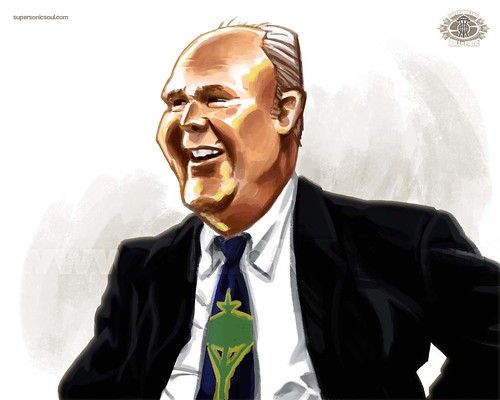
He came to Seattle under cover of darkness, an exile returned from Elba, his final chance at making it as a professional basketball coach awaiting him on the rain-soaked runways of SeaTac Airport.
Before the jet touched down from its long journey westward from Spain, his career ledger totaled 119 wins and 176 losses, a testimony to mediocrity. He seemed destined for a Gene Shue-like career at best, or, at worst, to be the Billy Martin of the NBA, but without the championships. Suffice it to say, Sonic fans were forgiven for not throwing a parade.
By the time he left town less than a decade later, however, George Karl had rejuvenated both a city and his career.
AGGRESSIVE
He made his Sonic debut on January 23, 1992, against Portland at the Coliseum. Fittingly, Shawn Kemp and Gary Payton, the two icons of Karl’s reign in Seattle, contributed mightily. Fittingly, the Sonics lost, not because they were bad, but because that’s what the Sonics did under Karl – they lost when it mattered most.
But back to those beginnings. The year he inherited the team from KC Jones, the Sonics finished the season with 775 steals.
It would prove to be the lowest total of Karl’s tenure.
If nothing else, George Karl was aggressive. He was aggressive in the way he coached, he was aggressive in the way he dealt with others, he was aggressive in the way he lived.
There’s a humorous tale of Karl striding through the lobby at All-Star Weekend as the head coach of the Western Conference. He was at the top of his game, risen from the wilds of the CBA and Europe to the penthouse of basketball. There he strode, though, wearing horrific zubaz pants, thumbing his nose at his Armani-clad coaching brothers. He was a misfit, and he loved it.

That was Karl, though. He had no interest in doing things the way others did. You can’t play three guards in the same lineup? Why not, when you’ve got Gill, Payton, and McMillan? Who says you can’t put a 6’9” forward on your opponent’s point guard, even if that point guard is a waterbug?
Karl’s contrarian ways had placed him in trouble during his previous stops in Golden State and Cleveland, where he was unable to win often enough to forestall his firing. In Seattle, however, he had a plethora of talent and, combined with his skills as a defensive teacher (as well as his assistants Tim Grgurich and Bob Kloppenburg) he finally was given the opportunity to see what he could do.
SUCCESS AT LAST
Don’t misunderstand, Karl was not a loser before he came to Seattle. He had won frequently in the CBA, and he took both the Cavs and the Warriors to the playoffs, no mean feat considering the woeful nature of those franchises.
No, Karl’s problems stemmed from his inability to make nice with his employers. In Seattle, though, with an equally contrarian Bob Whitsitt manning the GM seat, Karl had a kindred spirit running the show. Whitsitt and Karl were in harmony, for a time at least, and they molded a winner.
In his first full season as head coach, Whitsitt took the Sonics to the Western Conference Finals, where they lost a Game 7 heartbreaker to the Phoenix Suns in one of the most bitterly remembered games in Seattle sports history.
But reflect on the accomplishment for a moment, not the frustration. In the span of 15 months Karl had taken the Seattle Sonics from an afterthought to the most exciting team in the Western Conference, if not the league. Sure, the Suns “won” the conference title, but true NBA followers knew the best team in the West was from Seattle, not Phoenix.

It was an amazing turn of events. Accompanied by a national surge of interest in Seattle music, it was an exciting time to be a sports fan in the Northwest. After years of mediocrity and anonymity, Seattle was poised to plant its flag.

TOMORROW
Rise and Fall.
Wednesday, October 8
SupersonicSoul Xmas Gift #1
Christmas decorations are already making an apperance at the malls in Canada (and, I assume, in the States as well), so why not get a head start on Sonic gifts for ourselves?
I hope to make this a regular feature on the site, but to kick things off, let's have a look at this fine option from zazzle.com: A "Nobody Scores on Derrick McKey" t-shirt.
Sadly, I couldn't save a copy of the photo, so you'll have to click on it yourself to experience the shirt in all its glory. But for that hard-to-shop-for friend still bemoaning his departed Sonics, how can you go wrong with a tribute to one of the most enigmatic players in team history?
Granted, it's not as cool as the "Everybody Scores on Tom Chambers" shirt, but it still makes a nice gift.
I hope to make this a regular feature on the site, but to kick things off, let's have a look at this fine option from zazzle.com: A "Nobody Scores on Derrick McKey" t-shirt.
Sadly, I couldn't save a copy of the photo, so you'll have to click on it yourself to experience the shirt in all its glory. But for that hard-to-shop-for friend still bemoaning his departed Sonics, how can you go wrong with a tribute to one of the most enigmatic players in team history?
Granted, it's not as cool as the "Everybody Scores on Tom Chambers" shirt, but it still makes a nice gift.
Blazer Love
Pete Treperinas at bleacherreport.com posits a increasingly common inclination for fans of the former Seattle Sonics: To become a Portland TrailBlazer fan.
He gives the standard reasons: Nate McMillan, Paul Allen, Brandon Roy, Martell Webster, proximity of city, excitement level of roster, and so forth. And while he touches on the pain and betrayal he feels in becoming a fan of the team he used to hate, I have to say he's not as anguished about his decision as I would be.
Personally, if I were to root for any team this season it would be Golden State. Even with The Baron down in LA, I'm still partial to the madcap antics of the Warriors, from their exhuberant fans to their frenetic style of play. Yes, the Warriors would definitely be my team in a Sonic-less universe. To root for the Blazers, personally, would be like cheering for the Oakland A's if the Mariners left town, and I hate the A's (okay, I like Billy Beane, but I hate the franchise).
He gives the standard reasons: Nate McMillan, Paul Allen, Brandon Roy, Martell Webster, proximity of city, excitement level of roster, and so forth. And while he touches on the pain and betrayal he feels in becoming a fan of the team he used to hate, I have to say he's not as anguished about his decision as I would be.
Personally, if I were to root for any team this season it would be Golden State. Even with The Baron down in LA, I'm still partial to the madcap antics of the Warriors, from their exhuberant fans to their frenetic style of play. Yes, the Warriors would definitely be my team in a Sonic-less universe. To root for the Blazers, personally, would be like cheering for the Oakland A's if the Mariners left town, and I hate the A's (okay, I like Billy Beane, but I hate the franchise).
And besides, what happens if the Sonics eventually return to Seattle? Will those who cheered for the Blazers in the interim feel a little bit guilty for abadoning their city? Won't you feel like a hypocrite booing the Blazers when the year previous you were wearing their jersey?
It begs the obvious question: Why do I have to pick another team for which to cheer? Is abstention only available to priests now? By cheering for any NBA team, am I not giving tacit approval to the disgraceful shenanigans of David Stern, Clay Bennett, and the other 27 owners who voted for relocation?
At this point, while I am somewhat inclined to cheer for Golden State, I am more inclined not to root at all. And, I believe, that's the position of a large portion of Sonic fans.
Which leads me to ask this: Which team will you support this year, if any? Have you gone cold turkey on the NBA?
Monday, October 6
Where Are They Now? Art Harris
Usually, these Where Are They Now? pieces fall together pretty easily, especially for guys that have retired within the past decade or so. For those that quit balling two or three decades in the past, though, it gets a little trickier.
Take Art Harris.
If you’re like me, the name Art Harris draws a blank. Bob Love? Check. Spencer Haywood? Duh. Tommy Kron? Foggy, but I know the name.
But Art Harris? No dice.
Well, let’s fill in a few of the blanks.
- Born Arthur Carlos Harris, Jr. in Los Angeles on January 13, 1947
- Graduated from Jordan High School, the same high school in Watts which produced Florence Griffith Joyner and Charles Mingus
- One of Stanford’s most prolific scorers, named All Pac 8 as a sophomore
- Averaged 20.7 ppg for the Cardinal in 1967-68, including a couple of 30+ point outings
- Named a member of Stanford Athletic Hall of Fame
- 17.2 ppg career average is 7th best in school history
- Drafted by Sonics in second round of 1968 draft
- Averaged 12 ppg his rookie season
- Led NBA in disqualifications
- Named to All-Rookie First Team, the only Sonic guard ever to receive that honor
- Played only 5 games for Sonics in 1969-70 before being traded on Oct. 25 to Phoenix for Dick Snyder
- Remained in Phoenix for the next three seasons, then out of the league
And, finally
- October 2007, Art Harris RIP
I came across Harris’ passing on the NBA’s Retired Player Association website a year ago, and meant to pursue a story about him for the past twelve months. Occasionally, I would dig a little bit into his past, but I never got very far. Always, I thought, there’d be time to find out more.
Now a year has passed since Art Harris died, and I still don’t know anything more about him.
Here he was, a kid from Watts, who got a scholarship to Stanford, one of the greatest academic institutions in the entire country, goes on to make the NBA’s All-Rookie team, gets traded to Phoenix, then fades from memory.
What happened to Art Harris? What did his post-NBA life entail before he died at age 60? The NBRPA doesn’t even know the exact date of death, only a vague “mid-October” with no mention, either, of the location. The Stanford University site equally draws a blank, not even reporting his death until three months later, while the Seattle Times and PI were completely silent about the event.

Look at that team photo from 1968-69. Harris is the second from the far right, right next to Lenny Wilkens. Oddly, while all the other players were staring right at the camera, Harris stares to his right, his face in profile. Was he laughing at a joke from Bob Rule? It's as if, 40 years later, he's trying to make himself even more of an enigma.
Hey, I get it, he was an obscure player on an expansion team going nowhere. But couldn’t you say the same thing about Jeff Green? Sure, it’s possible Green will go on to greatness in the NBA, but the odds are more likely that within 5-8 years he’ll be long-gone from this league. Will his death 40, 50, 60 years from now pass as quietly as Harris?
A beautiful aspect to the internet is the way it facilitates communication. Perhaps someone reading this site will unearth a kernel of information, which will blossom into a full-blown story. Hopefully, someone out there can educate me as to what happened to Art Harris. Feel free to email us (see the top of the page), or fire off a comment below.
Take Art Harris.
If you’re like me, the name Art Harris draws a blank. Bob Love? Check. Spencer Haywood? Duh. Tommy Kron? Foggy, but I know the name.
But Art Harris? No dice.
Well, let’s fill in a few of the blanks.
- Born Arthur Carlos Harris, Jr. in Los Angeles on January 13, 1947
- Graduated from Jordan High School, the same high school in Watts which produced Florence Griffith Joyner and Charles Mingus
- One of Stanford’s most prolific scorers, named All Pac 8 as a sophomore
- Averaged 20.7 ppg for the Cardinal in 1967-68, including a couple of 30+ point outings
- Named a member of Stanford Athletic Hall of Fame
- 17.2 ppg career average is 7th best in school history
- Drafted by Sonics in second round of 1968 draft
- Averaged 12 ppg his rookie season
- Led NBA in disqualifications
- Named to All-Rookie First Team, the only Sonic guard ever to receive that honor
- Played only 5 games for Sonics in 1969-70 before being traded on Oct. 25 to Phoenix for Dick Snyder
- Remained in Phoenix for the next three seasons, then out of the league
And, finally
- October 2007, Art Harris RIP
I came across Harris’ passing on the NBA’s Retired Player Association website a year ago, and meant to pursue a story about him for the past twelve months. Occasionally, I would dig a little bit into his past, but I never got very far. Always, I thought, there’d be time to find out more.
Now a year has passed since Art Harris died, and I still don’t know anything more about him.
Here he was, a kid from Watts, who got a scholarship to Stanford, one of the greatest academic institutions in the entire country, goes on to make the NBA’s All-Rookie team, gets traded to Phoenix, then fades from memory.
What happened to Art Harris? What did his post-NBA life entail before he died at age 60? The NBRPA doesn’t even know the exact date of death, only a vague “mid-October” with no mention, either, of the location. The Stanford University site equally draws a blank, not even reporting his death until three months later, while the Seattle Times and PI were completely silent about the event.

Look at that team photo from 1968-69. Harris is the second from the far right, right next to Lenny Wilkens. Oddly, while all the other players were staring right at the camera, Harris stares to his right, his face in profile. Was he laughing at a joke from Bob Rule? It's as if, 40 years later, he's trying to make himself even more of an enigma.
Hey, I get it, he was an obscure player on an expansion team going nowhere. But couldn’t you say the same thing about Jeff Green? Sure, it’s possible Green will go on to greatness in the NBA, but the odds are more likely that within 5-8 years he’ll be long-gone from this league. Will his death 40, 50, 60 years from now pass as quietly as Harris?
A beautiful aspect to the internet is the way it facilitates communication. Perhaps someone reading this site will unearth a kernel of information, which will blossom into a full-blown story. Hopefully, someone out there can educate me as to what happened to Art Harris. Feel free to email us (see the top of the page), or fire off a comment below.
Cheer Up ...
Sadsack Sonic fans. Yes, I know the NBA season is prepped to kick off soon, and I know the weather in Seattle could not have been more miserable today, but it could be worse.
You could have lost $82,000,000 in the stock market today.
You could have lost $82,000,000 in the stock market today.
Friday, October 3
Danger, Politics Ahead
I'm loathe to write this for fear of incurring the wrath of GOP supporters, but it occurred to me last night while watching the debates that Sarah Palin reminded of someone, but I just couldn't put my finger on it until now.
Bill Walton. Like Walton, she talks alot, is very folksy, and occasionally makes an intelligent point, but those points are so diluted by all the other garbage coming of Walton/Palin's mouth(s) that they are never heard.
Bill Walton. Like Walton, she talks alot, is very folksy, and occasionally makes an intelligent point, but those points are so diluted by all the other garbage coming of Walton/Palin's mouth(s) that they are never heard.
Aubrey McClendon: Part III
During the course of the past week, I’ve looked closely – perhaps too closely – behind the curtain which surrounds Aubrey McClendon and his company, Chesapeake Energy.
Let me blunt – I don’t like McClendon. I don’t think anyone reading this site would struggle to understand that, any more than they would struggle to understand my reasons. He’s a cold, manipulative man who believes the government has every right to interject itself into marriage, that privacy laws are as disposable as toilet paper, and that the environment is as easily replenished as his vast wealth.
Most importantly, he has no qualms with stealing a franchise that resided in Seattle for 40 years, just because his hometown needed something to do in the winter other than watch Sooner football DVDs.
But that’s a side issue for today – this is a free nation, and the Sonics don’t belong to Seattle any more than the raindrops which fall from the sky.
Today, I want to explore the sickening relationship between McClendon’s immense wealth and his complete lack of interest in using that wealth to help whichever city his team calls home.
Let us look, first, and some of the expenses McClendon has incurred in the past two years:
1. $400 million, to state of West Virginia in damages from lawsuit
2. $1.3 billion, decrease in value of his shares of Chesapeake Energy
3. $40 million, to purchase a plot of land in Michigan, upon which he will spend hundreds of millions to build a new housing development
And now let us look at, second, how much money he has spent assisting the cities which house the Sonics/Thunder in building new stadiums:
1. $0
It is a disgraceful commentary on McClendon and Clay Bennett that they can withstand the costs listed above without so much as a blink of an eye, yet when they are asked to contribute to the very buildings in which their teams will play, they run in the other direction faster than Jerome James chasing a box of doughnuts.
Further, it is a damning tribute to David Stern that he spit upon a group of investors in Seattle which was willing to contribute hundreds of millions towards building an arena here, all the while heaping praise upon Bennett and McClendon, who have yet to spend one penny of their fortunes on building new stadiums.
Tim Keown wrote recently at espn.com about how the economic malaise facing the U.S. may spell the end of publicly financed stadiums. While his words are, in my view, wishful thinking, I pray that he is correct.
The time has come for this country to quit subsidizing billionaires on the backs of taxpayers. If stadiums were such a great investment – as owner after owner tells city after city – then why are there so few owners willing to build stadiums? They certainly have no trouble coming up with the hundreds of millions to purchase the team, so why can’t they come up with at least part of the money needed to house them?
The answer is simple – because they play us for fools.
As Keown wrote, if no other benefit arises out of this meltdown in the U.S. economy, perhaps it will be worth it if people such as McClendon are finally forced to part with some of their cash, and the government gets out of the business of stadiums.
Let me blunt – I don’t like McClendon. I don’t think anyone reading this site would struggle to understand that, any more than they would struggle to understand my reasons. He’s a cold, manipulative man who believes the government has every right to interject itself into marriage, that privacy laws are as disposable as toilet paper, and that the environment is as easily replenished as his vast wealth.
Most importantly, he has no qualms with stealing a franchise that resided in Seattle for 40 years, just because his hometown needed something to do in the winter other than watch Sooner football DVDs.
But that’s a side issue for today – this is a free nation, and the Sonics don’t belong to Seattle any more than the raindrops which fall from the sky.
Today, I want to explore the sickening relationship between McClendon’s immense wealth and his complete lack of interest in using that wealth to help whichever city his team calls home.
Let us look, first, and some of the expenses McClendon has incurred in the past two years:
1. $400 million, to state of West Virginia in damages from lawsuit
2. $1.3 billion, decrease in value of his shares of Chesapeake Energy
3. $40 million, to purchase a plot of land in Michigan, upon which he will spend hundreds of millions to build a new housing development
And now let us look at, second, how much money he has spent assisting the cities which house the Sonics/Thunder in building new stadiums:
1. $0
It is a disgraceful commentary on McClendon and Clay Bennett that they can withstand the costs listed above without so much as a blink of an eye, yet when they are asked to contribute to the very buildings in which their teams will play, they run in the other direction faster than Jerome James chasing a box of doughnuts.
Further, it is a damning tribute to David Stern that he spit upon a group of investors in Seattle which was willing to contribute hundreds of millions towards building an arena here, all the while heaping praise upon Bennett and McClendon, who have yet to spend one penny of their fortunes on building new stadiums.
Tim Keown wrote recently at espn.com about how the economic malaise facing the U.S. may spell the end of publicly financed stadiums. While his words are, in my view, wishful thinking, I pray that he is correct.
The time has come for this country to quit subsidizing billionaires on the backs of taxpayers. If stadiums were such a great investment – as owner after owner tells city after city – then why are there so few owners willing to build stadiums? They certainly have no trouble coming up with the hundreds of millions to purchase the team, so why can’t they come up with at least part of the money needed to house them?
The answer is simple – because they play us for fools.
As Keown wrote, if no other benefit arises out of this meltdown in the U.S. economy, perhaps it will be worth it if people such as McClendon are finally forced to part with some of their cash, and the government gets out of the business of stadiums.
Thursday, October 2
SSS HOF #8: Lenny Wilkens
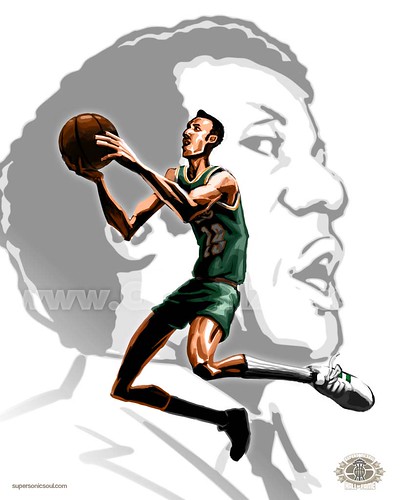
For one generation, he was a 3-time all star, a whirling dervish of a guard who slipped easily from facilitator to dominator.
For another, he was the curly-haired wizard with a Brooklyn accent who improbably guided a group of men to the only championship in Seattle sports history.
For yet another, he was a link from the past, tied tenuously to a corrupt ownership hell bent upon destroying the history he himself played such a vital role in creating.
He was Lenny Wilkens and, in many ways, he embodies the word “Sonic” more than any man.
Think of it thus – the Sonics have had four distinct phases in their existence: Expansion, championship, return to glory, and departure. Lenny Wilkens played a key role in three of those phases: first as the team’s inaugural star, second as the team’s coach in its halcyon days of the late 1970s, and third as the president during Clay Bennett’s destructive reign.
Long-forgotten by today’s fans, Wilkens was a three-time all-star, and was named the game’s MVP in 1971. He recorded the first ten triple-doubles in team history (only Gary Payton had more), was the first Sonic to lead the league in a major statistical category (assists, 1969-70), and held the team record for assists in a single game for more than a decade.
It was a remarkable run as a player (and coach) in Seattle, a run that would only – could only – be surpassed by the heights he reached as the team’s coach.
Everyone knows the story of the championship-era Sonics: of Brown, Johnson(s), Williams, Sikma, Shelton, Silas, and the rest. Wilkens is often a footnote to the tale, standing to the side, arms crossed while the players did the work.
What has been forgotten is how mediocre the Sonics had been before Wilkens took charge in 1977. As a player-coach in the early 1970s, Wilkens had guided the Sonics to a 47-win season in 1971-72 … and got traded. Those 47 wins would not be surpassed by the team until he guided the team again seven years later.
After letting Bill Russell go as coach after yet another 40-odd win season in 1976-77, the Sonics put Bob Hopkins in charge. 17 losses and only 5 wins later, Hopkins was gone, and with the team mired in the Pacific Division basement, Wilkens brought them back, coaching the team to a 42-18 record from then on.
Read those numbers again:
Hopkins: 5-17
Wilkens: 42-18
That’s with the same team, people. Hopkins would have had to go 37-1 to reach the record Wilkens attained with the same group of players.
And it was not merely regular season success, as that group of men reached the pinnacle of playoff heights by losing to the Bullets in the NBA Finals, a loss they would redeem the next season with Seattle’s only championship. The team’s first star became the team’s first coaching legend.
When I think of Lenny Wilkens, though, it is with more sadness than delight. I think of the man forced to subjugate himself to Clay Bennett’s rule, who had to parrot lines he must have believed to be lies just to keep his job. Wilkens ended his NBA life with a less than stellar reputation – he became known as much for self-preservation as for coaching ability – and that saddens me.
At the time of the unfortunate end to his life as a Sonic, Wilkens was chastised in the press for speaking out of turn and making statements that were less than true. Looking back on those times, though, he becomes less of a scapegoat, and more of a man desperately clinging to the reputation he had built over a lifetime of work in basketball.
I hope history will treat Lenny Wilkens more kindly than he was treated in his final days with this franchise, that his immense successes will outweigh his failures, and that his name will be erased from the sullied ending to a once-proud franchise’s life.
For all he gave this city, he deserves it.
For another, he was the curly-haired wizard with a Brooklyn accent who improbably guided a group of men to the only championship in Seattle sports history.
For yet another, he was a link from the past, tied tenuously to a corrupt ownership hell bent upon destroying the history he himself played such a vital role in creating.
He was Lenny Wilkens and, in many ways, he embodies the word “Sonic” more than any man.
Think of it thus – the Sonics have had four distinct phases in their existence: Expansion, championship, return to glory, and departure. Lenny Wilkens played a key role in three of those phases: first as the team’s inaugural star, second as the team’s coach in its halcyon days of the late 1970s, and third as the president during Clay Bennett’s destructive reign.
Long-forgotten by today’s fans, Wilkens was a three-time all-star, and was named the game’s MVP in 1971. He recorded the first ten triple-doubles in team history (only Gary Payton had more), was the first Sonic to lead the league in a major statistical category (assists, 1969-70), and held the team record for assists in a single game for more than a decade.
It was a remarkable run as a player (and coach) in Seattle, a run that would only – could only – be surpassed by the heights he reached as the team’s coach.
Everyone knows the story of the championship-era Sonics: of Brown, Johnson(s), Williams, Sikma, Shelton, Silas, and the rest. Wilkens is often a footnote to the tale, standing to the side, arms crossed while the players did the work.
What has been forgotten is how mediocre the Sonics had been before Wilkens took charge in 1977. As a player-coach in the early 1970s, Wilkens had guided the Sonics to a 47-win season in 1971-72 … and got traded. Those 47 wins would not be surpassed by the team until he guided the team again seven years later.
After letting Bill Russell go as coach after yet another 40-odd win season in 1976-77, the Sonics put Bob Hopkins in charge. 17 losses and only 5 wins later, Hopkins was gone, and with the team mired in the Pacific Division basement, Wilkens brought them back, coaching the team to a 42-18 record from then on.
Read those numbers again:
Hopkins: 5-17
Wilkens: 42-18
That’s with the same team, people. Hopkins would have had to go 37-1 to reach the record Wilkens attained with the same group of players.
And it was not merely regular season success, as that group of men reached the pinnacle of playoff heights by losing to the Bullets in the NBA Finals, a loss they would redeem the next season with Seattle’s only championship. The team’s first star became the team’s first coaching legend.
When I think of Lenny Wilkens, though, it is with more sadness than delight. I think of the man forced to subjugate himself to Clay Bennett’s rule, who had to parrot lines he must have believed to be lies just to keep his job. Wilkens ended his NBA life with a less than stellar reputation – he became known as much for self-preservation as for coaching ability – and that saddens me.
At the time of the unfortunate end to his life as a Sonic, Wilkens was chastised in the press for speaking out of turn and making statements that were less than true. Looking back on those times, though, he becomes less of a scapegoat, and more of a man desperately clinging to the reputation he had built over a lifetime of work in basketball.
I hope history will treat Lenny Wilkens more kindly than he was treated in his final days with this franchise, that his immense successes will outweigh his failures, and that his name will be erased from the sullied ending to a once-proud franchise’s life.
For all he gave this city, he deserves it.
Wednesday, October 1
Aubrey McClendon: Behind the Music, Part II
Tuesday’s improved signs of the health of America’s financial sector were certainly felt in the spacious living room of one Aubrey McClendon.
After seeing his investment in Chesapeake Energy drop more than one hundred million dollars on Monday, the co-owner of the Oklahoma City Thunder recouped his losses on Tuesday as CHK shares went up more than three points, earning McClendon an estimated $110 million within 24 hours.
But, as Lyndon Johnson famously drawled to a colleague more than 40 years ago, chicken salad can turn into chicken shit awful fast.
And it’s that propensity for precariousness that has some investors more than a little concerned about the overall health of Chesapeake.
Within the past month, McClendon’s company has:
- Reported a second-quarter loss of $1.65 billion, down from a profit of $492 million the previous year
- Announced a cut in natural gas production, including cutting rig counts
- Seen a drop in natural gas prices of close to 40%
- Announced that the shale deposits Chesapeake so zealously drilled in Barnett are “ramping down”
For many, it’s no cause for concern, and Chesapeake’s stock is still considered a strong buy for many investors. But for others, it is a little alarming. As a commenter at theoildrum.com noted: “If [Chesapeake] is pulling the plug on [its drilling operations] they better have something in the wings to replace their rapidly declining reserve base. Otherwise they've just announced to the world that their stock is worthless except for its breakup value.”
Many suspect that McClendon’s reasoning for curtailing production comes in the wake of the widespread credit crunch facing North America, but Business Week magazine weighed in with another possibility: that the trading methods practiced by large producers such as Chesapeake undermined the profits those companies made from drilling natural gas.
Essentially, because Chesapeake, and other companies like them, trades oil based on future prices, the constant hedging can often be disastrous, even when gas prices are soaring. As industry analyst Stephen Schork told the magazine after natural gas prices changed this summer, “A lot of people got creamed.”
Further, the magazine noted, there is the anxiety that Chesapeake wasn’t merely trading futures – hedging, if you will – for protection, but for profit. That’s great so long as prices fall in the future, but if that’s not the case, Chesapeake will be forced to pump out more gas to make up the difference, something that isn’t always as possible as it would like.
As the now bankrupt leaders of SemGroup can say with certainty, shorting energy prices isn’t always the wisest move for a company to take.
Simultaneously, a severe drop in natural gas prices can obviously be painful as well. And while natural gas was an attractive alternative fuel when oil was trading at $150 a barrel, it doesn’t look like such a great option when oil drops to less than $100.
With oil falling and natural gas increasing, the natural gas energy would seemingly be in desperate straights. What would be needed to strengthen the price of natural gas then, and, consequently, Chesapeake Energy? Well, how about a plan to get the government to subsidize the wholesale conversion of U.S. automobiles away from petroleum to natural gas? Heard anything about that idea? I thought you may have.
Nonsense ideas about “liberating” America from Middle Eastern oil aside, Chesapeake still faces tough situations stateside. It appears Chesapeake is hoping that its sizable (though dwindling) cash reserves will enable it to withstand any short-term reductions in revenue, unlike the smaller drillers out there who will be unable to hold out for long. Inevitably, the plan goes, the smaller concerns will prostrate themselves at McClendon’s altar, and Chesapeake will buy them up.
All of these financial shenanigans keep Aubrey McClendon a busy man – but not too busy.
When he’s not manipulating the Fort Worth city government into allowing him to put more oil wells within the city limits, hoodwinking the Sierra Club into thinking that his Clean Skies Foundation is anything but a front for drilling for more natural gas, or attempting to pass an “alternative fuels” initiative in California that would cost taxpayers upwards of 10 billion dollars – money that would flow directly to McClendon and Pickens, McClendon is making grandiose promises about future drilling sites, promises intended to buck up his stock’s plummeting value.
“Recent large discoveries using new technologies in natural gas shale basins such as the Barnett, Haynesville, Fayetteville, Woodford and Marcellus have provided new evidence that our country has ample natural gas supplies to power America’s economy for more than a century,” McClendon wrote earlier this year, neglecting to mention that he himself stated that the Barnett reserve has already reached its “high-water” mark.
It’s certainly possible that Chesapeake and McClendon will weather the storm surrounding energy prices and the credit markets, and that the company will snap up enough independent producers of natural gas to maintain an equilibrium. But it is also possible that McClendon’s wheeling and dealing may come back to bite him.
It’s that possibility we’ll look at Friday when we explore why all of this energy mumbo-jumbo matters to readers of a Sonics blog.
After seeing his investment in Chesapeake Energy drop more than one hundred million dollars on Monday, the co-owner of the Oklahoma City Thunder recouped his losses on Tuesday as CHK shares went up more than three points, earning McClendon an estimated $110 million within 24 hours.
But, as Lyndon Johnson famously drawled to a colleague more than 40 years ago, chicken salad can turn into chicken shit awful fast.
And it’s that propensity for precariousness that has some investors more than a little concerned about the overall health of Chesapeake.
Within the past month, McClendon’s company has:
- Reported a second-quarter loss of $1.65 billion, down from a profit of $492 million the previous year
- Announced a cut in natural gas production, including cutting rig counts
- Seen a drop in natural gas prices of close to 40%
- Announced that the shale deposits Chesapeake so zealously drilled in Barnett are “ramping down”
For many, it’s no cause for concern, and Chesapeake’s stock is still considered a strong buy for many investors. But for others, it is a little alarming. As a commenter at theoildrum.com noted: “If [Chesapeake] is pulling the plug on [its drilling operations] they better have something in the wings to replace their rapidly declining reserve base. Otherwise they've just announced to the world that their stock is worthless except for its breakup value.”
Many suspect that McClendon’s reasoning for curtailing production comes in the wake of the widespread credit crunch facing North America, but Business Week magazine weighed in with another possibility: that the trading methods practiced by large producers such as Chesapeake undermined the profits those companies made from drilling natural gas.
Essentially, because Chesapeake, and other companies like them, trades oil based on future prices, the constant hedging can often be disastrous, even when gas prices are soaring. As industry analyst Stephen Schork told the magazine after natural gas prices changed this summer, “A lot of people got creamed.”
Further, the magazine noted, there is the anxiety that Chesapeake wasn’t merely trading futures – hedging, if you will – for protection, but for profit. That’s great so long as prices fall in the future, but if that’s not the case, Chesapeake will be forced to pump out more gas to make up the difference, something that isn’t always as possible as it would like.
As the now bankrupt leaders of SemGroup can say with certainty, shorting energy prices isn’t always the wisest move for a company to take.
Simultaneously, a severe drop in natural gas prices can obviously be painful as well. And while natural gas was an attractive alternative fuel when oil was trading at $150 a barrel, it doesn’t look like such a great option when oil drops to less than $100.
With oil falling and natural gas increasing, the natural gas energy would seemingly be in desperate straights. What would be needed to strengthen the price of natural gas then, and, consequently, Chesapeake Energy? Well, how about a plan to get the government to subsidize the wholesale conversion of U.S. automobiles away from petroleum to natural gas? Heard anything about that idea? I thought you may have.
Nonsense ideas about “liberating” America from Middle Eastern oil aside, Chesapeake still faces tough situations stateside. It appears Chesapeake is hoping that its sizable (though dwindling) cash reserves will enable it to withstand any short-term reductions in revenue, unlike the smaller drillers out there who will be unable to hold out for long. Inevitably, the plan goes, the smaller concerns will prostrate themselves at McClendon’s altar, and Chesapeake will buy them up.
All of these financial shenanigans keep Aubrey McClendon a busy man – but not too busy.
When he’s not manipulating the Fort Worth city government into allowing him to put more oil wells within the city limits, hoodwinking the Sierra Club into thinking that his Clean Skies Foundation is anything but a front for drilling for more natural gas, or attempting to pass an “alternative fuels” initiative in California that would cost taxpayers upwards of 10 billion dollars – money that would flow directly to McClendon and Pickens, McClendon is making grandiose promises about future drilling sites, promises intended to buck up his stock’s plummeting value.
“Recent large discoveries using new technologies in natural gas shale basins such as the Barnett, Haynesville, Fayetteville, Woodford and Marcellus have provided new evidence that our country has ample natural gas supplies to power America’s economy for more than a century,” McClendon wrote earlier this year, neglecting to mention that he himself stated that the Barnett reserve has already reached its “high-water” mark.
It’s certainly possible that Chesapeake and McClendon will weather the storm surrounding energy prices and the credit markets, and that the company will snap up enough independent producers of natural gas to maintain an equilibrium. But it is also possible that McClendon’s wheeling and dealing may come back to bite him.
It’s that possibility we’ll look at Friday when we explore why all of this energy mumbo-jumbo matters to readers of a Sonics blog.
Subscribe to:
Posts (Atom)