
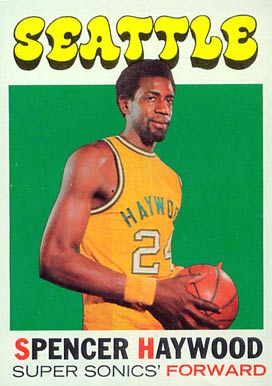
With the possible induction of Spencer Haywood in the Basketball Hall of Fame, and in deference to the wonderful Basketball-Reference and Bill James, here's a Keltner List for the former Mr. Iman.
1. Was he ever regarded as the best player in basketball? Did anybody, while he was active, ever suggest that he was the best player in basketball? It’s possible. Haywood never finished higher than fifth in MVP voting, although he did receive two first-place votes in 71-72 and four in 72-73. By the loosest definition, some people felt he was the most valuable player in the league, albeit a very small number of people, so, yes, he was considered the best player in basketball. Also of note, Haywood was the MVP of the ABA in his rookie season.
2. Was he the best player on his team? Absolutely. From his first pro season in Denver, his entire career in Seattle, and into his first campaign with the Knicks, Haywood was the best player on his team.
3. Was he the best player in basketball at his position? I think it could be safely argued that Haywood was the premier power forward in the ABA in 69-70 and in the NBA in 71-72 and 72-73. He turned over that crown to Elvin Hayes in 73-74, then, well, the rest was history.
4. Did he have an impact on a number of NBA Finals or Conference Finals? No. Haywood had a chance in 1979-80 with the Lakers, but a debilitating drug addiction proved his undoing. He did, however, lead the Denver Rockets to the ABA Finals in 69-70.
5. Was he good enough that he could play regularly after passing his prime? Yes. This is a difficult one to answer, but I think that the fact that even after destroying his career with drugs and spending a year in Italy, Haywood was able to come back to the NBA with Washington for two seasons indicates that his talent was enough to sustain him even after his prime had come and gone.
6. Is he the very best (eligible) basketball player in history who is not in the Hall of Fame? No. According to B-R, Haywood ranks 107th in Hall of Fame probability, trailing Jamaal Wilkes, Bob Dandridge, Jack Sikma, Chet Walker, Willie Naulls, Mel Hutchins, and others.
7. Are most players who have comparable statistics in the Hall of Fame? A mixed bag. Again, turning to B-R, Haywood’s similarity score companions are not, for the most part, HOFers. Of the 10 players most similar to Haywood, only two are in the Hall. It should be noted, however, that the player who truly most resembles Haywood, Connie Hawkins, is in the HOF. However, if you look at players with 19 ppg, 9 rpg, and TS% of 52.1, you’re looking at, basically, Hall of Famers.
8. Do the player’s numbers meet Hall of Fame standards? Yes. Haywood is at the bottom of the list due to his lack of games played, but his compatriots are, generally, either in the Hall or will be. However, it’s worth noting that his HOF probability (via B-R) is 51.6%. What does that mean, you ask? Well, Vince Carter’s is more than 85%, so take that into consideration.
9. Is there any evidence to suggest that the player was significantly better or worse than is suggested by his basic statistics? No. As the premier offensive option on his team, Haywood reaped the benefits of having the ball whenever he needed it for the first half of his career. Considering that his primary skill was in scoring and grabbing rebounds, and that those two statistical categories are the most rewarded in NBA history, I think he got his due.
10. Is he the best player at his position who is eligible for the Hall of Fame? Ironically, Haywood’s chief competition is another former Sonic, Jack Sikma. It’s a classic case of peak value vs. career value. On the one hand, you’ve got a superstar who grabbed All-NBA honors for a five-year span, but who was useless for the latter half of his career. On the other, you’ve got a crucial member of numerous playoff teams who was an excellent player well into his 30s. If forced to choose, and with no outside considerations factoring in, I think the Hall would opt for Sikma first and Haywood second.
11. How many MVP-type seasons did he have? Did he ever win an MVP award? If not, how many times was he close? One MVP in the ABA, none in the NBA. He was in the top five in voting once, but never made the top five in win shares at any point in his NBA career.

12. How many All-Star-type seasons did he have? How many All-Star games did he play in? Did most of the players who played in this many All-Star games go into the Hall of Fame? Haywood played in four NBA All-Star games and one ABA All-Star game. It is relatively certain that had he spent all of 1970-71 on a basketball court rather than a federal one he would have made it to five NBA All-Star games. Even giving credit to Haywood for 1970-71, his fellow five-timers include Brad Daugherty, Marques Johnson, Wayne Embry, Rudy LaRusso, Rudy Tomjanovich, Chris Webber, and Paul Westphal. To make it more extreme, you could give Haywood credit for 1969-70, giving him six appearances, tying him with (wait for it) … Shawn Kemp! Anyways, back to the original question; Haywood played in four All-Star games, tying him with 41 other players, of whom 34 are eligible for the Hall. Of those 34, nine are in the HOF.
13. If this man were the best player on his team, would it be likely that the team could win an NBA title? Well, Haywood was the best player on his team for half a decade, and none of those teams made the Conference Finals, let alone the NBA Finals. Does that mean that if he had been drafted by, say, the Knicks rather than the Sonics in the early 1970s he would have been making annual appearances in the NBA Finals? I’d say no. Haywood’s off-court problems seemed to surface no matter where he went, and I think his best situation was as a big fish in a small pond.
14. What impact did the player have on basketball history? Was he responsible for any rule changes? Did he introduce any new equipment? Did he change the game in any way? Was his college and/or international career especially noteworthy? Well, now. He helped overturn the NBA’s rule against early-entry, so, yeah, he certainly had a major impact in that way. Further, he earned a Gold Medal for the US in the 1968 Olympics in Mexico City, and was the leader for that team as well.
Verdict? At his peak, Spencer Haywood was a first-ballot Hall of Famer. However, that peak was sadly cut short by injuries and drugs. The argument, essentially, comes down to this: Does his involvement in ending the early-entry rule push his candidacy from borderline to certainty? To many, the answer is yes, and considering how cavalierly the Hall hands out membership, I don’t think it’s ridiculous to suggest that he “deserves” enshrinement. Personally, I would vote no, simply because his on-court career was lacking, and that he – rather than outside forces – was responsible for that. But, hey, if the Hall can induct the entire roster of the 1960s Boston Celtics, then, yes, I suppose there’s room for Mr. Haywood.

