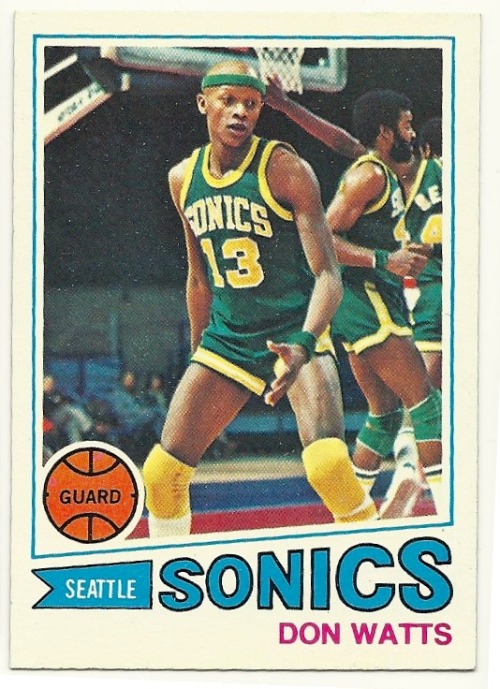
As Watts explains it, Russell tried as hard as he could to make the Sonics the Celtics of the West, going so far as to call Watts "KC Jones" and Fred Brown "Sam Jones," and so on. It was obvious to anyone observing the situation that Bill Russell thought that the Boston Celtic way was the right way. As Watts himself put it:
"When we played Boston, I thought Russell became the best coach in the world. For some reason, he prepared us well to play Boston. He said the game didn't mean anything to him, but for some reason we always played well. And he would come into the locker room pleased whenever we beat Boston."
Entering the 1974-75 season, the Sonics had existed for nearly a decade and had yet to reach the playoffs. The Celtics, meanwhile, had a vacation home in the NBA Finals and were the defending NBA Champions. Featuring John Havlicek, Dave Cowens, Paul Silas, Jo Jo White, Paul Westphal, and others, they were in another universe when compared to the Sonics.
And so it was, that on Feb. 19, 1975, the Sonics played host to the Celtics. At 27-31, the Sonics were coming off a surprising win over the Lakers the previous night, but they still figured to be no match for the 41-17 Celtics - a team that had won 11 in a row earlier in the month, and had won 22 of their previous 25 games on the year. Clearly, anyone could see that the Sonics were being prepped for the slaughterhouse.
Anyone, that is, except Bill Russell.
Who knows what Russ told his young team before the game started. Perhaps he threw up in a bucket; maybe he threatened them with a baseball bat. Whatever it was ... it didn't work.
(See what I did there?)
 Seriously, after one period of play, the Celtics were rolling, leading the Sonics by a comfortable 33-19 margin en route to another win.
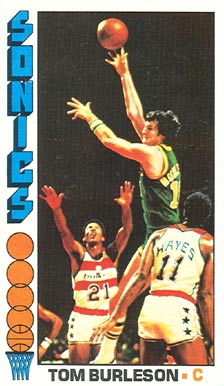
Somehow, though, the Sonics came alive. Buoyed by a standout performance from big man Tom Burleson (who would go on to score a career high 28 points on the night), Seattle roared back to take a 4-point halftime lead - helped in no small part by a 17-0 run during the quarter - then build upon that with a ridiculous 35-14 edge in the third quarter on the way to a 26-point win over the defending NBA Champion Boston Celtics!
"They smoked us." Boston Coach Tom Heinsohn told the AP. "It was their night."
Even the noted begrudger of popular sentiment, Bill Russell, had to concur. "It might be our best game of the year," Russell said afterwards, while no doubt dancing a jig on the inside.
Stranger still, Russell had used an incredible four rookies - Burleson, Rod Derline, Tal Skinner, Leonard Gray - and a second-year player (Watts) for a large portion of the second half.
It was a remarkable performance, and a turning point in the season for the green and gold. 27-31 entering play that Wednesday night, the Sonics caught fire and went 16-8 the rest of the way, including a 7-game win streak to close the season. The momentum carried into the playoffs, where they knocked off the Pistons in Seattle's inaugural playoff appearance, and took a 2-2 split before losing to eventual NBA Champion Golden State in the second round.
Box Score via NBA.com