Wednesday, February 20

This Date in Sonic History: Feb. 20, 2003, The Glove Comes Off

Pro sports are littered with antagonistic relationships between ownership and players, and it often seems that the larger the ego for both, the greater the drama.

From Babe Ruth and Col. Jacob Ruppert to Reggie Jackson and George Steinbrenner, it doesn't take a team of researchers to find evidence of the phenomenon, and Seattle sports history is no different, and the best illustration of that difficult relationship came between two of the most important people in Sonic history: Gary Payton and Howard Schultz.

Payton - the brash point guard with the confidence of a thousand burglers - and Schultz - the self-made millionaire with the confidence of a thousand Tony Robbins - were, to say the least, not a match made in heaven. When Schultz bought the Sonics in 2001, he hoped to bring his brand of corporate branding to the NBA and his adopted hometown.

Unfortunately, Schultz never had to deal with a barista with the ego of Gary Payton.

By 2003 the marriage was a disaster. Payton's career was on the downswing, and his relationship with Schultz - if you could call it that - was even worse. Still, his popularity in the city was unparalleled in Sonic history. Even 10 years later, I can't think of a single Sonic who resonates with this town as much as Gary Payton.

When Payton boycotted the first day of training camp in protest of the lack of progress on his soon-to-be-expiring contract, the die had been cast. Still, Schultz and his management team (Rick Sund!) had, in their mind, no choice. Payton had to go. But where?

Suddenly, on February 20, 2003 - minutes before the trading deadline of 3 pm - Payton was heading to Milwaukee.

It was news that burst like a thunderclap over the Seattle sports horizon. Gary Payton ... a Buck? Even with the salve of the incoming Ray Allen to ease their pain, most Sonic fans were beyond angry at the betrayal by Schultz.

In hindsight, it was a great deal for the Sonics. Payton never reached the heights he had experienced in Seattle, and Allen was an amazing player during his tenure in Seattle.

It could be said that the beginning of the end of Sonic basketball came that grey day in February, 10 years ago. While Allen, Rashard Lewis, and company propelled the Sonics to the playoffs a few years later, the majority of his time in Seattle was mired in mediocrity, a mediocrity which helped to grease the wheels for the team's eventual departure to ...

Well, you know the rest of the story.

Tuesday, February 19

This Date in Sonic History: Feb. 19, 1975, The Sonics Crush the Celtics

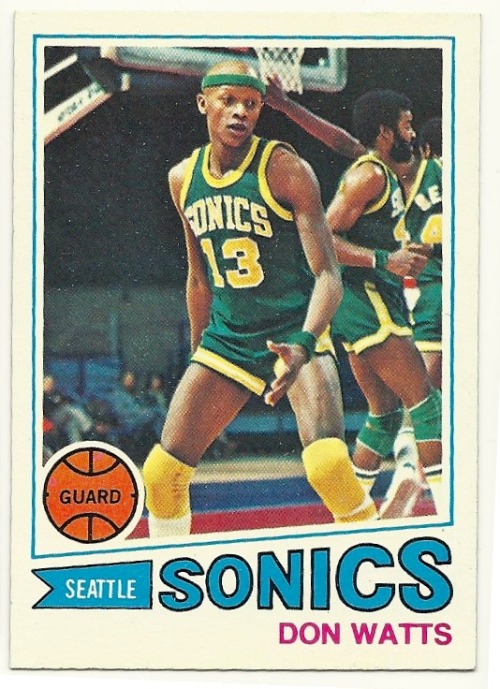
In his book Tales From the Seattle SuperSonics, Slick Watts (and co-auther Frank Hughes) go into great detail about Watts' sometimes-good, sometimes-not-so-good relationship with the great Bill Russell.

As Watts explains it, Russell tried as hard as he could to make the Sonics the Celtics of the West, going so far as to call Watts "KC Jones" and Fred Brown "Sam Jones," and so on. It was obvious to anyone observing the situation that Bill Russell thought that the Boston Celtic way was the right way. As Watts himself put it:

"When we played Boston, I thought Russell became the best coach in the world. For some reason, he prepared us well to play Boston. He said the game didn't mean anything to him, but for some reason we always played well. And he would come into the locker room pleased whenever we beat Boston."

Entering the 1974-75 season, the Sonics had existed for nearly a decade and had yet to reach the playoffs. The Celtics, meanwhile, had a vacation home in the NBA Finals and were the defending NBA Champions. Featuring John Havlicek, Dave Cowens, Paul Silas, Jo Jo White, Paul Westphal, and others, they were in another universe when compared to the Sonics.

And so it was, that on Feb. 19, 1975, the Sonics played host to the Celtics. At 27-31, the Sonics were coming off a surprising win over the Lakers the previous night, but they still figured to be no match for the 41-17 Celtics - a team that had won 11 in a row earlier in the month, and had won 22 of their previous 25 games on the year. Clearly, anyone could see that the Sonics were being prepped for the slaughterhouse.

Anyone, that is, except Bill Russell.

Who knows what Russ told his young team before the game started. Perhaps he threw up in a bucket; maybe he threatened them with a baseball bat. Whatever it was ... it didn't work.

(See what I did there?)

Seriously, after one period of play, the Celtics were rolling, leading the Sonics by a comfortable 33-19 margin en route to another win.

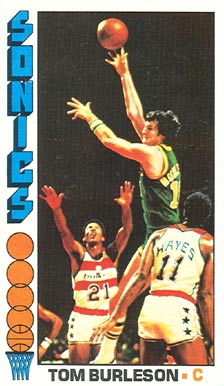
Somehow, though, the Sonics came alive. Buoyed by a standout performance from big man Tom Burleson (who would go on to score a career high 28 points on the night), Seattle roared back to take a 4-point halftime lead - helped in no small part by a 17-0 run during the quarter - then build upon that with a ridiculous 35-14 edge in the third quarter on the way to a 26-point win over the defending NBA Champion Boston Celtics!

"They smoked us." Boston Coach Tom Heinsohn told the AP. "It was their night."

Even the noted begrudger of popular sentiment, Bill Russell, had to concur. "It might be our best game of the year," Russell said afterwards, while no doubt dancing a jig on the inside.

Stranger still, Russell had used an incredible four rookies - Burleson, Rod Derline, Tal Skinner, Leonard Gray - and a second-year player (Watts) for a large portion of the second half.

It was a remarkable performance, and a turning point in the season for the green and gold. 27-31 entering play that Wednesday night, the Sonics caught fire and went 16-8 the rest of the way, including a 7-game win streak to close the season. The momentum carried into the playoffs, where they knocked off the Pistons in Seattle's inaugural playoff appearance, and took a 2-2 split before losing to eventual NBA Champion Golden State in the second round.

Box Score via NBA.com

Monday, February 18

This Date in Sonic History: Feb. 18, 1977, Slick Watts Goes Off

The 1976-77 season was one of the more unusual in the team's history - featuring the end of the line for both Hall of Fame Coach Bill Russell and popular point guard Slick Watts.

Unlike Russell, Watts wouldn't leave the team until the next season, but his future in Seattle took a inauspicious turn on Friday, February 18, 1977 when he unloaded his frustration about a perceived lack of fair compensation to the local media.

The Sonics were on the road that Friday, and while the on-court results were positive (Slick led the club with 19 points in a win over the New York Nets), Watts used the opportunity to explain that he wanted to be traded - and, boy the Nets and Tiny Archibald sure looked like a great place.

"I've got to get what I'm worth," Watts told a reporter. "I play hard and I do the dirty work and for doin' the dirty work I want to get compensated.... There's seven players on the Sonics makin' more money than I do."

It's easy in 2013 to underestimate how popular Watts was in Seattle in the mid-1970s. Prior to the arrival of the Seahawks and Mariners, Sonic basketball was the only professional entity in the state, and Watts - with his exuberant personality, cocked headband, and exciting play - was the most famous player on the roster. With hundreds of personal appearances a year, Watts was the Sonics.

And yet, his salary didn't reflect it. At $90,000 a year, Watts was making less than such players as Tom Burleson ($310,000), Fred Brown ($200,000) and - worse - Frank Oleynick ($100,000).

When Watts injured his knee during the season he suddenly became aware of his basketball mortality, and how close he was to going from Slick Watts, Basketball Player, to Slick Watts, Insurance Salesman. With that in his head, it didn't take much for Watts to spill his guts to PI reporter Blaine Johnson.

Watts' comments didn't help matters. His new contract - which he hoped would earn him in excess of $200,000 year - never came off, and Watts wound up being dealt to New Orleans for a first round draft choice in the fall of 1977. It was a shocking transformation for the poster boy of Seattle basketball.

Feb. 18, 1977 - the beginning of the end of the Slick Watts Era.