Friday, January 1

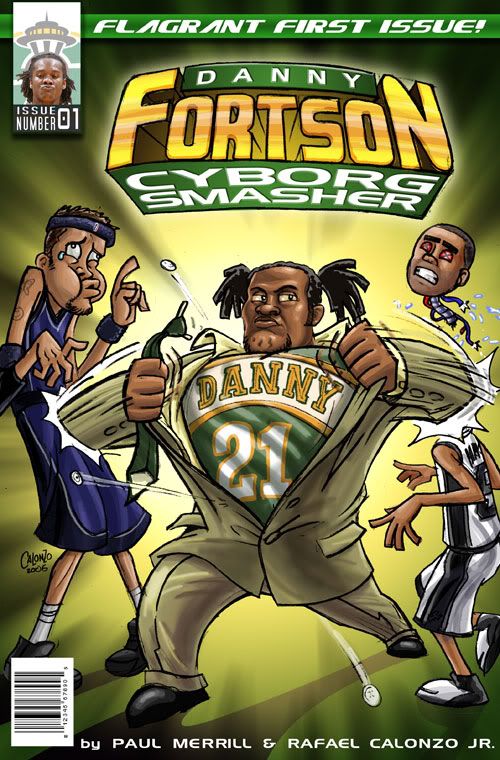
Danny Fortson: Cyborg Smasher!

In 2006, cartoonist extraordinaire Rafael Calonzo, Jr. and writer/comedian Paul Merrill created "Danny Fortson: Cyborg Smasher", a two-part comic series based on former Seattle Supersonics forward Danny Fortson.

(Originally published in 2006 on Supersonicsoul.com)


"Danny Fortson: Cyborg Smasher"
Issue #1

(Click on pictures for larger images.)


"Danny Fortson: Cyborg Smasher"
Issue #2


Friday, November 13

To Ponder

A short follow-up on the ridiculousness of LeBron James' quasi-demand that the NBA retire Michael Jordan's #23:

What about the four guys who have had #23 retired in their honor by their teams? I'm speaking of Lou Hudson (Atlanta), Calvin Murphy (Houston), Frank Ramsey (Boston), and John Williamson (New Jersey).

Of course, Williamson died of kidney disease due to diabetes 13 years ago, so I guess he won't complain much, and Murphy's had all sorts of off-court problems that help to keep him quiet, Hudson might have scored 18,000 points but LeBron never saw him play, so it didn't really count, right, and, sure, Ramsey made the Hall of Fame, but he was just a sixth man, really, and besides, the Celtics have too many retired jerseys anyways (okay, that last one actually makes some sense).

Can you tell that I'm bugged about this whole thing? Normally, it wouldn't be worth mentioning, but James has such power in the league right now, this idea might take off, regardless of how stupid it is. Retiring Jackie Robinson's jersey made sense, somewhat, because it was a way for baseball to atone for its past sins.

But why do we need to honor Jordan any more than Wilt, or Kareem, or Magic, or Bird, or Mikan, or anybody else in the upper echelons of greatness? Because LeBron watched Jordan as a kid, now the Warriors have to retire his jersey? Should the NFL retire Jim Brown's jersey league-wide because he was the best player ever?

To me, a better way of accomplishing this would be to go the way of the NHL and rename the trophies the league hands out at the end of the year. Call it the Chamberlain Award (MVP), or the Russell Award (defense), or the Jordan Award (offensive player of the year), or whatever. Keep those ideas on a league-wide basis, and leave the jersey retirements to the teams.

It was stupid enough for the Heat to retire Jordan's jersey a few years ago. Don't compound that idiocy on a league-wide scale.

Foyle: No More 31

Saying he wants to honor those who have gone before him, Orlando Magic center Adonal Foyle announced today that he will no longer wear number 31 in memory of Portland Trail Blazers' legend player Sam Bowie.

“When I think of Sam Bowie, I think of a guy like me – someone who was drafted high but never was able to fully demonstrate his gifts to the world,” Foyle told reporters in a Taco Bell parking lot near the team’s practice facility.

“I mean, without Sam Bowie, there would never have been an Alaa Abdelnaby, or a Duane Causwell, or an Adam Keefe,” Foyle said. “I’m starting a petition around the league to get other guys on board with this. Mikki Moore, Darko, Jerome James – hey, those guys all know the importance Bowie had to this league. We're all #31's little kids, you know? Growing up in the Grenadines, I had a huge poster of Sam on my wall – and I’m just living his dream now.”

While picking through the remains of a gordita supreme, Foyle dismissed questions about the meaningfulness of a player who has yet to get off the bench issuing edicts on uniform numbers.

“Hey, Sam didn’t get off the bench in the late 80s, either, but that doesn’t change how he impacted this league,” Foyle claimed. “When you think of guys with wrapped knees sitting on the end of the bench, you think of Sam Bowie, right? When you think of teams regretting wasted picks on useless big men, you think of Sam Bowie. I’d like to think I’m part of that tradition as well.”

NBA officials declined to comment when reached by email, and Orlando officials expressed surprise at both Foyle’s petition and the fact he’s still on the team’s roster.

“Honestly, I thought we had waived him during the summer,” a baffled GM Otis Smith told reporters. “I thought I saw him at the end of the bench last week, but I wasn’t really paying close enough attention. It’s nice to have Adonal around, I guess.”

NBA Attendance: Brief Notes

I'll have some graphs and such on Monday (too few games to generate anything worth looking at thus far), but here's some short notes, Harper's Index style of what's happened so far.

Number of times the Jazz failed to sell out the Delta Center in their last 164 regular season games: 1
Number of times it happened in their first four games this season: 2

Average attendance at the first four Pistons games in last two seasons: 22,076
Average attendance at the first four from this year: 17,541

Change in overall attendance in the first two games of this NBA season compared to the first two games of last season: -22,462

Number of teams who have seen attendance decreases: 19
Number who have increased or remained the same: 11

Tuesday, November 10

Action

I suppose there are a few ways to look at the election of Seattle’s new mayor, Mike McGinn, at least as to how his election affects the reintroduction of the NBA to the city:

McGinn is, on the surface, less of a supporter of the NBA than his opponent, Joe Mallahan. This fact is troubling to those who support a revamped KeyArena, and McGinn’s left-leaning ways – he’s a former leader at the Sierra Club, he’s a “neighborhood activist,” his campaign was almost all volunteers – certainly don’t reinforce the negative opinions some may have of him.

On the other hand, though, I found one interesting aspect of his campaign that may indicate a willingness on McGinn’s part to be open to the NBA: His complete reversal on the Alaskan Way/Tunnel situation.

In the months after the run-off election, McGinn made considerable noise about his absolute opposition to a tunnel, and repeatedly stated he would oppose the tunnel regardless of what the state said.

Then, on October 19th, McGinn made a complete about-face, saying he would not oppose the tunnel if he was elected.

This, to me, signals one of two things:

1. McGinn is a political opportunist who realized the majority of voters supported the tunnel, and if he wanted to be their mayor, he’d better get on board.

2. McGinn tasted his tunnel soup, found it to be a little bland, and added some more salt. In other words, he looked at both sides of the issue and decided that maybe his opinion wasn’t the best one.

To many observers, McGinn’s flip-flop was a disgrace. How dare he change his mind! the opponents charged, with images of Bill Clinton pulsing in their minds.

To me, though, it was a blessing. Honestly, as someone who doesn’t live in the state, let alone Seattle, the future mayor of the city is really none of my business.

But consider it from this vantage: If you support an issue (oh, I don’t know, say an improved KeyArena), would you rather have as a mayor a man who staked out positions and refused to budge, regardless of what the populace said, or would you rather have as a mayor a man who listened to public opinion and did what he thought his voters thought was best.

I suppose, in a perfect world, our elected officials would do what was right and just, even if opinion was against them, the whole Atticus Finch ideal. And, in the instance of racial injustice or human rights abuses, that would be great. But KeyArena does not resemble one of those scenarios in the slightest. Rather, it is a public works project which, while its economic benefits are arguable, is certainly popular among some portion of the population.

Essentially, the election of Mike McGinn comes down to this point:

For the past half-decade, Seattle has been run by someone who was repeatedly accused of inaction when action was desperately needed. Snow removal, the Sonics leaving … Greg Nickels’ legacy will forever be one of what he didn’t do rather than what he did do. The fact his replacement is an activist?

Well, it certainly can’t hurt.

Friday, November 6

Last Man Standing

I have had, for some time now, a rather bizarre fascination with the remnants of long-deceased franchises.

There is no rational explanation for this obsession, although I imagine it began while collecting baseball cards in the early 1980s. As much as I enjoyed discovering the nuances of Jim Essian’s 1.000 batting average or Bert Campaneris’ bizarre 1970 home run total, I was just as happy with the team names and cities which only existed as a quick blip on the back of those cards.

Sure, Toby Harrah’s last name forms a wonderful palindrome, but what the heck was the deal with the WASH at the top of his statistics? Who was the SEA on Marty Pattin’s card? And just what happened to those teams, those Roanoke Colonies of major league baseball?

As a 10-year-old, it was difficult to piece together, but fascinating nonetheless; those brief elements of history intrigued me, much the same way that the still-living actors who served as munchkins in The Wizard of Oz still command a small (pardon the pun) bit of attention from fans of that film, or why so much interest was lavished upon the last surviving members of the Titanic. In some way, they enable us to touch a piece of history.

It’s the same for the last men who played for extinct teams; their continuing existence in pro sports – whether basketball, football, or whatever – enables fans to see tangible evidence of a fable.

As you might have heard, the Sonics left Seattle nearly two years ago, with a roster full of cast-offs, rookies, and failed big men. From among that muck, though, are two young men – Jeff Green and Kevin Durant – who will undoubtedly be playing professional basketball for a very, very long time. The Pippen to Durant’s Jordan, Green may wind up outlasting his more famous teammate, but considering the age difference, the smart money is on Durant to hang on longer.

Durant is now 21 years old, having celebrated his birthday last September. By the end of this season, he will have scored – barring injury – more than 5,000 points as an NBA player. By that same age, the last two famous Seattle Sonic teenagers, Shawn Kemp and Rashard Lewis, had scored about 3,500 points.

Combined.

Obviously, we’re talking about a special player here. Having played only a single season in Seattle at the start of what should be a prosperous career, is it possible that Durant will stand alone as the longest-tenured player of a defunct team? In other words, will his career stretch out the longest after the death of his initial team?

I did a bit of research, and, surprisingly, my guess is no. Here’s the list, in ascending order, of the longest careers after a team went bust. The numbers correspond to the number of years each player was in the league after their respective team either moved or folded.

12 years
LaSalle Thompson – Kansas City Kings
Tiny Archibald – Cincinnati Royals
Calvin Murphy – San Diego Rockets
Paul Silas – St. Louis Hawks
Walt Bellamy – Chicago Zephyrs
Chet Walker – Syracuse Nationals
Elgin Baylor – Minneapolis Lakers

13 years
Adrian Dantley – Buffalo Braves
Elvin Hayes – San Diego Rockets
Don Nelson – Chicago Zephyrs

14 years
Eddie Johnson – Kansas City Kings
Tom Chambers – San Diego Clippers
Ricky Pierce – San Diego Clippers

16 years
Otis Thorpe – Kansas City Kings
Terry Cummings – San Diego Clippers

And, your champion, at 17 years
Moses Malone – Buffalo Braves

You have to admit it’s a fascinating list, featuring no fewer than six players with ties to Seattle (Baylor, EJ, Chambers, Pierce, Cummings, and Silas). Of more importance, though, is the amazing career of Moses Eugene Malone, who played two games for Buffalo in 1976-77 at the age of 21, was dealt to Houston for two first-round picks, then spent the next 17 years moving his ample posterior throughout a wide array of NBA arenas, before finally coming to rest in the Hall of Fame.

Will Durant last 18 years in the league? It’s entirely possible, of course, but consider the length of the careers of these gentlemen, who, like Durant, scored 1,200 or more points in their age 20 seasons:

Magic Johnson – 17
Adrian Dantley – 15
Chris Webber – 15
Spencer Haywood – 14
Cliff Robinson – 13
Isiah Thomas – 13
Shareef Abdur-Rahim – 12
Antoine Walker – 12
John Drew – 11
Johnny Neumann – 7

Zero for ten. To be fair, there are a number of active players who will likely reach at least 17 seasons (Shaquille O’Neal and Kevin Garnett are at the top of that list), but for every Shaq there are a whole host of Tracy McGradys.

So, while it’s hard to say if Durant will match Moses’ longevity, it’s pretty clear to me that he will be the last man standing to have worn a Sonic jersey. And maybe, 15 years from now, some kid will be looking at three-dimensional statistics on his HoloComputer and ask his dad, “Who’s this team Kevin Durant played for at the start of his career? What’s a Sonic?”

And that sound, my friends, is the sound of a hundred Seattle fans punching themselves in the leg.

Wednesday, October 28

Vintage Sonics Halloween Fun!

Print and clip your choice of Vanilla or Lime Flavor!

As we at Supersonicsoul attempt to get our kiddies ready for Halloween ("Where'd I put that Detlef wig?"), here's a vintage Supersonicsoul cartoon from our resident artist extraordinaire Rafael Calonzo, Jr. (aka Chunkstyle) from way back in 2007.

Happy Halloween . . . and good luck with those Danny Fortson costumes!

Thursday, October 22

Dale Ellis: On Tour

Perhaps the least surprising aspect of this story by Mike Griffiths of GoVols.com is the fact that, at age 49, Dale Ellis can still drain 3's.

Ellis visited his old haunts at the University of Tennessee recently, and he told Griffiths that he's interested in returning to the game, possibly as a coach. In addition, Ellis said he's headed off for a tour of Europe with, among others, Dennis Rodman and Penny Hardaway. Not exactly a dream team of coachable players when it comes to late 80s, early 90s stars, but an interesting group nonetheless.

Tuesday, October 20

APB for stolen Shawn Kemp shoes, KFC, more

From the Post Bulletin in Austin, Minnesota:

Food was among the list of items that an Austin man says was missing after he called police to report a burglary at his apartment Thursday night.

... a resident in the 600 block of Fourth Avenue Northwest reported listed as missing from the apartment: a computer tower, a 16-inch computer monitor, Shawn Kemp basketball shoes valued at $180 and Kentucky Fried Chicken, White Castle food, pork ribs, pork chops and food stamps. Police also notified the victim that 1994 ended 15 years ago, and provided him with a complimentary 2009 Austin Police Calendar.

Friday, October 16

Sonicsgate: A Slam Dunk

There are, perhaps, as many ways to judge a work of art as there are a basketball player.

The evaluator of a player, luckily, has cold, hard numbers to help him, while a man standing before a work of art, whether Monet or Miley Cyrus, is forced to look inward and answer the question, “How does this make me feel?”

Ultimately, a great work of art stimulates thought in the mind of the viewer, creates discussion, and – if it is truly great – a wide range of opinions.

And so, while I won’t elevate it to the level of Dog Day Afternoon or Lawrence of Arabia, you have to say Sonicsgate is a worthwhile piece of art.

Okay, there are at least four or five movies in there, and, granted, two hours is waaaay too long for this story, but, that’s all immaterial, really.

What is important is that this film got made, and kudos to the three gentlemen who created it. Those who might argue that the Sonic history half of the movie should have been pared down are not grasping how important that part of the story is to Sonic fans. That is our history up there on screen, and if this film doesn’t tell our story, what will?

Sure, the film is a downer, but so is the subject matter. What did you expect, a lighthearted rom-com?

I was not eagerly anticipating the release of Sonicsgate. Obviously, I’ve digested more than my fill of this story already, and the idea of sitting through two hours of something that would leave me with a horrible mixture of anger, depression, and misery was … well it was less than appealing.

But about halfway through the movie – around the time it focused upon the botched negotiations between Steve Ballmer, the City, the State, the Sonics, and the NBA – I had an epiphany of sorts, and it really surprised me.

The NBA will come back to Seattle.

At first, it was a rush of excitement, one of those rare clear-headed moments that happen about once a year, when all the complications fall away and you’re left with a crystallized insight of the future.

It seems obvious when you think about for more than a moment, really. Assuming (I know, I know) Ballmer’s plan comes to fruition and the economy eventually reaches a point at which the $75 million required from the State becomes viable, Seattle will be left with a fantastic arena and no tenant.

And how long do you think it would take the NBA to react? Six months? Six minutes?

I understand other cities – St. Louis, Kansas City, Las Vegas, etc. – are ready to host the NBA, but none of those cities combine Seattle’s deep basketball history with the league’s guilt over abandoning it, tossed in with the fact that Seattle is a large metropolis with equally large corporations ready to spend money on luxury suites and advertising.

But almost as soon as that rush of excitement arrived, it departed, because I was left with the realization that the only way the dream of the NBA in Seattle can take shape is for us to swipe another city’s team.

And let’s face it, that is the engorged river we’ll have to cross at some point in the next few years. After all of our whining and complaining about the unfairness of Oklahoma City stealing “our team” (and, yeah, your narrator’s as guilty as anyone), we are poised to repeat that same dance on another city’s grave.

Last spring, while driving down to Portland to watch the Blazers, I had an almost identical conversation with a fellow SupersonicSoul author, and I reasoned that if we got an expansion team it would be different since it would mean we wouldn’t have the blood of relocation on our hands.

Raf’s counter-argument, as I look back upon it now, was right. Simply by building another arena and joining the NBA – whether with an expansion team or one heisted from another city – we become co-conspirators in the never-ending game of arena creep taking place across the country.

Sure, we’d be able to argue that we hadn’t stolen someone else’s team, but by creating yet another ridiculously overpriced altar to basketball, we would have given the people in Minneapolis or New Jersey or Oakland, more reason to worry that within months, they were going to hear the inevitable refrain from their team’s owner about “unbalanced revenue streams” and “lack of competitive edge.”

And I honestly don’t know how to counter that argument. As someone who likes to think of himself as a quasi-Libertarian who hates to see wasted spending, despises the way professional sports leagues play cities and fans off one another, and recoils at the thought of how many mouths could have been fed with the dollars spent on demolished stadiums, I’m torn.

There is the part of me that loves sports, and the NBA. Watching the NLCS last night, there was a moment in the 8th inning when Manny Ramirez strode to the plate with the game on the line. Ramirez v. Madson might not be Ali v. Frazier, but it was fantastically exciting to watch, and it reminded me of how it felt when the Sonics were in the championship mix for most of the 1990s.

The thrill you get as a fan in those moments is almost incomparable, and it is those moments we’re craving when we consider dipping our toe back into the NBA’s pool.

Do those moments, though, justify the expense? Will our joy in watching the Sonics compete for the ’19-’20 championship override the guilt in knowing we did to another city what we criticized Oklahoma City for doing to us, in knowing that we, as a people, spent more than a billion dollars on three stadiums – Safeco, Qwest, KeyArena – in the same time as we ran up tremendous deficits, causing all sorts of devastating cutbacks to crucial services?

It’s a tough, tough question to answer. The makers of Sonicsgate may not have intended to ask those questions, but their film certainly contributed to at least one person thinking about them.