
January 24, 1988.
A day of which most Sonic fans have no recollection, lost amidst an otherwise forgettable season which culminated with a first-round loss to the Denver Nuggets.
But it was – for part of the day, anyways – a glorious day to be a Sonic fan.
To begin with, it was a Sunday which, in 1988, meant the opportunity to watch the one game a week televised around the country (at least, for those of us not fortunate enough to possess cable television). For a Sonic fan, Sunday matinees were as frequent as NBA Finals appearances, so if you had asked me in mid-November whether the Sonics would be on national television in January, my answer would have been an emphatic no. Sure, the Sonics had made it to the Western Conference Finals the previous spring on the wings of a miraculous run of victories, but that was a fluke, a mirage.
But for some reason, magic hit the Sonics that year, especially within the friendly confines of the Seattle Center Coliseum. Entering that Sunday, they owned an 18-1 home record, and were in the midst of a 17-game win streak at home and six straight in total. Sure, the 24-15 overall record didn’t indicate much, but that 18-1 mark, well, that meant a lot.
So much that CBS rolled Dick Stockton into town for a classic matchup between the Lakers and the Sonics on national TV. These were your uncle’s Lakers – Magic, Kareem, Worthy, AC, Rambis – and the Sonics were throwing out their killer trio of Chambers, Ellis, and Xavier McDaniel to combat them. To say Seattle fans were riled up entering the contest would be understatement.
Spearheading the Sonics’ torrid pace, the X-Man was on fire heading into that contest, averaging nearly 30 points per game in the previous five outings, including 41 against the Knicks at MSG. Would this be our opportunity to show the rest of the country just how great he was? Would we finally be able to sneak out from behind the shadow of Showtime and plant our flag as a great team?
For 24 minutes that Sunday, it sure seemed so.
The Sonics raced out to a huge lead that afternoon, thrilling the locals with their offensive exploits. With Michael Cooper suspended due to a fight the previous Friday night, the Laker bench was thinned to three men, and Seattle wasted no time in jumping out to a double-digit first-quarter lead.
Then? Then it happened.
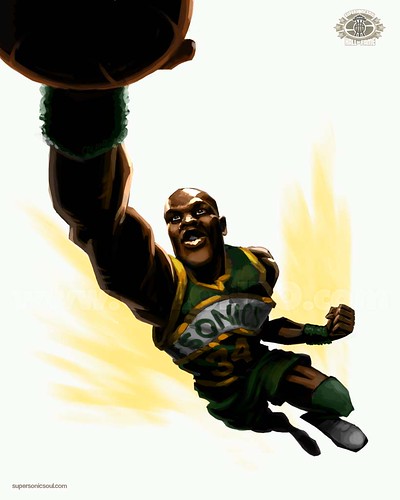
By it, I mean the single greatest dunk in Seattle SuperSonics history. The crowd was at a Nigel Tufnel-11, screaming for Los Angeles blood, relishing every turnover, every made shot with an intensity almost never seen in regular season games. This was the Lakers, man! And we’re winning! On a Sunday!
Following another run of Sonic points early in the second quarter, Seattle forced a turnover, with Nate McMillan and the X-Man racing up court as the crowd roared them along. Approaching the basket, McMillan slowed slightly, awaiting the perfect moment to feed McDaniel.
Finally, he could wait no longer. The young point guard lofted the ball up, seemingly too far back for X to grab, and a thousand throats clinched in the stadium, thousands more at home.
Yet reach McDaniel did, so far back you thought he would dislocate his shoulder from the exertion. That overzealous feed from McMillan was the perfect recipe, though, as the extra momentum McDaniel’s arm received from starting so far back provided even more ammunition for the thunderous dunk that was to follow, a dunk so powerful that Pat Riley signaled for timeout before the ball hit the floor.
At that moment, at that time, you could have fed me a bottle of cyanide and I’ve have died a happy boy. Sunday afternoon, national TV, the Sonics beating the Lakers to a pulp, the X-Man dunking so hard it’s making my ears hurt, I mean, what more could you possibly ask for?
Sadly, X’s 35-point performance that Sunday afternoon wasn’t enough, and Seattle’s first half lead disappeared in the second half. The Sonics, despite their 17-game win streak at home, were not the Lakers, and Magic’s 19 free throws were enough to convert a debacle into a classic Lakers road victory.
For that moment, though, Xavier McDaniel was all a 15-year-old fan could want. He was power, he was cool, he was X. Part of me wishes video evidence of the dunk existed somewhere on the internet, but another part of me prefers watching it in my mind, for fear that the real thing would fall short of my memories.
Xavier McDaniel – the X-Man – was more than the thug people saw in New York, he was more than the cartoon character peering out from the infamous Costacos brother poster, he was more than a goofy cameo on “Singles.”
Xavier McDaniel was a marvelous combination of powerful dunks and graceful turnaround jumpers, and he was our hero.


