Showing posts with label SSS Hall of Fame. Show all posts

Friday, October 31

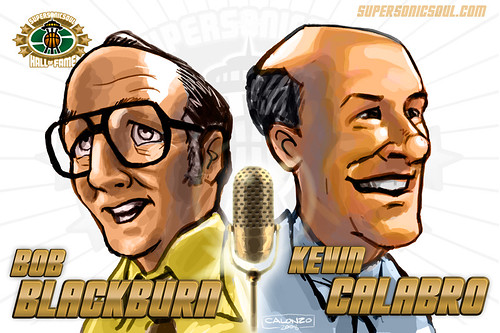
SSS HOF #10 & 11: Blackburn & Calabro

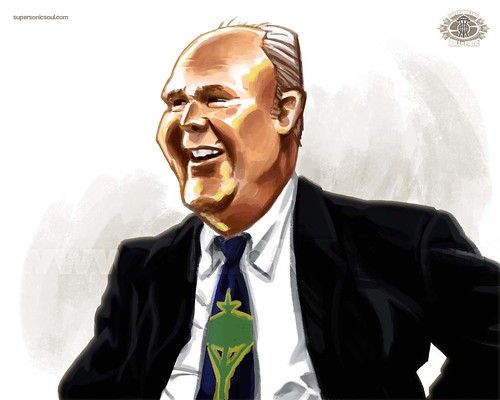
Bob Blackburn & Kevin Calabro

Safe under the covers from the winter cold, lights off save for the glowing red radiating from a small clock radio on the dresser, tuned to a static-filled station. Coming through the crackling noise is a voice from thousands of miles away, but seemingly sitting there next to him in the room.

The voice tells the boy the score is close, his team has a chance. His heroes –Williams, Sikma, Johnson – will come through yet again. Tonight, he’s at the Cow Palace to extol the exploits of Teagle and Floyd, and Wednesday he’ll be at The Forum, that magical place filled with superstars the boy loves to hate. Every night, he’s talking to him from these places with names so incredible – Spectrum, Garden, Reunion, Salt Palace – they seem to have sprung forth from a Twain novel.

Each night, the announcer is the conduit for the boy. In an era before the internet, before cable, the broadcaster was your PDA, his voice your instant message.

He is Bob Blackburn, and, to a 10-year-old boy growing up in Seattle, he is a high-pitched messenger communicating from the heights of Mount Olympus.

-----

Driving through a drenching rainstorm on I-5, somewhere north of Portland and south of Olympia, a no man’s land of farms and utter darkness, the college student leaves his dial tuned to a station blasting only static. Soon, though, a voice will begin to interrupt the static, gradually becoming clearer and clearer, if only he can get close enough to Seattle to gain reception.

It’s late November, but already the season has taken on a sense of urgency and the student needs to know if his team can take down their hated Oregon rivals. He could listen to the Portland station, but, honestly, he’d rather listen to static than all that Rip City garbage.

No, he waits for his guy, his representative at the Coliseum, to tell him a bit of good news. To tell him Payton and Kemp are running like the bulls at Pamplona, Drexler’s jump shot is off, Porter is tentative.

He waits for Kevin Calabro.

----

In the field of sport-related recognition, basketball play-by-play men rank somewhere above ‘resin bag filler’ and below ‘groupie wrangler.’

Baseball has Harwell, Scully, and Caray. Football has Summerall, Enberg, and Jackson. NBA announcing’s upper echelon, though, is more famous for other pursuits (e.g., Marv Albert) than for basketball duties. Sure, there are Johnny Mosts, Bill Kings, and Chick Hearns, but as far as national renown, they rank far down the list. The most well known basketball announcers are Billy Packer and Dick Vitale, not Marv Albert and Mike Breen.

In Seattle, though, this is not the case. Kevin Calabro and Bob Blackburn are as well loved as anyone in this city, with the possible exception of the Mariners’ Dave Niehaus.

Growing up in this area back in the 80s, I was lucky enough to fall asleep on hundreds of nights with Blackburn’s somewhat nasal words echoing in my head. Sure, Calabro became the emblem of the team in the ensuing decades, but it was Blackburn who laid the foundation. His call of Gus Williams “hurls the ball into the air” at the end of the Sonics’ only world championship remains the signature utterance in Seattle pro basketball history, and the way he always brought excitement to any game, regardless of the score or the opponent, made him a continual joy.

In the years since he left the booth, Blackburn has faded from view, a relic of days gone by. For fans who grew up before Shawn Kemp arrived on the scene, though, Blackburn will always remain part of the fabric of Sonic lore.

Likewise, Calabro became as integral to the Sonic experience as Payton, Kemp, Karl, or any of the great players he covered. While even casual fans can tick Calabroisms (“Get up on that magic carpet and ride!”) off their fingers with the ease of a teacher counting heads on a field trip, it was the smaller contributions from Calabro that I appreciated more.

The majority of announcers are homers, and, to a degree, that’s just fine. After all, their listeners are certainly pulling for the home team to win, so a little rooting is certainly acceptable. Calabro, to his credit, would let you know he was delighted to see the Sonics doing well, but when they failed to perform up to their capabilities, he always let us know.

Teamed with Marques Johnson (a match made in announcing heaven), Calabro felt free to make disdainful remarks about the way the Sonics were playing. Not in a “this team is terrible and here’s why” sort of way, but in a “c’mon guys, you can do better than this” sort of way. It was that honesty made his excitement over legitimate greatness all the sweeter, and enabled him to catch on with the networks, allowing us to still hear his voice this season, albeit a voice that perhaps will never say Sonics again.

---

With the Sonics a piece of history now, I’ve often been asked by non-Sonic fans what it is I miss the most about the NBA. Is it the games? The rivalries? The daily activities?

Of course, I miss all of that, but, perhaps, what I miss the most is hearing about the team through Kevin Calabro. It’s been two decades since I first heard him tell me about Dana Barros, Derrick McKey, and the rest of the late-80s early-90s Sonics, two decades of marvelous phrases and beautiful intonations. Half my life passed in the interim, and KC has been the messenger of (mostly) good news for the majority of it. This year, though, is different. This year, I won’t have Kevin Calabro in my life.

No matter how hard I search on my clock radio.

Thursday, October 16

SSS HOF #9: George Karl, Part II

Coach Karl

Have you ever watched a five-year-old paint a picture?

In the beginning, the work appears, while often manic and confusing, promising. There are strokes of brilliance, a beautiful mixture of soft and hard brushes, and, at one point, it appears as if the entire project will become a smashing success.

Sadly, inevitably, the process cannibalizes itself. The five-year-old begins dumping all the paint onto the page, gets frustrated, throws things around the room, complains he wasn’t given the proper tools, and eventually walks away from the work before it is completed.

Likewise with George Karl’s various tenures as an NBA head coach.

I won’t speak to the other destinations in Karl’s version of The Odyssey, but even the heartiest defender of his time in Seattle would begrudgingly admit that it was a marriage marked more by conflict than agreement, a relationship headed for break-up almost as soon as it began.

That isn’t to say that Karl wasn’t beloved by Sonic fans – in fact, you could argue that he is more loved than any coach in team history, his off-the-cuff manner and everyman persona a hit with fans from Blaine to Walla Walla.

And yet, and yet … there was always something frustrating about the Karl Sonics. The Sonics’ first-round loss to Denver came the 2nd year of the Clinton presidency, yet it feels as raw and painful today as it did more than a decade ago.

There were numerous complaints about Karl’s team while he was in Seattle: that they lacked a competent half-court offense and that they could only operate successfully in the open floor were chief among them. (I can vividly recall hoping that Hersey Hawkins would prove to be the elusive spot-up jump shooter the Sonics needed at the 2-guard, only to see him be as mediocre as all the other players who passed through that spot. Was it Karl? Was it the dominating affect of GP in the backcourt? Hard to say.)

Still, those playoff frustrations paled in comparison to the wounds we would suffer as Sonic fans a decade later. Sure, it’s painful to get spurned by the girl you adore on the dance floor, but it’s even worse not to go at all.

Heck, in the decade after Karl left, Sonic fans didn’t even know there was a dance.

But back to the man himself. More than any other adjective stapled to his life in Seattle, George Karl was fun.

Frustrated because your team doesn’t have passion? Not when George is in town.

Want your guys to push the ball faster up the court? Gotcha.

Wish your coach would speak his mind and not talk in double-negatives and clichés? Not exactly a problem with Karl.

And that’s why, with the Karl Era firmly in the rearview mirror, we can look upon it as a success from all angles. Yes, he should have nurtured his relationship with Bob Whitsitt and, more importantly, Barry Ackerly. Sure, he could have taken a page from the Chuck Knox Book of Life and played the cards he was dealt a little more happily. Naturally, a championship would have been the perfect topping to the mixed-up concoction he gave us for a half-dozen wonderful years.

But to have done that would have violated his bizarre methodology. George Karl, like that five-year-old, wasn’t one to paint by numbers. He wanted big, broad strokes and flamboyant colors, by damn, and nobody was going to tell him otherwise.

Speaking as a Sonic fan, I’m certainly glad he felt that way.

Thursday, October 9

SSS HOF #9: George Karl

Coach Karl

He came to Seattle under cover of darkness, an exile returned from Elba, his final chance at making it as a professional basketball coach awaiting him on the rain-soaked runways of SeaTac Airport.

Before the jet touched down from its long journey westward from Spain, his career ledger totaled 119 wins and 176 losses, a testimony to mediocrity. He seemed destined for a Gene Shue-like career at best, or, at worst, to be the Billy Martin of the NBA, but without the championships. Suffice it to say, Sonic fans were forgiven for not throwing a parade.

By the time he left town less than a decade later, however, George Karl had rejuvenated both a city and his career.

AGGRESSIVE

He made his Sonic debut on January 23, 1992, against Portland at the Coliseum. Fittingly, Shawn Kemp and Gary Payton, the two icons of Karl’s reign in Seattle, contributed mightily. Fittingly, the Sonics lost, not because they were bad, but because that’s what the Sonics did under Karl – they lost when it mattered most.

But back to those beginnings. The year he inherited the team from KC Jones, the Sonics finished the season with 775 steals.

It would prove to be the lowest total of Karl’s tenure.

If nothing else, George Karl was aggressive. He was aggressive in the way he coached, he was aggressive in the way he dealt with others, he was aggressive in the way he lived.

There’s a humorous tale of Karl striding through the lobby at All-Star Weekend as the head coach of the Western Conference. He was at the top of his game, risen from the wilds of the CBA and Europe to the penthouse of basketball. There he strode, though, wearing horrific zubaz pants, thumbing his nose at his Armani-clad coaching brothers. He was a misfit, and he loved it.

That was Karl, though. He had no interest in doing things the way others did. You can’t play three guards in the same lineup? Why not, when you’ve got Gill, Payton, and McMillan? Who says you can’t put a 6’9” forward on your opponent’s point guard, even if that point guard is a waterbug?

Karl’s contrarian ways had placed him in trouble during his previous stops in Golden State and Cleveland, where he was unable to win often enough to forestall his firing. In Seattle, however, he had a plethora of talent and, combined with his skills as a defensive teacher (as well as his assistants Tim Grgurich and Bob Kloppenburg) he finally was given the opportunity to see what he could do.

SUCCESS AT LAST


Don’t misunderstand, Karl was not a loser before he came to Seattle. He had won frequently in the CBA, and he took both the Cavs and the Warriors to the playoffs, no mean feat considering the woeful nature of those franchises.

No, Karl’s problems stemmed from his inability to make nice with his employers. In Seattle, though, with an equally contrarian Bob Whitsitt manning the GM seat, Karl had a kindred spirit running the show. Whitsitt and Karl were in harmony, for a time at least, and they molded a winner.

In his first full season as head coach, Whitsitt took the Sonics to the Western Conference Finals, where they lost a Game 7 heartbreaker to the Phoenix Suns in one of the most bitterly remembered games in Seattle sports history.

But reflect on the accomplishment for a moment, not the frustration. In the span of 15 months Karl had taken the Seattle Sonics from an afterthought to the most exciting team in the Western Conference, if not the league. Sure, the Suns “won” the conference title, but true NBA followers knew the best team in the West was from Seattle, not Phoenix.

It was an amazing turn of events. Accompanied by a national surge of interest in Seattle music, it was an exciting time to be a sports fan in the Northwest. After years of mediocrity and anonymity, Seattle was poised to plant its flag.

TOMORROW

Rise and Fall.

Thursday, October 2

SSS HOF #8: Lenny Wilkens

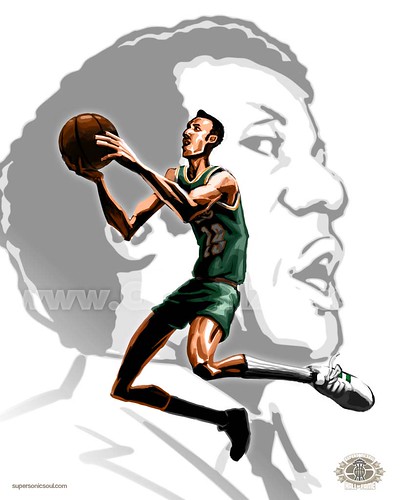
Player. Coach.

For one generation, he was a 3-time all star, a whirling dervish of a guard who slipped easily from facilitator to dominator.

For another, he was the curly-haired wizard with a Brooklyn accent who improbably guided a group of men to the only championship in Seattle sports history.

For yet another, he was a link from the past, tied tenuously to a corrupt ownership hell bent upon destroying the history he himself played such a vital role in creating.

He was Lenny Wilkens and, in many ways, he embodies the word “Sonic” more than any man.

Think of it thus – the Sonics have had four distinct phases in their existence: Expansion, championship, return to glory, and departure. Lenny Wilkens played a key role in three of those phases: first as the team’s inaugural star, second as the team’s coach in its halcyon days of the late 1970s, and third as the president during Clay Bennett’s destructive reign.

Long-forgotten by today’s fans, Wilkens was a three-time all-star, and was named the game’s MVP in 1971. He recorded the first ten triple-doubles in team history (only Gary Payton had more), was the first Sonic to lead the league in a major statistical category (assists, 1969-70), and held the team record for assists in a single game for more than a decade.

It was a remarkable run as a player (and coach) in Seattle, a run that would only – could only – be surpassed by the heights he reached as the team’s coach.

Everyone knows the story of the championship-era Sonics: of Brown, Johnson(s), Williams, Sikma, Shelton, Silas, and the rest. Wilkens is often a footnote to the tale, standing to the side, arms crossed while the players did the work.

What has been forgotten is how mediocre the Sonics had been before Wilkens took charge in 1977. As a player-coach in the early 1970s, Wilkens had guided the Sonics to a 47-win season in 1971-72 … and got traded. Those 47 wins would not be surpassed by the team until he guided the team again seven years later.

After letting Bill Russell go as coach after yet another 40-odd win season in 1976-77, the Sonics put Bob Hopkins in charge. 17 losses and only 5 wins later, Hopkins was gone, and with the team mired in the Pacific Division basement, Wilkens brought them back, coaching the team to a 42-18 record from then on.

Read those numbers again:

Hopkins: 5-17
Wilkens: 42-18

That’s with the same team, people. Hopkins would have had to go 37-1 to reach the record Wilkens attained with the same group of players.

And it was not merely regular season success, as that group of men reached the pinnacle of playoff heights by losing to the Bullets in the NBA Finals, a loss they would redeem the next season with Seattle’s only championship. The team’s first star became the team’s first coaching legend.

When I think of Lenny Wilkens, though, it is with more sadness than delight. I think of the man forced to subjugate himself to Clay Bennett’s rule, who had to parrot lines he must have believed to be lies just to keep his job. Wilkens ended his NBA life with a less than stellar reputation – he became known as much for self-preservation as for coaching ability – and that saddens me.

At the time of the unfortunate end to his life as a Sonic, Wilkens was chastised in the press for speaking out of turn and making statements that were less than true. Looking back on those times, though, he becomes less of a scapegoat, and more of a man desperately clinging to the reputation he had built over a lifetime of work in basketball.

I hope history will treat Lenny Wilkens more kindly than he was treated in his final days with this franchise, that his immense successes will outweigh his failures, and that his name will be erased from the sullied ending to a once-proud franchise’s life.

For all he gave this city, he deserves it.

Friday, September 26

SSS HOF #7: Jack Sikma

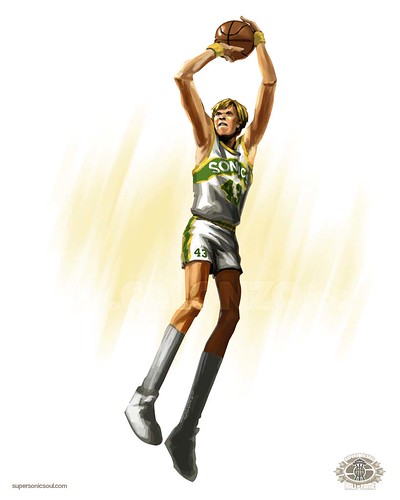
Sikma

Jack Sikma, Harpers Index-style

Points scored by Jack Sikma in his Sonic career: 12,034
Points scored by Alton Lister, Jim McIlvaine, Olden Polynice in their Sonic careers, combined: 4,245

Number of 3-pointers made by Sikma in the first 11 years of his career: 7
Number made in the next three: 196

Number of playoff games Sonics played in Sikma’s first three years: 54
Number in the next 10 years: 47

Number of years Sikma averaged 10 or more rebounds per game in the playoffs: 6
Number of times since he was traded a Sonic center has done so: 3

Amount Sikma earned in his career as a player: $13,497,000
Amount Wally Szczerbiak earned last year: $12,275,000

Number of blocks by Alton Lister, for whom the Sonics traded Sikma, in his three years in Seattle: 500
Number by Sikma in those three years: 231

Number of points Sikma scored: 3,465
Number for Lister: 1,989

Number of categories in which Sikma ranks among Seattle’s top 10: 22
Number of categories in which Lister does: 1

Number of times Sikma was dunked on by Shawn Kemp and made to look like a punk: 0

Thursday, September 18

SSS HOF #6: Spencer Haywood

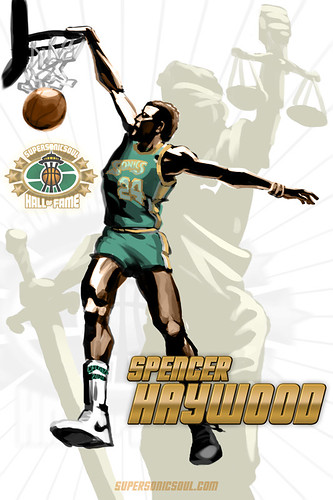
Spencer Haywood

Here's a fish hangs in the net, like a poor man's right in the law.


"Pericles," William Shakespeare

Two courts played a pivotal role in the last two years of Sonic basketball – the court we have come to expect, made up of hardwood and stretching 94 feet in length, and the court with which we sadly grew increasingly familiar, the one in which 5’8” lawyers stand taller than even the tallest center.

With those frustrating years in mind, those who followed the shenanigans of Clay Bennett, Howard Schultz, David Stern, and this city may be forgiven for thinking it was always thus, that the wheel in this costly game of roulette has been forever tilted in favor of the all-powerful NBA.

That, however, would not be mindful of history. For once upon a time, a man named Haywood slew the mighty beast called the NBA, defeating them in the highest court of them all – the Supreme Court.

It was 1970 and Spencer Haywood, a prodigious talent from the fields of Mississippi by way of Motown, was maneuvering himself to enter the NBA, even though he was a mere two years removed from high school.

Haywood entered the ABA with the Denver Rockets, but, no fool he, knew the big money and fame was in the league with the “N” and not the “A”, and, after pocketing the ABA’s MVP award, prevailed upon Sonic owner Sam Schulman to sign him to a six-year, $1.5 million contract.

And therein laid the problem. The NBA forbade players from playing until they completed four years of college, meaning Haywood, with Schulman’s assistance, had thrown down a massive challenge to an essential part of the league’s structure. Haywood, however, unlike certain current members of the Seattle municipal government, was willing and able to do whatever it took to defeat the league.

Haywood would not fight alone. Shed any notions you have that the past few years were the first time Seattle battled the NBA. Back in 1971, more than 35 years before the recent conflagration, the league reacted indignantly to the Sonics’ move to add Haywood, threatening to not only disallow the roster move, but to add “punitive measures” to the Sonics as a franchise.

Looking back on the situation with 40 years of hindsight, the whole state of affairs is slightly amazing. Here is a young man being told he is too young to play professional basketball, seeing other men his age being told they’re old enough to die in Vietnam. Like so many other young people of that generation, Haywood rebelled, refusing to knuckle under to authority.

You wonder, looking back now, what was going through Haywood’s mind during those months of court trials, through the series of appeals? Remember, Muhammad Ali had just been allowed to fight again, and Ali’s successful battle against what he felt to be an injustice had to be at the forefront of Haywood’s thoughts. Further, as a member of the 1968 Olympic team in Mexico City, he was an eyewitness to the fists raised in defiance by Tommie Smith and John Carlos. Whether he agreed with their position or not, the young man was undoubtedly changed by it.

With all of that in mind, contrast the two scenarios, now almost four decades removed. In one, you have a league endeavoring to bully a young man and a free-spirited owner into yielding to its will. Like so many others in the early 70s, Haywood and Schulman would have no part of it, and would take no quarter from the aggressor, regardless of how unlikely their victory seemed.

Turn the clock forward forty years, and an entirely different scenario plays out. A manipulative and condescending league office attempts to bully a city into yielding to its will, and it succeeds beyond its wildest dreams.

When push came to shove, Haywood pushed back. The city? It just got shoved.

Haywood, unlike the City of Seattle and Howard Schultz, would prevail against the league, as the Supreme Court sided with his argument that the league’s policy of forbidding young men from entering its front doors was a restraint of trade and, hence, utterly illegal.

Forty years have passed since Spencer Haywood challenged the NBA. The NBA continues to force its morals on poor black men by denying them an opportunity to earn a living because of their “youth,” while men the same age as they go off to die in an increasingly unpopular war.

Forty years ago, such revolutionaries as Joan Baez, James Brown, Spencer Haywood, and Muhammad Ali fought injustices, putting their own lives behind the causes in which they believed. Today, that spirit of sacrifice and noble pursuit of righteousness seems to have vanished, a long-forgotten relic of the nation’s past.

One look only at the differences between the US Olympic team of 1968 and the 2008 version for a perfect illustration of the changes which have transpired. On one hand you have Kareem Abdul-Jabbar and others, under the urging of Dr. Harry Edwards, declining to play for their country as a political protest of the racial unrest in the United States. As Edwards told New York Times Magazine at the time, “We're not trying to lose the Olympics for the Americans. What happens to them is immaterial….But it's time for the black people to stand up as men and women and refuse to be utilized as performing animals for a little extra dog food.”

As Jabbar points out on his blog, at the same time as black soldiers were being led off to fight for their country in Vietnam, black basketball players were being asked to go off to fight for their country in Mexico City. In both cases, Jabbar writes, those who left came back to be treated as second-class citizens.

(To be fair, Haywood did not join the boycott of the Mexico City Olympics, and the only reason he made the team was because others had abandoned their spots. In his words, he understood the boycott, but he didn’t agree with it. However, it might be argued that the events which transpired in 1968, combined with the racial upheaval in the U.S. in the ensuing years, altered his thinking, prompting him to challenge the NBA.)

Now contrast that set of emotions from 40 years ago to the series of events in Beijing at the just-completed Summer Olympics. Now, you have a group kowtowing to every whim of the Chinese officials, the entire roster forbidden from even speaking a word contrary to the glory which is China, let alone contemplating a boycott.

Now, you have a group of black men being silenced by white authority figures.

An observer far-removed would wonder, what has happened to this country in the gulf of time separating 1968 from 2008?

Where, he might also wonder, have all the Spencer Haywoods gone?

Thursday, August 21

SSS HOF #5: Nate McMillan

Mac 10

He came to Seattle as unheralded as an autumn rain, a point guard from the other side of the country, plucked from the second round of the 1986 draft by a team fresh off consecutive 51-loss seasons.

That two decades later he would be one of the most, if not the most, beloved players in team history was not just unexpected, it was impossible. What was it about Nate McMillan, a player who never averaged more than 7.5 points in any season, a player who started fewer than 400 games in his dozen-year career, what was it about this man that made him such an essential part of the Seattle Sonic basketball experience?

I’m reminded of a passage from Roger Angell’s “Late Innings,” wherein he tried to explain what made Willie Mays such a joy to behold. “You can take apart a watch, but not a sunset,” Angell finally concluded, leaving the reader to imagine him casting his hands into the hair.

McMillan was no Mays, to be sure, but he was as integral to the Sonics’ success for the 12 years he spent in Seattle as any player in team history. Mac-10 was the ultimate glue guy, the consummate teammate, the type of player any coach in the league would have relished seeing in the locker room before a crucial game.

Twice named to the 2nd-team All-Defensive Team, it was on that end of the court upon which McMillan made his mark in the league. At 6’5”, he could defend either guard – and many small forwards – with ease. To cap off his brilliance as a defender, in 1993-94 McMillan would lead the entire league in steals, averaging three per game.

Even that accomplishment was understated, for a closer look at the top five that season shows just how unbelievable his accomplishment was. The four players who ranked behind Nate that year, starters all, averaged 2,800 minutes apiece.

McMillan played 1,800.

That’s how he was, though, and that’s why we loved him. Other players would have bemoaned their fates after seeing the parade of replacements brought in for him – Sedale Threatt, John Lucas, Avery Johnson, Gary Payton all donned Sonic jerseys during his tenure – but McMillan soldiered on. With the arrival of Payton in 1990, McMillan never again started more than 30 games in a season, and injuries further curtailed his minutes.

But you never heard a peep from him. Like the rest of us, Nate suffered while the Sonics flamed out season after season in the playoffs. Living in Southern California in 1995, I can still painfully recall seeing him with his head in his hands after the Sonics fell to the Lakers in the first round, another 50-win season tossed in the garbage. His angst needed no commentary, his grief at seeing the dying embers of his career smoldering right in front of him needed no explanation.

Living on borrowed time as an NBA player, McMillan had to know time was growing short on his shot at a title. With the Sonics’ ascendance to the promised land in 1996, it should have been his chance to show the rest of the country why Nate McMillan was every bit the defensive player we believed him to be.

Sadly, it was not to be. Waylaid by injuries once again, McMillan watched from the sideline for most of the series. His emotional return to the floor in game four was the impetus behind Seattle’s victory, and I can still hear the standing ovation he received from a delighted KeyArena crowd that night. The Sonics’ failure to capture the title that season was almost secondary, from my viewpoint, to McMillan’s failure to play up to his abilities on the national stage.

At this point, a writer would turn to numbers to aid him in painting the greatness of the one whom he profiles, but going into statistics to explain McMillan’s place in team history is a fruitless task, because his greatness to us belied his numbers. For the same reason Yankee fans loved Phil Rizzutto and Celtic fans loved John Havlicek, Sonic fans loved Nate McMillan, unconditionally and devotedly.

Asking me to explain my affinity for McMillan would be like asking a child why he likes a parade or asking a mountain climber why he likes to stand on a summit. It is a relationship built upon years of successes and failures, upon memories of alley-oops and picked pockets, upon flat-top haircuts, hiked-up socks, and furrowed brows.

Quite simply, I like Nate McMillan because to not like him would never occur to me.

Thursday, August 14

SSS HOF #4: Gus Williams

The Wizard

Play word association with some people and when “wizard” comes up, they’ll turn to “Merlin” or “Harry Potter.”

Say wizard to a Sonic fan, though, and you’ll get an entirely different answer.

Gus Williams, to a Seattleite, was and is The Wizard.

And with good reason; while fans raised in the past dozen or so years might be oblivious to Williams’ greatness, those of us who feasted on that magical late-70s run of delicious playoff victories know better.

More than anything I remember from growing up outside of Seattle, I remember Gus’ shoelaces, or the way he tied them. To the rest of the country it’s a trivial bit of NBA history, but to those who grew up with the green and gold, it was an initiation rite. Williams tied his laces behind his ankles, a leftover from a period when his laces were too long. Since the habit started during the Sonics’ run to the NBA Finals, he was reluctant to break it, and before you knew it, every adolescent boy in greater Seattle was copying him.

The loyalty to Gus came from his on-court greatness, though. Williams was playoff-great, posting nearly half of the ten best post-season scoring games in team history and nearly half of the best assist totals.

As further, evidence, consider that in the two consecutive years that the Sonics played in the NBA Finals, they played a total of 39 games.

Gus Williams led them in scoring 19 times.

Even more, in the NBA Finals against the Bullets Williams led the team in scoring in all five games, averaging 28.6 points, a remarkable display of his abilities in the ultimate proving grounds.

Even more remarkable was the fact Williams did all that without the benefit of a 3-point line. In his 477 regular-season games in a Sonic jersey, Williams made the grand total of 22 three-pointers.

That’s right, 22. In fact, in 1981-82, Williams managed to hit 2 of 43 from beyond the arc. 2 of 43! Heck, Olden Polynice could have done that, right?

Well, the NBA was a different league back then. Even Fred Brown, certainly the most renowned long ball shooter in Seattle history, topped out at 39 3’s made in a season, or a good week and a half for Ray Allen.

But I’ve been sidetracked. Gus, DJ, Downtown – they are the touchstone for a generation of Sonic fans. I must have played a million make-believe games on the basketball court in front of my house, nearly all of them as the Sonics, especially the late-seventies Sonics.

And nearly all of those games came down to the same situation – Sonics down by one, seven seconds left, Gus Williams with the ball. Inevitably, he’d sink the winning shot (or, be fouled; the referees were kind to the Sonics in my make-believe world).

I’m not sure why the Wizard became the most imitated player at my house; Dennis Johnson was a better all-around player, Jack Sikma was an all-star center, Fred Brown was a wonderful outside shooter. But he was.

Maybe it was the shoelaces.

Thursday, August 7

SSS HOF Inductee #3: Xavier McDaniel

X-Man

January 24, 1988.

A day of which most Sonic fans have no recollection, lost amidst an otherwise forgettable season which culminated with a first-round loss to the Denver Nuggets.

But it was – for part of the day, anyways – a glorious day to be a Sonic fan.

To begin with, it was a Sunday which, in 1988, meant the opportunity to watch the one game a week televised around the country (at least, for those of us not fortunate enough to possess cable television). For a Sonic fan, Sunday matinees were as frequent as NBA Finals appearances, so if you had asked me in mid-November whether the Sonics would be on national television in January, my answer would have been an emphatic no. Sure, the Sonics had made it to the Western Conference Finals the previous spring on the wings of a miraculous run of victories, but that was a fluke, a mirage.

But for some reason, magic hit the Sonics that year, especially within the friendly confines of the Seattle Center Coliseum. Entering that Sunday, they owned an 18-1 home record, and were in the midst of a 17-game win streak at home and six straight in total. Sure, the 24-15 overall record didn’t indicate much, but that 18-1 mark, well, that meant a lot.

So much that CBS rolled Dick Stockton into town for a classic matchup between the Lakers and the Sonics on national TV. These were your uncle’s Lakers – Magic, Kareem, Worthy, AC, Rambis – and the Sonics were throwing out their killer trio of Chambers, Ellis, and Xavier McDaniel to combat them. To say Seattle fans were riled up entering the contest would be understatement.

Spearheading the Sonics’ torrid pace, the X-Man was on fire heading into that contest, averaging nearly 30 points per game in the previous five outings, including 41 against the Knicks at MSG. Would this be our opportunity to show the rest of the country just how great he was? Would we finally be able to sneak out from behind the shadow of Showtime and plant our flag as a great team?

For 24 minutes that Sunday, it sure seemed so.

The Sonics raced out to a huge lead that afternoon, thrilling the locals with their offensive exploits. With Michael Cooper suspended due to a fight the previous Friday night, the Laker bench was thinned to three men, and Seattle wasted no time in jumping out to a double-digit first-quarter lead.

Then? Then it happened.

By it, I mean the single greatest dunk in Seattle SuperSonics history. The crowd was at a Nigel Tufnel-11, screaming for Los Angeles blood, relishing every turnover, every made shot with an intensity almost never seen in regular season games. This was the Lakers, man! And we’re winning! On a Sunday!

Following another run of Sonic points early in the second quarter, Seattle forced a turnover, with Nate McMillan and the X-Man racing up court as the crowd roared them along. Approaching the basket, McMillan slowed slightly, awaiting the perfect moment to feed McDaniel.

Finally, he could wait no longer. The young point guard lofted the ball up, seemingly too far back for X to grab, and a thousand throats clinched in the stadium, thousands more at home.

Yet reach McDaniel did, so far back you thought he would dislocate his shoulder from the exertion. That overzealous feed from McMillan was the perfect recipe, though, as the extra momentum McDaniel’s arm received from starting so far back provided even more ammunition for the thunderous dunk that was to follow, a dunk so powerful that Pat Riley signaled for timeout before the ball hit the floor.

At that moment, at that time, you could have fed me a bottle of cyanide and I’ve have died a happy boy. Sunday afternoon, national TV, the Sonics beating the Lakers to a pulp, the X-Man dunking so hard it’s making my ears hurt, I mean, what more could you possibly ask for?

Sadly, X’s 35-point performance that Sunday afternoon wasn’t enough, and Seattle’s first half lead disappeared in the second half. The Sonics, despite their 17-game win streak at home, were not the Lakers, and Magic’s 19 free throws were enough to convert a debacle into a classic Lakers road victory.

For that moment, though, Xavier McDaniel was all a 15-year-old fan could want. He was power, he was cool, he was X. Part of me wishes video evidence of the dunk existed somewhere on the internet, but another part of me prefers watching it in my mind, for fear that the real thing would fall short of my memories.

Xavier McDaniel – the X-Man – was more than the thug people saw in New York, he was more than the cartoon character peering out from the infamous Costacos brother poster, he was more than a goofy cameo on “Singles.”

Xavier McDaniel was a marvelous combination of powerful dunks and graceful turnaround jumpers, and he was our hero.

Thursday, July 31

SSS Hall of Fame Inductee #2: The Reign Man

Reignman

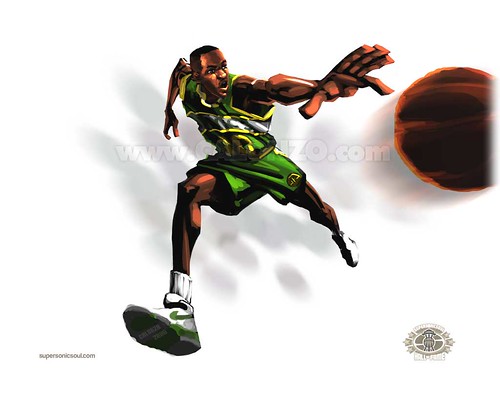
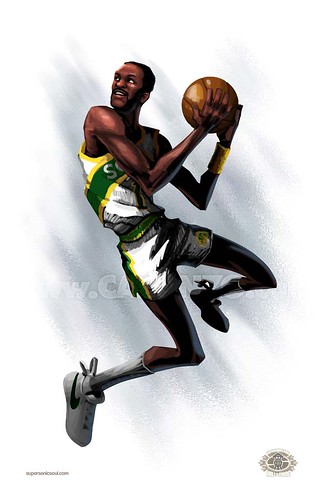
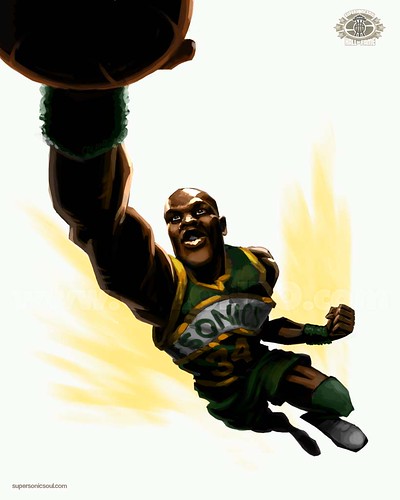
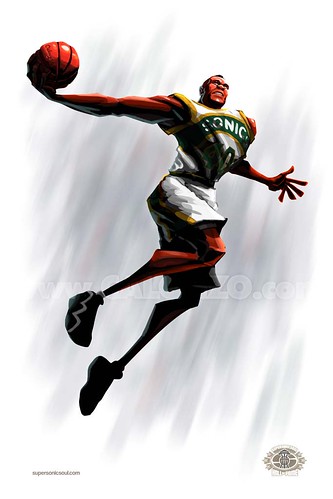
Words: Peter Nussbaum Illustration: Rafael Calonzo Jr.

The Reign Man

Once upon a midnight dreary, while we fretted weak and weary
Waiting for a redeeming hero like someone from long before
While we waited, nearly sleeping, suddenly there came a creeping
As of someone gently peeping, peeping at our polished floor
“‘Tis only a teenager,” we muttered, “peeping at our floor
Only this, and nothing more.”

Ah, yes, now we see him, the days are shorter, it’s mid-December
And the teenager, he is now much older than he was before
Flies from floor to ceiling, with a power that was quite appealing
With a graceful majesty that bespoke of the greats of lore
A greatness we’d see again so often, but never had before
Nameless here for evermore.

Presently our souls grew stronger, hesitating then no longer,
“Oh, great one, do never leave us, it is of this our hearts implore”
And for a time it seemed he would never dream of leaving
Adultation he was receiving, greatness stretching on ever more
With a touch and power few had equal and none had more
Greatness there, and nothing more.

Onto the heights of warmer June his skills would one day take us,
On the magic carpet he’s riding, no matter what the score
“Thank you, thank you great one,” the crowds stand chanting
While his opponents were left panting, panting on the floor
Smiling, he’d leap even higher, even higher than before
Then, exhausted, sit, and nothing more.

The years began a-counting, the first-round losses mounting
Muttered rumblings of discord come flooding through the door.
Coaches more and more demanding, and a waistline e'er-expanding
Less running now and much more standing, no matter what the score,
All are wond’ring what has become of the man-child from before
Quoth the Reign Man, “Nevermore.”

Writers questions are repeated, a face begins to look defeated
Fans full of memories of their favorite highlights of yore.
He floats through the league, first with drugs, then with drinking
All are wondering what he’s thinking, thinking of nothing more?
They cling to dreamings, pleading return to where he’d left before
Quoth the Reign Man, “Nevermore.”

So an owner so beguiling, always talking, never smiling
Snatches team, leaving only memories of gold jerseys they had wore.
All the while the fans remember, oftentimes in November
Of the great one who they had worshipped on that floor.
In their heads they see him flying, giving anything to once more adore
Quoth the Reign Man, “Nevermore.”


With apologies to Edgar Allen Poe.

Thursday, July 24

SSS HOF Inductee #1: Gary Payton

The Glove

Words: Peter Nussbaum | Illustration: Rafael Calonzo Jr.

How does it happen?

How does a man so menacing, so scowling, so intense become so beloved?

How does a brash youngster from Oakland by way of Corvallis become the most treasured player in four decades of Seattle basketball?

So many questions, all coming back to the same answer.

Intensity.

Gary Payton’s given middle name may have been Dwayne, but to those of us who followed his career in a Sonics’ jersey, his true middle name was always Intensity. His 1,335-game career was built upon a foundation of ferocious defense, perhaps more than any guard in history.


Ask yourself: How many other guards earned nicknames because of defensive skills? Are there any beyond Payton? He wasn’t “The Glove” for the way he stroked teammates’ egos, he was “The Glove” because of the way he clung to opposing guards like a wool sock to a freshly laundered towel.

Relax and remember Payton now in your mind’s eye. Not the GP that wandered the NBA like Odysseus for the final years of his career; that wasn’t The Glove. I mean the Payton who dominated his position for a decade in Seattle, the Payton who inhabited the All-Defense Team as if it was his summer cottage.

What do you see when you turn on the film projector in your mind? Is it the chest-bumping menace, arms stretching ever-outwards – as if he was part Plastic Man and could reach all the way around a man from both sides? Perhaps you see him poised in his defensive stance, shorts hiked up with a snarl – oh, that menacing snarl! – daring his opponent to try and drive past him? Is it the way he snapped off jumpers with disdain, as if he couldn’t believe he had to settle for an outside shot when all he really wanted to do was drive into the forest of big men? Maybe you see Payton artfully lofting the ball to an absolute perfect apex up-up-up for Kemp to snatch it and throw it back down-down-DOWN through the cylinder, a roller coaster of delicate passing and violent dunking so utterly incongruous it defied description?

For me, that rickety film projector always plays the same clip. It is Payton cockily trotting backwards up the court after yet another knife-like incision into the paint, his head cocked sideways, mouth wide open, words spilling out faster than an Al Sharpton sermon. It wasn’t enough for Payton to beat you, he wanted you to know you had been beaten, that he was going to beat you again the next time, and the time after that, and the time after that, and if you didn’t watch yourself, he was going to take the ball right from your ha .... crap, there he goes!

To me, the pinnacle of Payton’s tenure wasn’t the 1996 NBA Finals but two years previous, during the infamous 1993-94 season. The trio of Payton, Nate McMillan, and Kendall Gill only lasted two seasons in Seattle, but it was two seasons of utter hell for opposing guards. Three guards, three defensive demons, all three capable of a steal at a moment’s notice.

Just how fantastic were Payton and his Co-conspirators? The NBA has kept track of steals since the 1972-73 season, and in those 35 years, two teams have managed to pass 1,000 steals in a season – and one of them was the 1993-94 Sonics (if you know the other, tout your knowledge in the comments). So great were the Sonics that season that the second-place team was closer to seventh than to first. The incomparable McMillan led all individual players in steals despite averaging a scant 26 minutes, and Gill and Payton both cracked the league’s top ten, but even those amazing figures don’t tell the whole story.

The Sonics were like religious fanatics that season, and assistant coaches Tim Grgurich and Bob Kloppenburg were the resident preachers. The whole team (well, perhaps not Ricky Pierce; never Ricky Pierce) drank in their defensive mantras, and the most apt disciples were Gill, McMillan, and Payton.

Imagine yourself an opposing point guard that season. Perhaps you’re Spud Webb of the Kings, and you’ve been given the role of bringing the ball up against Gary Payton. You receive the inbounds pass and turn backwards as you approach half-court, but Payton starts bumping you with his chest, forcing you to spin sideways so you can gain an angle. Out of the corner of your eye, you see McMillan inching off his man, eyes intensely focused on the ball, waiting for you to let up for just one second. You pivot around again, trying to get by Payton so that you can just pass the ball to someone – anyone – and be done with these vultures. But he won’t let you get by; Gary wants you to do the work. The shot-clock ticks downward, urging you to cross the line before a violation is called.

Finally, you make it past half-court, and now McMillan has given up the charade of guarding his man – why bother, the idea of you passing the ball was laughable to begin with – and now he’s bearing down on you and the two-headed monster – McPayton – has you by the throat. As Payton slaps at the ball for the sixth time in the last eight seconds – or was it McMillan? who can tell? – your willpower begins to fade. Who can withstand this fury? Finally, Payton wins, Kemp sprints down the court, snatches an alley-oop, the crowd screams, Garry St. Jean beckons for a timeout, and you trudge back to the bench, only to see Gill taking off his warmups.

It never ended.

Well, that was every night in 1993-94 – every night until the Denver Nuggets and Dikembe Mutombo ... no, we won’t talk about that part today.

But back to Payton (wipes blood from forehead after aborted attempt at lobotomy). I don’t think it’s a stretch to make the claim that he’s the greatest player in team history. To wit:

- Franchise leader in games, minutes, points, assists, and steals
- 18,207 points scored, or as many as Gus Williams and Xavier McDaniel combined
- Nine-time all star
- Nine times 1st, 2nd, or 3rd-team All-NBA
- Nine times 1st-team All Defensive Team
- Of the ten best single-season PERs in team history, five belong to Payton

Admittedly, Payton was not the perfect player. His antagonistic attitude towards rookies was frustrating to the team’s development, and his undying confidence in his abilities – so useful on the court – proved to be his undoing off it, as he wound up being on the losing end of a battle with Howard Schultz. At the time of his trade to Milwaukee for Ray Allen, most fans bemoaned the move, but looking back it was obviously a wise one.

That said, there’s no point belaboring the argument of his place in Sonic history. Gary Payton is the greatest Sonic ever and will be the first (only?) drafted Sonic ever inducted into the Hall of Fame. He is the Alpha and the Omega of Seattle basketball. There is no “if only” with Payton because he never left the door open to questioning – he played seemingly every minute of every game he could in a Sonics’ uniform with a manic fury unrivaled in Seattle sports history. A history of the SuperSonics without Gary Payton would be like a history of the United States without Abraham Lincoln, a history of rap music without Public Enemy. He may not have been the first or the last, but his importance is as undeniable as his will to compete.

Have I said enough? Perhaps. I’ll yield the floor, then, to the man himself, with words from his appearance at the Save Our Sonics rally a month ago.

“You guys have always supported me, and I’m supporting you,” Payton said, the crowd chanting his name as if it was 1996 once again. “And there ain’t nothin’ going to be stamped on my chest but Sonics when I go into the Hall of Fame.”

Still intense. Still beloved.

Wednesday, July 23

Supersonicsoul Hall of Fame: First Inductee Tomorrow!


Oh man, just wait 'til you get a load of Pete's introduction "speech" for our first ever inductee. It'll make you weep.

Speculating on the first member of The Most Esteemed Make-Believe Sports Hall of Fame may begin... nnnow.