I'm loathe to write this for fear of incurring the wrath of GOP supporters, but it occurred to me last night while watching the debates that Sarah Palin reminded of someone, but I just couldn't put my finger on it until now.
Bill Walton. Like Walton, she talks alot, is very folksy, and occasionally makes an intelligent point, but those points are so diluted by all the other garbage coming of Walton/Palin's mouth(s) that they are never heard.

Friday, October 3


Aubrey McClendon: Part III
During the course of the past week, I’ve looked closely – perhaps too closely – behind the curtain which surrounds Aubrey McClendon and his company, Chesapeake Energy.
Let me blunt – I don’t like McClendon. I don’t think anyone reading this site would struggle to understand that, any more than they would struggle to understand my reasons. He’s a cold, manipulative man who believes the government has every right to interject itself into marriage, that privacy laws are as disposable as toilet paper, and that the environment is as easily replenished as his vast wealth.
Most importantly, he has no qualms with stealing a franchise that resided in Seattle for 40 years, just because his hometown needed something to do in the winter other than watch Sooner football DVDs.
But that’s a side issue for today – this is a free nation, and the Sonics don’t belong to Seattle any more than the raindrops which fall from the sky.
Today, I want to explore the sickening relationship between McClendon’s immense wealth and his complete lack of interest in using that wealth to help whichever city his team calls home.
Let us look, first, and some of the expenses McClendon has incurred in the past two years:
1. $400 million, to state of West Virginia in damages from lawsuit
2. $1.3 billion, decrease in value of his shares of Chesapeake Energy
3. $40 million, to purchase a plot of land in Michigan, upon which he will spend hundreds of millions to build a new housing development
And now let us look at, second, how much money he has spent assisting the cities which house the Sonics/Thunder in building new stadiums:
1. $0
It is a disgraceful commentary on McClendon and Clay Bennett that they can withstand the costs listed above without so much as a blink of an eye, yet when they are asked to contribute to the very buildings in which their teams will play, they run in the other direction faster than Jerome James chasing a box of doughnuts.
Further, it is a damning tribute to David Stern that he spit upon a group of investors in Seattle which was willing to contribute hundreds of millions towards building an arena here, all the while heaping praise upon Bennett and McClendon, who have yet to spend one penny of their fortunes on building new stadiums.
Tim Keown wrote recently at espn.com about how the economic malaise facing the U.S. may spell the end of publicly financed stadiums. While his words are, in my view, wishful thinking, I pray that he is correct.
The time has come for this country to quit subsidizing billionaires on the backs of taxpayers. If stadiums were such a great investment – as owner after owner tells city after city – then why are there so few owners willing to build stadiums? They certainly have no trouble coming up with the hundreds of millions to purchase the team, so why can’t they come up with at least part of the money needed to house them?
The answer is simple – because they play us for fools.
As Keown wrote, if no other benefit arises out of this meltdown in the U.S. economy, perhaps it will be worth it if people such as McClendon are finally forced to part with some of their cash, and the government gets out of the business of stadiums.
Let me blunt – I don’t like McClendon. I don’t think anyone reading this site would struggle to understand that, any more than they would struggle to understand my reasons. He’s a cold, manipulative man who believes the government has every right to interject itself into marriage, that privacy laws are as disposable as toilet paper, and that the environment is as easily replenished as his vast wealth.
Most importantly, he has no qualms with stealing a franchise that resided in Seattle for 40 years, just because his hometown needed something to do in the winter other than watch Sooner football DVDs.
But that’s a side issue for today – this is a free nation, and the Sonics don’t belong to Seattle any more than the raindrops which fall from the sky.
Today, I want to explore the sickening relationship between McClendon’s immense wealth and his complete lack of interest in using that wealth to help whichever city his team calls home.
Let us look, first, and some of the expenses McClendon has incurred in the past two years:
1. $400 million, to state of West Virginia in damages from lawsuit
2. $1.3 billion, decrease in value of his shares of Chesapeake Energy
3. $40 million, to purchase a plot of land in Michigan, upon which he will spend hundreds of millions to build a new housing development
And now let us look at, second, how much money he has spent assisting the cities which house the Sonics/Thunder in building new stadiums:
1. $0
It is a disgraceful commentary on McClendon and Clay Bennett that they can withstand the costs listed above without so much as a blink of an eye, yet when they are asked to contribute to the very buildings in which their teams will play, they run in the other direction faster than Jerome James chasing a box of doughnuts.
Further, it is a damning tribute to David Stern that he spit upon a group of investors in Seattle which was willing to contribute hundreds of millions towards building an arena here, all the while heaping praise upon Bennett and McClendon, who have yet to spend one penny of their fortunes on building new stadiums.
Tim Keown wrote recently at espn.com about how the economic malaise facing the U.S. may spell the end of publicly financed stadiums. While his words are, in my view, wishful thinking, I pray that he is correct.
The time has come for this country to quit subsidizing billionaires on the backs of taxpayers. If stadiums were such a great investment – as owner after owner tells city after city – then why are there so few owners willing to build stadiums? They certainly have no trouble coming up with the hundreds of millions to purchase the team, so why can’t they come up with at least part of the money needed to house them?
The answer is simple – because they play us for fools.
As Keown wrote, if no other benefit arises out of this meltdown in the U.S. economy, perhaps it will be worth it if people such as McClendon are finally forced to part with some of their cash, and the government gets out of the business of stadiums.
Thursday, October 2
SSS HOF #8: Lenny Wilkens
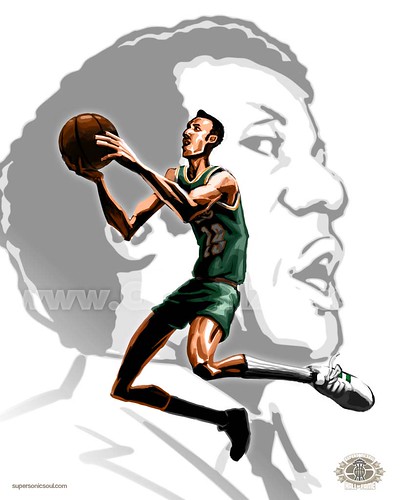
For one generation, he was a 3-time all star, a whirling dervish of a guard who slipped easily from facilitator to dominator.
For another, he was the curly-haired wizard with a Brooklyn accent who improbably guided a group of men to the only championship in Seattle sports history.
For yet another, he was a link from the past, tied tenuously to a corrupt ownership hell bent upon destroying the history he himself played such a vital role in creating.
He was Lenny Wilkens and, in many ways, he embodies the word “Sonic” more than any man.
Think of it thus – the Sonics have had four distinct phases in their existence: Expansion, championship, return to glory, and departure. Lenny Wilkens played a key role in three of those phases: first as the team’s inaugural star, second as the team’s coach in its halcyon days of the late 1970s, and third as the president during Clay Bennett’s destructive reign.
Long-forgotten by today’s fans, Wilkens was a three-time all-star, and was named the game’s MVP in 1971. He recorded the first ten triple-doubles in team history (only Gary Payton had more), was the first Sonic to lead the league in a major statistical category (assists, 1969-70), and held the team record for assists in a single game for more than a decade.
It was a remarkable run as a player (and coach) in Seattle, a run that would only – could only – be surpassed by the heights he reached as the team’s coach.
Everyone knows the story of the championship-era Sonics: of Brown, Johnson(s), Williams, Sikma, Shelton, Silas, and the rest. Wilkens is often a footnote to the tale, standing to the side, arms crossed while the players did the work.
What has been forgotten is how mediocre the Sonics had been before Wilkens took charge in 1977. As a player-coach in the early 1970s, Wilkens had guided the Sonics to a 47-win season in 1971-72 … and got traded. Those 47 wins would not be surpassed by the team until he guided the team again seven years later.
After letting Bill Russell go as coach after yet another 40-odd win season in 1976-77, the Sonics put Bob Hopkins in charge. 17 losses and only 5 wins later, Hopkins was gone, and with the team mired in the Pacific Division basement, Wilkens brought them back, coaching the team to a 42-18 record from then on.
Read those numbers again:
Hopkins: 5-17
Wilkens: 42-18
That’s with the same team, people. Hopkins would have had to go 37-1 to reach the record Wilkens attained with the same group of players.
And it was not merely regular season success, as that group of men reached the pinnacle of playoff heights by losing to the Bullets in the NBA Finals, a loss they would redeem the next season with Seattle’s only championship. The team’s first star became the team’s first coaching legend.
When I think of Lenny Wilkens, though, it is with more sadness than delight. I think of the man forced to subjugate himself to Clay Bennett’s rule, who had to parrot lines he must have believed to be lies just to keep his job. Wilkens ended his NBA life with a less than stellar reputation – he became known as much for self-preservation as for coaching ability – and that saddens me.
At the time of the unfortunate end to his life as a Sonic, Wilkens was chastised in the press for speaking out of turn and making statements that were less than true. Looking back on those times, though, he becomes less of a scapegoat, and more of a man desperately clinging to the reputation he had built over a lifetime of work in basketball.
I hope history will treat Lenny Wilkens more kindly than he was treated in his final days with this franchise, that his immense successes will outweigh his failures, and that his name will be erased from the sullied ending to a once-proud franchise’s life.
For all he gave this city, he deserves it.
For another, he was the curly-haired wizard with a Brooklyn accent who improbably guided a group of men to the only championship in Seattle sports history.
For yet another, he was a link from the past, tied tenuously to a corrupt ownership hell bent upon destroying the history he himself played such a vital role in creating.
He was Lenny Wilkens and, in many ways, he embodies the word “Sonic” more than any man.
Think of it thus – the Sonics have had four distinct phases in their existence: Expansion, championship, return to glory, and departure. Lenny Wilkens played a key role in three of those phases: first as the team’s inaugural star, second as the team’s coach in its halcyon days of the late 1970s, and third as the president during Clay Bennett’s destructive reign.
Long-forgotten by today’s fans, Wilkens was a three-time all-star, and was named the game’s MVP in 1971. He recorded the first ten triple-doubles in team history (only Gary Payton had more), was the first Sonic to lead the league in a major statistical category (assists, 1969-70), and held the team record for assists in a single game for more than a decade.
It was a remarkable run as a player (and coach) in Seattle, a run that would only – could only – be surpassed by the heights he reached as the team’s coach.
Everyone knows the story of the championship-era Sonics: of Brown, Johnson(s), Williams, Sikma, Shelton, Silas, and the rest. Wilkens is often a footnote to the tale, standing to the side, arms crossed while the players did the work.
What has been forgotten is how mediocre the Sonics had been before Wilkens took charge in 1977. As a player-coach in the early 1970s, Wilkens had guided the Sonics to a 47-win season in 1971-72 … and got traded. Those 47 wins would not be surpassed by the team until he guided the team again seven years later.
After letting Bill Russell go as coach after yet another 40-odd win season in 1976-77, the Sonics put Bob Hopkins in charge. 17 losses and only 5 wins later, Hopkins was gone, and with the team mired in the Pacific Division basement, Wilkens brought them back, coaching the team to a 42-18 record from then on.
Read those numbers again:
Hopkins: 5-17
Wilkens: 42-18
That’s with the same team, people. Hopkins would have had to go 37-1 to reach the record Wilkens attained with the same group of players.
And it was not merely regular season success, as that group of men reached the pinnacle of playoff heights by losing to the Bullets in the NBA Finals, a loss they would redeem the next season with Seattle’s only championship. The team’s first star became the team’s first coaching legend.
When I think of Lenny Wilkens, though, it is with more sadness than delight. I think of the man forced to subjugate himself to Clay Bennett’s rule, who had to parrot lines he must have believed to be lies just to keep his job. Wilkens ended his NBA life with a less than stellar reputation – he became known as much for self-preservation as for coaching ability – and that saddens me.
At the time of the unfortunate end to his life as a Sonic, Wilkens was chastised in the press for speaking out of turn and making statements that were less than true. Looking back on those times, though, he becomes less of a scapegoat, and more of a man desperately clinging to the reputation he had built over a lifetime of work in basketball.
I hope history will treat Lenny Wilkens more kindly than he was treated in his final days with this franchise, that his immense successes will outweigh his failures, and that his name will be erased from the sullied ending to a once-proud franchise’s life.
For all he gave this city, he deserves it.
Subscribe to:
Posts (Atom)