Monday, February 18

This Date in Sonic History: Feb. 18, 1977, Slick Watts Goes Off

The 1976-77 season was one of the more unusual in the team's history - featuring the end of the line for both Hall of Fame Coach Bill Russell and popular point guard Slick Watts.

Unlike Russell, Watts wouldn't leave the team until the next season, but his future in Seattle took a inauspicious turn on Friday, February 18, 1977 when he unloaded his frustration about a perceived lack of fair compensation to the local media.

The Sonics were on the road that Friday, and while the on-court results were positive (Slick led the club with 19 points in a win over the New York Nets), Watts used the opportunity to explain that he wanted to be traded - and, boy the Nets and Tiny Archibald sure looked like a great place.

"I've got to get what I'm worth," Watts told a reporter. "I play hard and I do the dirty work and for doin' the dirty work I want to get compensated.... There's seven players on the Sonics makin' more money than I do."
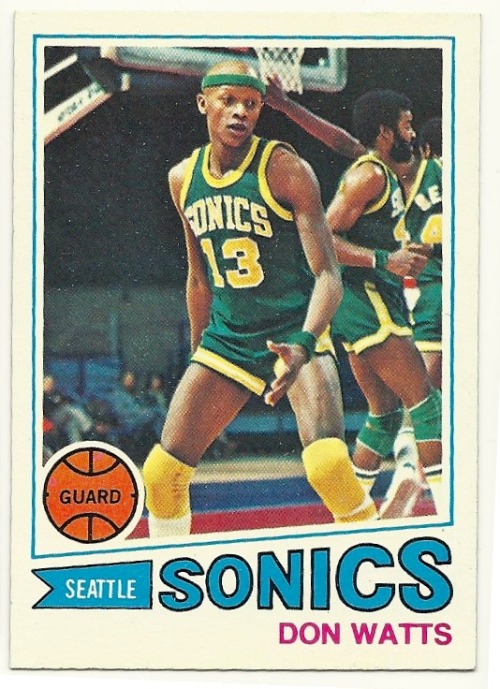
It's easy in 2013 to underestimate how popular Watts was in Seattle in the mid-1970s. Prior to the arrival of the Seahawks and Mariners, Sonic basketball was the only professional entity in the state, and Watts - with his exuberant personality, cocked headband, and exciting play - was the most famous player on the roster. With hundreds of personal appearances a year, Watts was the Sonics.

And yet, his salary didn't reflect it. At $90,000 a year, Watts was making less than such players as Tom Burleson ($310,000), Fred Brown ($200,000) and - worse - Frank Oleynick ($100,000).

When Watts injured his knee during the season he suddenly became aware of his basketball mortality, and how close he was to going from Slick Watts, Basketball Player, to Slick Watts, Insurance Salesman. With that in his head, it didn't take much for Watts to spill his guts to PI reporter Blaine Johnson.

Watts' comments didn't help matters. His new contract - which he hoped would earn him in excess of $200,000 year - never came off, and Watts wound up being dealt to New Orleans for a first round draft choice in the fall of 1977. It was a shocking transformation for the poster boy of Seattle basketball.

Feb. 18, 1977 - the beginning of the end of the Slick Watts Era.

Saturday, February 16

Terence Stansbury

In honor of tonight's dunk contest, here's arguably the greatest dunker (non-Shawn Kemp division) in Sonic history, Terence Stansbury, competing in the 1987 Slam Dunk Contest.

Statue of Liberty, here we come.
(Photo via SI.com).

Friday, February 15

This Date in Sonic History: Feb. 15, 1991


22 years ago today, the Sonics and the Milwaukee Bucks did what all teams do when they have disagreeable superstars – they swapped them.

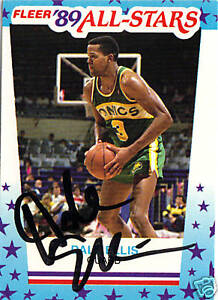
And so it was that Ricky Pierce and Dale Ellis – two of the shootin’-est shooting guards in NBA history – wound up trading uniforms on February 15, 1991 in a straight-up, no-blinking trade that seemed more at home in a fantasy league than in a real one.

The reasons for the trade were, naturally, both financial and emotional. Per The Seattle Times, Ellis had become dissatisfied with his usage under new coach KC Jones, while Pierce was frustrated with Milwaukee’s foot-dragging in contract negotiations.

(Want to feel old? Try this on for size – Pierce’s deal was for $1 million a year. He was looking for something north of $2 million.).

With the benefit of hindsight, we can attempt to figure out who won the deal.

Oddly, even though I’ve always assumed the opposite, Pierce wasn’t that much older than Ellis (perhaps it’s because Ricky Pierce was already 31 when he was born). In any event, neither player wound up lasting too long in their new homes. By 1992, Ellis had been dealt to San Antonio, while Pierce lasted until 1994 before being traded to Golden State. Pierce – famously – bickered with new star Gary Payton during the infamous Denver Nugget Debacle in the 1994 playoffs, a not insignificant coincidence with his trade later that summer.

The two subsequent moves offer one opportunity to judge how the players turned out post-trade. Here’s how they worked out:

To San Antonio: Dale Ellis
To Milwaukee: Tracy Murray (a first round pick that year with the 18th overall selection)

To Golden State: Ricky Pierce, Carlos Rogers, 2 2nd rounders
To Seattle: Sarunas Marciulionis, Byron Houston

It’s difficult to say who’s valuation was higher. Sarunas was coming off consecutive 17+ ppg seasons, but Rogers was an 11th overall pick that helped to sweeten the deal.

Statistically speaking, both players enjoyed long and productive careers, with Ellis even returning to Seattle nearly a decade later (and leading the league in 3-point percentage at the ripe old age of 37!). 

Post-Trade Win Shares
Ellis: 42
Pierce: 29.6

Post-Trade PER
Ellis: 142.7
Pierce: 132.6

Ellis gets a slight edge, but a chunk of that gets erased by the fact he played an extra season relative to Pierce. In all honesty, both players contributed at high levels immediately after the trade, and while Ellis’ numbers were slightly higher, that could be balanced by the fact Pierce started more playoff games in one season (1993) than Ellis did in the entirety of his post-trade career.

Clear winner? None.