Here's a trivia question you can use to stump your friends the next time you're hanging out at Oskar's:
Can you name the six players who have held the title as all-time leading scorer in Sonic history?
(Answer below. Also, a sidebar: Assume for the sake of brevity that the all-time leading scorer race commenced at the end of the inaugural 1968-69 season; otherwise, we wind up with a dozen guys from the first season jockeying for first place and it becomes a jumbled mess).
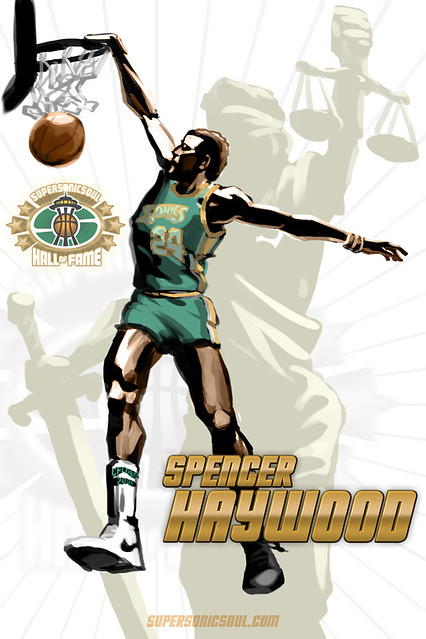
To help you in your decision-making, recall that on Feb. 26, 1978, Fred Brown became the leading scorer in Sonic history, passing Spencer Haywood's old record of 8,131 points. Brown tallied 32 points as the Sonics edged Philadelphia 99-97 in a come from behind victory.
Of note, Coach Lenny Wilkens was ejected for arguing with officials ("I guess I lost my head," the normally placid Wilkens said after the game), the first time in his career (playing and coaching) that he had ever received that dubious honor. Also of note, Philly Coach Billy Cunningham received the heave-ho as well.
Brown provided the winning score with 18 seconds left on the clock just as the 24-second clock was about to expire, helping the Sonics eliminate what had been a 16-point third quarter deficit. The Sixers had three chances to tie the game in the closing moments, but Doug Collins (!), Daryl Dawkins (!!), and Julius Erving (!!!) all came up short.
And now, in case you couldn't come up with the six, here's a handy-dandy graphic with all the details.
That's Walt Hazzard, Bob Rule, Lenny Wilkens, Spencer Haywood, Fred Brown, and Gary Payton, in case you couldn't gather from the photos.
Tuesday, February 26
Monday, February 25
Not on This Date in Seattle Sonics History, But Why Not
Everybody knows about Phil Jackson and his long-suffering back. But did you know that Jackson once missed game action because his back acted up on a bus ride from Seattle to Vancouver, BC?
I sure didn't, until I read this article in the Google news archives. In late December 1968, Jackson and the Knicks were en route from Seattle to Vancouver for a game with the Sonics (the two clubs met first in Seattle, then traveled by I-5 into Canada for a rematch the next day).
Apparently, the bus ride was too much for Jackson, sending him to the hospital (or, as they say in Canada, to hospital). It's worth noting that Jackson played in the Vancouver game, and in fact didn't miss any time until the middle of January, but his pain was enough to eventually sideline him for almost half of the 68/69 season.
I have no idea whether Jackson's now legendary back problems were around before the bus trip to Vancouver, but wouldn't it be something if that trip was what started the whole thing?
I sure didn't, until I read this article in the Google news archives. In late December 1968, Jackson and the Knicks were en route from Seattle to Vancouver for a game with the Sonics (the two clubs met first in Seattle, then traveled by I-5 into Canada for a rematch the next day).
Apparently, the bus ride was too much for Jackson, sending him to the hospital (or, as they say in Canada, to hospital). It's worth noting that Jackson played in the Vancouver game, and in fact didn't miss any time until the middle of January, but his pain was enough to eventually sideline him for almost half of the 68/69 season.
I have no idea whether Jackson's now legendary back problems were around before the bus trip to Vancouver, but wouldn't it be something if that trip was what started the whole thing?
Friday, February 22
This Date in Seattle Supersonics History: Feb. 22, 1971, Spencer v NBA
It was 32 years ago today that Spencer Haywood went from the hardcourt to the Supreme Court, one of the biggest steps in his controversial and crucial case against professional basketball.
Haywood's case has been percolating for a long time, with lower courts initially affirming his right to play. This was affirmed by the 9th US Circuit Court of Appeals on January 26th, but on February 17th, NBA Commissioner Walter Kennedy ruled that Haywood's contract with the Sonics was invalid. Thus, on February 22nd, Haywood and his legal team filed a petition with the Supreme Court so that he could continue his livelihood as a professional basketball player.
It's difficult in hindsight to appreciate how much nonsense Haywood had to go through. He was simultaneously fighting:
A) a lawsuit with the ABA's Denver Rockets, who claimed he was still under contract to them
B) a lawsuit with the NBA about whether he had the right to play before his 'four years removed from high school' bit was up
C) a petition to be able to play while (B) was being resolved
Oh, and he had to travel around the country appearing in different courthouses, as well as being physically ready to play professional basketball.
And he was all of 21 years old.
Eventually, the courts all wound up ruling in Haywood's favor, paving the way for Shawn Kemp, Moses Malone, etc. to play in the league. February 22, 1971, though, was a pivotal first step of that whole process.
(Also, it's Chunkstyle's birthday today, so join me in wishing the best artist I'll ever know a Happy Birthday. Still waiting on that Pulitzer, young man!)
Subscribe to:
Comments (Atom)