 Click to enlarge.

Wednesday, September 3


Tuesday, August 26
Mini-Hiatus

The Supersonicsoul Worldwide Headquarters is observing an extended pre-Labor Day break this week and shall return next Tuesday. See you, as they say in this biz, "after the jump."
Friday, August 22
Reign Forecast for Seattle

As first reported by Brian Robinson at sonicscentral.com, Shawn Kemp will make a - albeit brief - return to KeyArena tonight at 7:30 pm as part of the 3BA basketball league.
Founded by AC Green, the league shrinks the team size from 5-on-5 to 3-on-3 in an attempt to provide fans with more offense and excitement.
(As I recall, this is similar to what happened when Alton Lister and the Sonics used to battle Moses Malone and the Hawks. Those big fellas would often gather for a little confab at one end of the court while the other four players on their respective teams would battle on the other. No sense breaking a sweat if you don't need to, right?)
Anyhow, as I was saying, Kemp will join the roster of the Seattle team tonight against Portland. Alongside the Reign Man will be, among others, Donald Watts and Jamie Booker, while Portland features David Lucas and CJ Miles (Gary Washburn has the full story here).
The game will also be broadcast on FSN on Sunday at 6 pm on a tape-delayed basis. Tickets are available at the stadium, or online here, and range from $4 to $23. Considering the situation, it is about 100% likely this is the last chance anyone will ever see Shawn Kemp play a competitive game in uniform in Seattle. That, to me, despite the odd style of play and the semi-pro atmosphere of the league, makes this a pretty big deal.
Thursday, August 21
Marshall Waived
That's Donyell, not John, in case you wondering. As the headline from cavsboard.com put it, "The Sonics would have traded us Wally and Delonte for some cardboard boxes."
Yes, but only if the boxes had those little holes for you to put your hands in on the side. Otherwise, it would have been no-deal.
Yes, but only if the boxes had those little holes for you to put your hands in on the side. Otherwise, it would have been no-deal.
SSS HOF #5: Nate McMillan
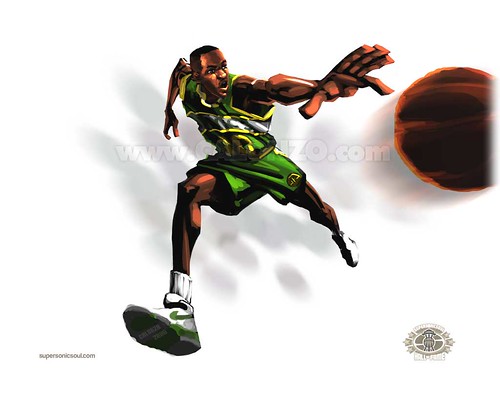
He came to Seattle as unheralded as an autumn rain, a point guard from the other side of the country, plucked from the second round of the 1986 draft by a team fresh off consecutive 51-loss seasons.
That two decades later he would be one of the most, if not the most, beloved players in team history was not just unexpected, it was impossible. What was it about Nate McMillan, a player who never averaged more than 7.5 points in any season, a player who started fewer than 400 games in his dozen-year career, what was it about this man that made him such an essential part of the Seattle Sonic basketball experience?
I’m reminded of a passage from Roger Angell’s “Late Innings,” wherein he tried to explain what made Willie Mays such a joy to behold. “You can take apart a watch, but not a sunset,” Angell finally concluded, leaving the reader to imagine him casting his hands into the hair.
McMillan was no Mays, to be sure, but he was as integral to the Sonics’ success for the 12 years he spent in Seattle as any player in team history. Mac-10 was the ultimate glue guy, the consummate teammate, the type of player any coach in the league would have relished seeing in the locker room before a crucial game.
Twice named to the 2nd-team All-Defensive Team, it was on that end of the court upon which McMillan made his mark in the league. At 6’5”, he could defend either guard – and many small forwards – with ease. To cap off his brilliance as a defender, in 1993-94 McMillan would lead the entire league in steals, averaging three per game.
Even that accomplishment was understated, for a closer look at the top five that season shows just how unbelievable his accomplishment was. The four players who ranked behind Nate that year, starters all, averaged 2,800 minutes apiece.
McMillan played 1,800.
That’s how he was, though, and that’s why we loved him. Other players would have bemoaned their fates after seeing the parade of replacements brought in for him – Sedale Threatt, John Lucas, Avery Johnson, Gary Payton all donned Sonic jerseys during his tenure – but McMillan soldiered on. With the arrival of Payton in 1990, McMillan never again started more than 30 games in a season, and injuries further curtailed his minutes.
But you never heard a peep from him. Like the rest of us, Nate suffered while the Sonics flamed out season after season in the playoffs. Living in Southern California in 1995, I can still painfully recall seeing him with his head in his hands after the Sonics fell to the Lakers in the first round, another 50-win season tossed in the garbage. His angst needed no commentary, his grief at seeing the dying embers of his career smoldering right in front of him needed no explanation.
Living on borrowed time as an NBA player, McMillan had to know time was growing short on his shot at a title. With the Sonics’ ascendance to the promised land in 1996, it should have been his chance to show the rest of the country why Nate McMillan was every bit the defensive player we believed him to be.
Sadly, it was not to be. Waylaid by injuries once again, McMillan watched from the sideline for most of the series. His emotional return to the floor in game four was the impetus behind Seattle’s victory, and I can still hear the standing ovation he received from a delighted KeyArena crowd that night. The Sonics’ failure to capture the title that season was almost secondary, from my viewpoint, to McMillan’s failure to play up to his abilities on the national stage.
At this point, a writer would turn to numbers to aid him in painting the greatness of the one whom he profiles, but going into statistics to explain McMillan’s place in team history is a fruitless task, because his greatness to us belied his numbers. For the same reason Yankee fans loved Phil Rizzutto and Celtic fans loved John Havlicek, Sonic fans loved Nate McMillan, unconditionally and devotedly.
Asking me to explain my affinity for McMillan would be like asking a child why he likes a parade or asking a mountain climber why he likes to stand on a summit. It is a relationship built upon years of successes and failures, upon memories of alley-oops and picked pockets, upon flat-top haircuts, hiked-up socks, and furrowed brows.
Quite simply, I like Nate McMillan because to not like him would never occur to me.
That two decades later he would be one of the most, if not the most, beloved players in team history was not just unexpected, it was impossible. What was it about Nate McMillan, a player who never averaged more than 7.5 points in any season, a player who started fewer than 400 games in his dozen-year career, what was it about this man that made him such an essential part of the Seattle Sonic basketball experience?
I’m reminded of a passage from Roger Angell’s “Late Innings,” wherein he tried to explain what made Willie Mays such a joy to behold. “You can take apart a watch, but not a sunset,” Angell finally concluded, leaving the reader to imagine him casting his hands into the hair.
McMillan was no Mays, to be sure, but he was as integral to the Sonics’ success for the 12 years he spent in Seattle as any player in team history. Mac-10 was the ultimate glue guy, the consummate teammate, the type of player any coach in the league would have relished seeing in the locker room before a crucial game.
Twice named to the 2nd-team All-Defensive Team, it was on that end of the court upon which McMillan made his mark in the league. At 6’5”, he could defend either guard – and many small forwards – with ease. To cap off his brilliance as a defender, in 1993-94 McMillan would lead the entire league in steals, averaging three per game.
Even that accomplishment was understated, for a closer look at the top five that season shows just how unbelievable his accomplishment was. The four players who ranked behind Nate that year, starters all, averaged 2,800 minutes apiece.
McMillan played 1,800.
That’s how he was, though, and that’s why we loved him. Other players would have bemoaned their fates after seeing the parade of replacements brought in for him – Sedale Threatt, John Lucas, Avery Johnson, Gary Payton all donned Sonic jerseys during his tenure – but McMillan soldiered on. With the arrival of Payton in 1990, McMillan never again started more than 30 games in a season, and injuries further curtailed his minutes.
But you never heard a peep from him. Like the rest of us, Nate suffered while the Sonics flamed out season after season in the playoffs. Living in Southern California in 1995, I can still painfully recall seeing him with his head in his hands after the Sonics fell to the Lakers in the first round, another 50-win season tossed in the garbage. His angst needed no commentary, his grief at seeing the dying embers of his career smoldering right in front of him needed no explanation.
Living on borrowed time as an NBA player, McMillan had to know time was growing short on his shot at a title. With the Sonics’ ascendance to the promised land in 1996, it should have been his chance to show the rest of the country why Nate McMillan was every bit the defensive player we believed him to be.
Sadly, it was not to be. Waylaid by injuries once again, McMillan watched from the sideline for most of the series. His emotional return to the floor in game four was the impetus behind Seattle’s victory, and I can still hear the standing ovation he received from a delighted KeyArena crowd that night. The Sonics’ failure to capture the title that season was almost secondary, from my viewpoint, to McMillan’s failure to play up to his abilities on the national stage.
At this point, a writer would turn to numbers to aid him in painting the greatness of the one whom he profiles, but going into statistics to explain McMillan’s place in team history is a fruitless task, because his greatness to us belied his numbers. For the same reason Yankee fans loved Phil Rizzutto and Celtic fans loved John Havlicek, Sonic fans loved Nate McMillan, unconditionally and devotedly.
Asking me to explain my affinity for McMillan would be like asking a child why he likes a parade or asking a mountain climber why he likes to stand on a summit. It is a relationship built upon years of successes and failures, upon memories of alley-oops and picked pockets, upon flat-top haircuts, hiked-up socks, and furrowed brows.
Quite simply, I like Nate McMillan because to not like him would never occur to me.
Wednesday, August 20
Ridnour Relocation
For the entirety of his Seattle Sonic career, Luke Ridnour bore the designation of "bad defense."
Merited or not (and, towards the end, it's safe to say that his poor defensive reputation began to become a bit overdone), ask any Sonic fan which player - Earl Watson or Ridnour - deserved to be the starting point guard, and the answer invariably came back "neither." Instead, we wanted a hybrid of the two: Watson on defense and Frodo on offense.
So, it was with a chuckle that I read this quote from Scott Skiles in the aftermath of Milwaukee's acquisition of Ridnour last week. When asked how the former Sonic will impact the Bucks, Skiles said:
"One way or another, we are going to be a much better defensive team."
Really. I'm not making this up. You can read the whole story here, courtesy Charles Gardner of the Milwaukee Journal Sentinel.
It's slightly stunning, to say the least. Acquiring Ridnour for his defense is a bit like buying a Hummer for its gas mileage or marrying Kim Kardashian for her high moral values.
Or, looked at another way, just how bad was Mo Williams on defense that Luke Ridnour is an improvement?
Merited or not (and, towards the end, it's safe to say that his poor defensive reputation began to become a bit overdone), ask any Sonic fan which player - Earl Watson or Ridnour - deserved to be the starting point guard, and the answer invariably came back "neither." Instead, we wanted a hybrid of the two: Watson on defense and Frodo on offense.
So, it was with a chuckle that I read this quote from Scott Skiles in the aftermath of Milwaukee's acquisition of Ridnour last week. When asked how the former Sonic will impact the Bucks, Skiles said:
"One way or another, we are going to be a much better defensive team."
Really. I'm not making this up. You can read the whole story here, courtesy Charles Gardner of the Milwaukee Journal Sentinel.
It's slightly stunning, to say the least. Acquiring Ridnour for his defense is a bit like buying a Hummer for its gas mileage or marrying Kim Kardashian for her high moral values.
Or, looked at another way, just how bad was Mo Williams on defense that Luke Ridnour is an improvement?
Tuesday, August 19
Local Updates
The Howard Schultz lawsuit against PBC has now been set to begin June 15th, 2009, according to the Seattle Times. Given that that date is still 10 months away, there's plenty of time left for all sorts of emails to surface, on both sides of the courtroom.
In other news, the 3 season ticket holders suing the PBC have turned to an innovative solution to the situation - free tickets to see the Oklahoma City Thunderballs. As reported by Greg Johns in the PI today, the three wish to retain their "priority seat" number, and as the expense of traveling to OKC is greater than the value of the tickets, they want free ducats from the PBC.
If his hair were long enough, I'd bet Clay Bennett would want to pull it out after hearing this latest ploy.
In other news, the 3 season ticket holders suing the PBC have turned to an innovative solution to the situation - free tickets to see the Oklahoma City Thunderballs. As reported by Greg Johns in the PI today, the three wish to retain their "priority seat" number, and as the expense of traveling to OKC is greater than the value of the tickets, they want free ducats from the PBC.

If his hair were long enough, I'd bet Clay Bennett would want to pull it out after hearing this latest ploy.
Monday, August 18
Il Uomo di Reign
After weeks of rumors and speculation, Shawn Kemp officially became a professional basketball player - again - on Sunday, signing with Italian team Premiata Montegranaro to a two-year, 1.5 million hamburger contract.
A few quick notes about Premiata Montegranaro:
1. Team photo here (and, guys, that look was old in 1987)
2. In addition to Kemp, the Montegranarians have also signed former Duck Bryce Taylor
3. Kemp will wear number 40
4. The team's first game will be October 5th against Bologna
5. The population of Montegranaro is about 12,000, a number which may increase exponentially with Kemp's arrival, given Italy's views on birth control
6. Montegranaro is about 2 1/2 hours south of Bologna and 3 hours north of Rome
Hey, the Sonics are gone, is it really that bad of an idea to visit Italy and get a chance to see Kemp dunk for one last time?
"Honey, remember how I was always promising you a trip to see Rome and Florence? Well, let's do it!"
A few quick notes about Premiata Montegranaro:
1. Team photo here (and, guys, that look was old in 1987)
2. In addition to Kemp, the Montegranarians have also signed former Duck Bryce Taylor
3. Kemp will wear number 40
4. The team's first game will be October 5th against Bologna
5. The population of Montegranaro is about 12,000, a number which may increase exponentially with Kemp's arrival, given Italy's views on birth control
6. Montegranaro is about 2 1/2 hours south of Bologna and 3 hours north of Rome
Hey, the Sonics are gone, is it really that bad of an idea to visit Italy and get a chance to see Kemp dunk for one last time?
"Honey, remember how I was always promising you a trip to see Rome and Florence? Well, let's do it!"
That's Not What We Mean by Fiddling
There are bad off-seasons, then there are Vincent Askew off-seasons.
On the heels of Askew's on-again, off-again, on-again coaching tenures in the ABA comes word that the former Sonic has landed in hot water in Miami.
No word on how this will affect Askew's coaching career, such that it is, but I'm guessing his chances of joining his former coach and fellow CBA veteran George Karl on the sidelines (if there were ever any to begin with) went from exceedingly unlikely to Mitt Romney-Duet-with-50 Cent unlikely.
Dare I say, Vincent's off-season has gone slightly askew?
(Hat tip to Hacksaw for the link).
On the heels of Askew's on-again, off-again, on-again coaching tenures in the ABA comes word that the former Sonic has landed in hot water in Miami.
Askew, 42, was arrested by Miami-Dade police on Wednesday and charged with three counts of sexual battery. He is accused of having sex with a 16-year-old girl at a hotel in Florida.
No word on how this will affect Askew's coaching career, such that it is, but I'm guessing his chances of joining his former coach and fellow CBA veteran George Karl on the sidelines (if there were ever any to begin with) went from exceedingly unlikely to Mitt Romney-Duet-with-50 Cent unlikely.
Dare I say, Vincent's off-season has gone slightly askew?
(Hat tip to Hacksaw for the link).
Thursday, August 14
SSS HOF #4: Gus Williams
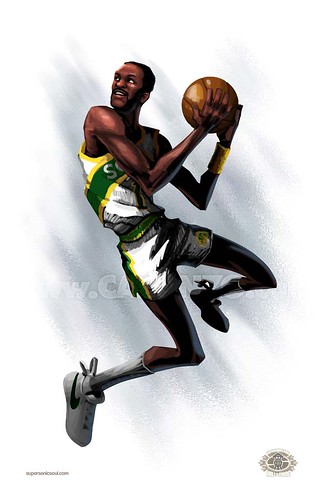
Play word association with some people and when “wizard” comes up, they’ll turn to “Merlin” or “Harry Potter.”
Say wizard to a Sonic fan, though, and you’ll get an entirely different answer.
Gus Williams, to a Seattleite, was and is The Wizard.
And with good reason; while fans raised in the past dozen or so years might be oblivious to Williams’ greatness, those of us who feasted on that magical late-70s run of delicious playoff victories know better.
More than anything I remember from growing up outside of Seattle, I remember Gus’ shoelaces, or the way he tied them. To the rest of the country it’s a trivial bit of NBA history, but to those who grew up with the green and gold, it was an initiation rite. Williams tied his laces behind his ankles, a leftover from a period when his laces were too long. Since the habit started during the Sonics’ run to the NBA Finals, he was reluctant to break it, and before you knew it, every adolescent boy in greater Seattle was copying him.
The loyalty to Gus came from his on-court greatness, though. Williams was playoff-great, posting nearly half of the ten best post-season scoring games in team history and nearly half of the best assist totals.
As further, evidence, consider that in the two consecutive years that the Sonics played in the NBA Finals, they played a total of 39 games.
Gus Williams led them in scoring 19 times.
Even more, in the NBA Finals against the Bullets Williams led the team in scoring in all five games, averaging 28.6 points, a remarkable display of his abilities in the ultimate proving grounds.
Even more remarkable was the fact Williams did all that without the benefit of a 3-point line. In his 477 regular-season games in a Sonic jersey, Williams made the grand total of 22 three-pointers.
That’s right, 22. In fact, in 1981-82, Williams managed to hit 2 of 43 from beyond the arc. 2 of 43! Heck, Olden Polynice could have done that, right?
Well, the NBA was a different league back then. Even Fred Brown, certainly the most renowned long ball shooter in Seattle history, topped out at 39 3’s made in a season, or a good week and a half for Ray Allen.
But I’ve been sidetracked. Gus, DJ, Downtown – they are the touchstone for a generation of Sonic fans. I must have played a million make-believe games on the basketball court in front of my house, nearly all of them as the Sonics, especially the late-seventies Sonics.
And nearly all of those games came down to the same situation – Sonics down by one, seven seconds left, Gus Williams with the ball. Inevitably, he’d sink the winning shot (or, be fouled; the referees were kind to the Sonics in my make-believe world).
I’m not sure why the Wizard became the most imitated player at my house; Dennis Johnson was a better all-around player, Jack Sikma was an all-star center, Fred Brown was a wonderful outside shooter. But he was.
Maybe it was the shoelaces.
Tuesday, August 12
40 Years Gone By
A great piece is up from Sonic legend Spencer Haywood at the NBRPA site at the moment (actually, it’s been up since August 6th, but we roll kinda slow at SuperSonicSoul), detailing the events surrounding his quest for a Gold Medal at the 1968 Summer Olympics in Mexico City. Among other wonderful anecdotes:
- Charlie Scott getting into a fight with the Cincinnati Royals’ Tom Thacker in an exhibition game
- Scott abandoning the team during European exhibitions, then rejoining the team back in the states
- Kareem Abdul-Jabbar, Elvin Hayes, and Wes Unseld all deciding not to participate, thus opening the door for Hayood to play
- The American team enjoying a dinner of horse meat in Kiev, Ukraine
- The Russians forcing all spectators to leave a game the U.S. is winning, then changing the scoreboard from a 26-point American lead to all even
There’s much, much more, and it’s all written in an enjoyable style that makes you feel like you've traveled back in time – very enjoyable.
But it makes me think – would any of that be possible in 2008? I sincerely doubt it. In today’s corporate/athlete world where the NBA players stay in luxury yachts rather than mixing with the hoi polloi, where LeBron James’ Nike salary this year probably exceeds the budget for the entire athletic team in 1968, it’s just not possible for the zaniness which took place 40 years to be recreated in our times.
And, to me, that’s extremely sad. I’ve read how the soccer teams at this year’s Olympics have eschewed using superteams of professionals and, instead, turned to a combination of pros and amateurs, with an emphasis on younger players, a tact I wish FIBA would pursue.
Further, when I think of Harry Edwards convincing basketball players and other prospective Olympians that the moral thing to do is boycott the ’68 games, I wonder, where is the ’08 version of Edwards? Where is the person in authority who decides that swallowing your tongue in the face of an oppressive regime is wrong, that speaking out and taking a stand is right?
A nation turns its lonely eyes to you, Professor Edwards.
- Charlie Scott getting into a fight with the Cincinnati Royals’ Tom Thacker in an exhibition game
- Scott abandoning the team during European exhibitions, then rejoining the team back in the states
- Kareem Abdul-Jabbar, Elvin Hayes, and Wes Unseld all deciding not to participate, thus opening the door for Hayood to play
- The American team enjoying a dinner of horse meat in Kiev, Ukraine
- The Russians forcing all spectators to leave a game the U.S. is winning, then changing the scoreboard from a 26-point American lead to all even
There’s much, much more, and it’s all written in an enjoyable style that makes you feel like you've traveled back in time – very enjoyable.
But it makes me think – would any of that be possible in 2008? I sincerely doubt it. In today’s corporate/athlete world where the NBA players stay in luxury yachts rather than mixing with the hoi polloi, where LeBron James’ Nike salary this year probably exceeds the budget for the entire athletic team in 1968, it’s just not possible for the zaniness which took place 40 years to be recreated in our times.
And, to me, that’s extremely sad. I’ve read how the soccer teams at this year’s Olympics have eschewed using superteams of professionals and, instead, turned to a combination of pros and amateurs, with an emphasis on younger players, a tact I wish FIBA would pursue.
Further, when I think of Harry Edwards convincing basketball players and other prospective Olympians that the moral thing to do is boycott the ’68 games, I wonder, where is the ’08 version of Edwards? Where is the person in authority who decides that swallowing your tongue in the face of an oppressive regime is wrong, that speaking out and taking a stand is right?
A nation turns its lonely eyes to you, Professor Edwards.
Friday, August 8
Xavier McDaniel, pt.2

(photo courtesy of Michael Richardson. See also the X vs. Bennett version.)

Xavier McDaniel was my first superstar man-crush. Sure, I worshiped Julius Erving, but by the time I was old enough to go to a game, Dr. J was already in his Spalding comic book ads / “The Fish That Saved Pittsburg” era. Besides, Erving belonged to another city far away. In the early eighties we had . . . Sikma. Then X arrived.
In 1985, Xavier McDaniel was new. He was hip. He was on the cover of “The Rocket”! He was the Mr.T of Seattle basketball. After the rapid decline following the championship year, X-man was our b-ball savior, set to bring us back to the Promised Land.
It didn’t quite work out that way. It turns out bad-ass small forwards with sweet turnarounds and mean left hooks aren’t the magic ingredients for a championship. X had some tough years. But then, there was 1987. My favorite year in Sonics history. The pundits didn’t think we had a single good player on that team. They were right. We had three.
Tom Chambers, Dale Ellis and Xavier McDaniel formed the mightiest three-headed, ball-hogging, shoot the lights out monster Seattle has ever seen. The Sonics barely snuck into the playoffs, but they managed to knock-out the best team in the west, the Mavericks, then beat the twin towers of Houston in a nail-bitter. And what did our boys get as a reward? The chance to face the showtime Lakers. Ugh. Let's skip that part.
X was the heart of that team, and in that brief era between Gus and Griffey, he was the biggest star in Seattle.
Some things you might not know about X:
- He provided motion capture moves for NBA Jam 2000 (!) for the N64
- He was on Married with Children
- He's not very good at tennis
Essential Xavier McDaniel links:
X-man in Singles
X-man's college highlights
X-man at the (sniff-sniff) Save Our Sonics rally
More X-man videos
Subscribe to:
Posts (Atom)