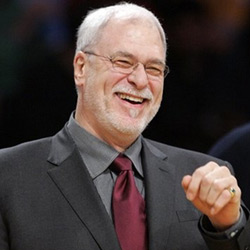
Not sure where this fits in an NBA blog, but am I the only one who feels his skin crawl when Roy Williams smiles?
I really had little interest in this year's tournament (its boringness has been dissected elsewhere), but when Williams and UNC appeared on the screen Monday night, well, it was quite easy to find a rooting interest.
At one time, there were NBA coaches who generated that sort of animosity (this guy for one; maybe him; and this fella bugged a few people a decade ago, but not so much anymore), but that era has sort of ended, no? Of the 30 coaches working right now, is there anyone who gets people riled up?

Tuesday, April 7


Monday, April 6
Not Quite Right
Last year, a friend of mine recommended I read Daniel Yergin's "The Prize," an exhaustive study of the petroleum industry, from the 1800s to today. (How exhaustive? Try 928 pages.)
After slogging through the first quarter of the book, I came to Yergin's analysis of World War I, and how oil played a role in that horrific bloodbath. I was especially interested, in that I had spent the past year reading every book I could on WWI (don't ask; I get obsessed with weird topics sometimes).
Sadly, Yergin's focus on tanks and supply lines was totally out of whack with the facts, and it ruined the rest of the book for me. While previous to that point of the story I was swallowing everything he wrote, all subsequent chapters came with hesitation in my eyes. After all, if he could be so wrong about the section which I knew alot about, how wrong was he about the rest?
That's a rather long-winded reference to this piece from ESPN's Tom McKean at TrueHoop today. McKean compiles a list of teams that failed to win championships despite posting phenomenal regular season records over an extended period of time.
And, yes, your favorite basketball team is right there, sandwiched between the Blazers and the Knicks. I won't repeat everything McKean wrote (you should read the article in its entirety), but I will copy this portion:
[emphasis added]
To which my astonished inner reader responded, "Uh, come again?" Is his contention that the reason the Sonics failed to win a championship during George Karl's tenure was Michael Jordan?
Think back to that time frame. When Wally Walker canned Karl, was it because he lost to the Bulls in the NBA Finals, or because the Sonics imploded in the first round so often? Obviously, it was the latter, right?
I don't mean to belittle McKean's article, and I'm sure he spent a considerable amount of time culling together candidates for the story, but, as I did when reading The Prize last year, I was left with a slightly bewildered and disappointed feeling after I read it. If he can be that wrong about a crucial element of the Sonics' failure, how wrong is he about the rest of the article?
After slogging through the first quarter of the book, I came to Yergin's analysis of World War I, and how oil played a role in that horrific bloodbath. I was especially interested, in that I had spent the past year reading every book I could on WWI (don't ask; I get obsessed with weird topics sometimes).
Sadly, Yergin's focus on tanks and supply lines was totally out of whack with the facts, and it ruined the rest of the book for me. While previous to that point of the story I was swallowing everything he wrote, all subsequent chapters came with hesitation in my eyes. After all, if he could be so wrong about the section which I knew alot about, how wrong was he about the rest?
That's a rather long-winded reference to this piece from ESPN's Tom McKean at TrueHoop today. McKean compiles a list of teams that failed to win championships despite posting phenomenal regular season records over an extended period of time.
And, yes, your favorite basketball team is right there, sandwiched between the Blazers and the Knicks. I won't repeat everything McKean wrote (you should read the article in its entirety), but I will copy this portion:
In 1996, Seattle reached the NBA Finals, but fell to the Bulls in 6 games. During that era, to be the best, a team most likely had to go through Chicago, and the problem was that Seattle was 4-12 against the Bulls between 1991-98 when Michael Jordan played, including playoff games.
[emphasis added]
To which my astonished inner reader responded, "Uh, come again?" Is his contention that the reason the Sonics failed to win a championship during George Karl's tenure was Michael Jordan?
Think back to that time frame. When Wally Walker canned Karl, was it because he lost to the Bulls in the NBA Finals, or because the Sonics imploded in the first round so often? Obviously, it was the latter, right?
I don't mean to belittle McKean's article, and I'm sure he spent a considerable amount of time culling together candidates for the story, but, as I did when reading The Prize last year, I was left with a slightly bewildered and disappointed feeling after I read it. If he can be that wrong about a crucial element of the Sonics' failure, how wrong is he about the rest of the article?
Bird, Magic and the '79 Supersonics
 1979. For Sonics fans, that means one thing: The Championship Year. For the rest of the basketball world, however, it also marks the beginning of the Bird/Magic era.
In the new book When March Went Mad: The Game That Transformed Basketball
 , author Seth Davis takes a look at the game that put basketball on the map: the 1979 NCAA championship match-up between the Michigan State Spartans and the Indiana State Sycamores.
The book starts out with a group of TV execs arguing about how to cover the big game. After some angry words, they finally agree to focus almost exclusively on the two stars of the game, Michigan State's Magic Johnson and Indiana State's Larry Bird. Unprecedented at the time, this kind of "superstar" promotion was soon picked up by the NBA (something David Stern is always quick to take credit for) and the rest, as they say, is history.
Davis does a great job of not only delving into the behind-the scenes shenanigans, but also taking a closer look at Bird and Magic during an era when few of us knew them.
In the book, Davis also mentions how in 1979 no one was paying attention to basketball, and even the NBA Finals were shown on tape-delay. Yes, the Sonics' only championship was relegated to the late-night realm of infomercials. Sigh.
Despite this depressing history lesson, When March Went Mad
is a terrific book and highly recommended for hoop nerds of all ages.
Subscribe to:
Comments (Atom)