Monday, October 6
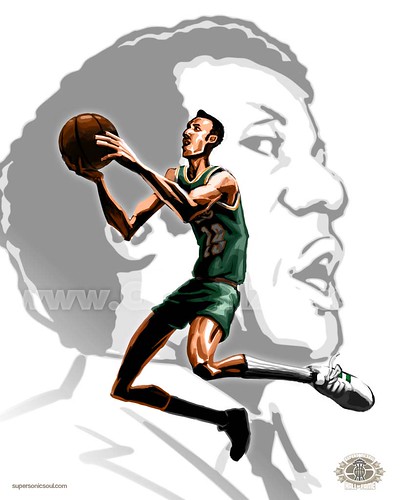
Where Are They Now? Art Harris
Take Art Harris.
If you’re like me, the name Art Harris draws a blank. Bob Love? Check. Spencer Haywood? Duh. Tommy Kron? Foggy, but I know the name.
But Art Harris? No dice.
Well, let’s fill in a few of the blanks.
- Born Arthur Carlos Harris, Jr. in Los Angeles on January 13, 1947
- Graduated from Jordan High School, the same high school in Watts which produced Florence Griffith Joyner and Charles Mingus
- One of Stanford’s most prolific scorers, named All Pac 8 as a sophomore
- Averaged 20.7 ppg for the Cardinal in 1967-68, including a couple of 30+ point outings
- Named a member of Stanford Athletic Hall of Fame
- 17.2 ppg career average is 7th best in school history
- Drafted by Sonics in second round of 1968 draft
- Averaged 12 ppg his rookie season
- Led NBA in disqualifications
- Named to All-Rookie First Team, the only Sonic guard ever to receive that honor
- Played only 5 games for Sonics in 1969-70 before being traded on Oct. 25 to Phoenix for Dick Snyder
- Remained in Phoenix for the next three seasons, then out of the league
And, finally
- October 2007, Art Harris RIP
I came across Harris’ passing on the NBA’s Retired Player Association website a year ago, and meant to pursue a story about him for the past twelve months. Occasionally, I would dig a little bit into his past, but I never got very far. Always, I thought, there’d be time to find out more.
Now a year has passed since Art Harris died, and I still don’t know anything more about him.
Here he was, a kid from Watts, who got a scholarship to Stanford, one of the greatest academic institutions in the entire country, goes on to make the NBA’s All-Rookie team, gets traded to Phoenix, then fades from memory.
What happened to Art Harris? What did his post-NBA life entail before he died at age 60? The NBRPA doesn’t even know the exact date of death, only a vague “mid-October” with no mention, either, of the location. The Stanford University site equally draws a blank, not even reporting his death until three months later, while the Seattle Times and PI were completely silent about the event.
Look at that team photo from 1968-69. Harris is the second from the far right, right next to Lenny Wilkens. Oddly, while all the other players were staring right at the camera, Harris stares to his right, his face in profile. Was he laughing at a joke from Bob Rule? It's as if, 40 years later, he's trying to make himself even more of an enigma.
Hey, I get it, he was an obscure player on an expansion team going nowhere. But couldn’t you say the same thing about Jeff Green? Sure, it’s possible Green will go on to greatness in the NBA, but the odds are more likely that within 5-8 years he’ll be long-gone from this league. Will his death 40, 50, 60 years from now pass as quietly as Harris?
A beautiful aspect to the internet is the way it facilitates communication. Perhaps someone reading this site will unearth a kernel of information, which will blossom into a full-blown story. Hopefully, someone out there can educate me as to what happened to Art Harris. Feel free to email us (see the top of the page), or fire off a comment below.
Cheer Up ...
You could have lost $82,000,000 in the stock market today.
Friday, October 3
Danger, Politics Ahead
Bill Walton. Like Walton, she talks alot, is very folksy, and occasionally makes an intelligent point, but those points are so diluted by all the other garbage coming of Walton/Palin's mouth(s) that they are never heard.
Aubrey McClendon: Part III
Let me blunt – I don’t like McClendon. I don’t think anyone reading this site would struggle to understand that, any more than they would struggle to understand my reasons. He’s a cold, manipulative man who believes the government has every right to interject itself into marriage, that privacy laws are as disposable as toilet paper, and that the environment is as easily replenished as his vast wealth.
Most importantly, he has no qualms with stealing a franchise that resided in Seattle for 40 years, just because his hometown needed something to do in the winter other than watch Sooner football DVDs.
But that’s a side issue for today – this is a free nation, and the Sonics don’t belong to Seattle any more than the raindrops which fall from the sky.
Today, I want to explore the sickening relationship between McClendon’s immense wealth and his complete lack of interest in using that wealth to help whichever city his team calls home.
Let us look, first, and some of the expenses McClendon has incurred in the past two years:
1. $400 million, to state of West Virginia in damages from lawsuit
2. $1.3 billion, decrease in value of his shares of Chesapeake Energy
3. $40 million, to purchase a plot of land in Michigan, upon which he will spend hundreds of millions to build a new housing development
And now let us look at, second, how much money he has spent assisting the cities which house the Sonics/Thunder in building new stadiums:
1. $0
It is a disgraceful commentary on McClendon and Clay Bennett that they can withstand the costs listed above without so much as a blink of an eye, yet when they are asked to contribute to the very buildings in which their teams will play, they run in the other direction faster than Jerome James chasing a box of doughnuts.
Further, it is a damning tribute to David Stern that he spit upon a group of investors in Seattle which was willing to contribute hundreds of millions towards building an arena here, all the while heaping praise upon Bennett and McClendon, who have yet to spend one penny of their fortunes on building new stadiums.
Tim Keown wrote recently at espn.com about how the economic malaise facing the U.S. may spell the end of publicly financed stadiums. While his words are, in my view, wishful thinking, I pray that he is correct.
The time has come for this country to quit subsidizing billionaires on the backs of taxpayers. If stadiums were such a great investment – as owner after owner tells city after city – then why are there so few owners willing to build stadiums? They certainly have no trouble coming up with the hundreds of millions to purchase the team, so why can’t they come up with at least part of the money needed to house them?
The answer is simple – because they play us for fools.
As Keown wrote, if no other benefit arises out of this meltdown in the U.S. economy, perhaps it will be worth it if people such as McClendon are finally forced to part with some of their cash, and the government gets out of the business of stadiums.
Thursday, October 2
SSS HOF #8: Lenny Wilkens

For another, he was the curly-haired wizard with a Brooklyn accent who improbably guided a group of men to the only championship in Seattle sports history.
For yet another, he was a link from the past, tied tenuously to a corrupt ownership hell bent upon destroying the history he himself played such a vital role in creating.
He was Lenny Wilkens and, in many ways, he embodies the word “Sonic” more than any man.
Think of it thus – the Sonics have had four distinct phases in their existence: Expansion, championship, return to glory, and departure. Lenny Wilkens played a key role in three of those phases: first as the team’s inaugural star, second as the team’s coach in its halcyon days of the late 1970s, and third as the president during Clay Bennett’s destructive reign.
Long-forgotten by today’s fans, Wilkens was a three-time all-star, and was named the game’s MVP in 1971. He recorded the first ten triple-doubles in team history (only Gary Payton had more), was the first Sonic to lead the league in a major statistical category (assists, 1969-70), and held the team record for assists in a single game for more than a decade.
It was a remarkable run as a player (and coach) in Seattle, a run that would only – could only – be surpassed by the heights he reached as the team’s coach.
Everyone knows the story of the championship-era Sonics: of Brown, Johnson(s), Williams, Sikma, Shelton, Silas, and the rest. Wilkens is often a footnote to the tale, standing to the side, arms crossed while the players did the work.
What has been forgotten is how mediocre the Sonics had been before Wilkens took charge in 1977. As a player-coach in the early 1970s, Wilkens had guided the Sonics to a 47-win season in 1971-72 … and got traded. Those 47 wins would not be surpassed by the team until he guided the team again seven years later.
After letting Bill Russell go as coach after yet another 40-odd win season in 1976-77, the Sonics put Bob Hopkins in charge. 17 losses and only 5 wins later, Hopkins was gone, and with the team mired in the Pacific Division basement, Wilkens brought them back, coaching the team to a 42-18 record from then on.
Read those numbers again:
Hopkins: 5-17
Wilkens: 42-18
That’s with the same team, people. Hopkins would have had to go 37-1 to reach the record Wilkens attained with the same group of players.
And it was not merely regular season success, as that group of men reached the pinnacle of playoff heights by losing to the Bullets in the NBA Finals, a loss they would redeem the next season with Seattle’s only championship. The team’s first star became the team’s first coaching legend.
When I think of Lenny Wilkens, though, it is with more sadness than delight. I think of the man forced to subjugate himself to Clay Bennett’s rule, who had to parrot lines he must have believed to be lies just to keep his job. Wilkens ended his NBA life with a less than stellar reputation – he became known as much for self-preservation as for coaching ability – and that saddens me.
At the time of the unfortunate end to his life as a Sonic, Wilkens was chastised in the press for speaking out of turn and making statements that were less than true. Looking back on those times, though, he becomes less of a scapegoat, and more of a man desperately clinging to the reputation he had built over a lifetime of work in basketball.
I hope history will treat Lenny Wilkens more kindly than he was treated in his final days with this franchise, that his immense successes will outweigh his failures, and that his name will be erased from the sullied ending to a once-proud franchise’s life.
For all he gave this city, he deserves it.
Wednesday, October 1
Aubrey McClendon: Behind the Music, Part II
After seeing his investment in Chesapeake Energy drop more than one hundred million dollars on Monday, the co-owner of the Oklahoma City Thunder recouped his losses on Tuesday as CHK shares went up more than three points, earning McClendon an estimated $110 million within 24 hours.
But, as Lyndon Johnson famously drawled to a colleague more than 40 years ago, chicken salad can turn into chicken shit awful fast.
And it’s that propensity for precariousness that has some investors more than a little concerned about the overall health of Chesapeake.
Within the past month, McClendon’s company has:
- Reported a second-quarter loss of $1.65 billion, down from a profit of $492 million the previous year
- Announced a cut in natural gas production, including cutting rig counts
- Seen a drop in natural gas prices of close to 40%
- Announced that the shale deposits Chesapeake so zealously drilled in Barnett are “ramping down”
For many, it’s no cause for concern, and Chesapeake’s stock is still considered a strong buy for many investors. But for others, it is a little alarming. As a commenter at theoildrum.com noted: “If [Chesapeake] is pulling the plug on [its drilling operations] they better have something in the wings to replace their rapidly declining reserve base. Otherwise they've just announced to the world that their stock is worthless except for its breakup value.”
Many suspect that McClendon’s reasoning for curtailing production comes in the wake of the widespread credit crunch facing North America, but Business Week magazine weighed in with another possibility: that the trading methods practiced by large producers such as Chesapeake undermined the profits those companies made from drilling natural gas.
Essentially, because Chesapeake, and other companies like them, trades oil based on future prices, the constant hedging can often be disastrous, even when gas prices are soaring. As industry analyst Stephen Schork told the magazine after natural gas prices changed this summer, “A lot of people got creamed.”
Further, the magazine noted, there is the anxiety that Chesapeake wasn’t merely trading futures – hedging, if you will – for protection, but for profit. That’s great so long as prices fall in the future, but if that’s not the case, Chesapeake will be forced to pump out more gas to make up the difference, something that isn’t always as possible as it would like.
As the now bankrupt leaders of SemGroup can say with certainty, shorting energy prices isn’t always the wisest move for a company to take.
Simultaneously, a severe drop in natural gas prices can obviously be painful as well. And while natural gas was an attractive alternative fuel when oil was trading at $150 a barrel, it doesn’t look like such a great option when oil drops to less than $100.
With oil falling and natural gas increasing, the natural gas energy would seemingly be in desperate straights. What would be needed to strengthen the price of natural gas then, and, consequently, Chesapeake Energy? Well, how about a plan to get the government to subsidize the wholesale conversion of U.S. automobiles away from petroleum to natural gas? Heard anything about that idea? I thought you may have.
Nonsense ideas about “liberating” America from Middle Eastern oil aside, Chesapeake still faces tough situations stateside. It appears Chesapeake is hoping that its sizable (though dwindling) cash reserves will enable it to withstand any short-term reductions in revenue, unlike the smaller drillers out there who will be unable to hold out for long. Inevitably, the plan goes, the smaller concerns will prostrate themselves at McClendon’s altar, and Chesapeake will buy them up.
All of these financial shenanigans keep Aubrey McClendon a busy man – but not too busy.
When he’s not manipulating the Fort Worth city government into allowing him to put more oil wells within the city limits, hoodwinking the Sierra Club into thinking that his Clean Skies Foundation is anything but a front for drilling for more natural gas, or attempting to pass an “alternative fuels” initiative in California that would cost taxpayers upwards of 10 billion dollars – money that would flow directly to McClendon and Pickens, McClendon is making grandiose promises about future drilling sites, promises intended to buck up his stock’s plummeting value.
“Recent large discoveries using new technologies in natural gas shale basins such as the Barnett, Haynesville, Fayetteville, Woodford and Marcellus have provided new evidence that our country has ample natural gas supplies to power America’s economy for more than a century,” McClendon wrote earlier this year, neglecting to mention that he himself stated that the Barnett reserve has already reached its “high-water” mark.
It’s certainly possible that Chesapeake and McClendon will weather the storm surrounding energy prices and the credit markets, and that the company will snap up enough independent producers of natural gas to maintain an equilibrium. But it is also possible that McClendon’s wheeling and dealing may come back to bite him.
It’s that possibility we’ll look at Friday when we explore why all of this energy mumbo-jumbo matters to readers of a Sonics blog.
Monday, September 29
Aubrey McClendon: Behind the Music
At the time, ol' Chesapeake was ridin' high (to use the vernacular of the locals), while Starbucks was lower than the broken axle of a prairie schooner in September (I'm just winging it now).
Since then, though, the money in Mr. McClendon's pocketbook has found a bit more room with which to roam around. The chart below traces Chesapeake’s value for the past three months.

As you can see, the partial owner of the Thunder has seen his shares plummet in value from $70 in July to $32 in September. Considering McClendon personally owns close to 34,000,000 shares, that’s a decrease in his net worth of more than one billion dollars.
Ah, you say, but surely McClendon acquired his shares back in the halcyon days of Chesapeake, and while the value has sunk recently, it is still far above what he paid for it way back when.
Ah, but you would be wrong, because your man Aubrey has purchased close to 2 million shares in the past three months, most of them at a price of between $55 and $60 a pop. Even those limited shares, less than 10% of his holdings and only purchased in the time it took to move the Sonics from Seattle to Oklahoma City, have cost McClendon $45 million in losses.
(And isn’t it amusing how McClendon so readily spares $120 million to purchase shares of his energy company, but was incapable of contributing a single dime to the renovation of KeyArena? Reminds one of the CCR song, Fortunate Son: “Some folks are born with silver spoons in hand/Lord, don’t they help themselves/But when the tax man comes to the door/Lord, the house looks like a rummage sale.”)
It also doesn’t help matters when CHK announces plans to cut drilling by 17% in the coming year, or when the price of natural gas drops by 50% since the Sonics relocated to Oklahoma City, delivering a lethal blow to the future health of the company. As you will see, though, losing $45 million in stock value would be the least of McClendon’s troubles in the past few years.
UNION DUES & BLUES
This past August, the United Steelworkers union held a rally at a West Virginia business park. Their target? Chesapeake and Aubrey McClendon. Among other complaints, the union accused the company of shirking its duties and short-changing long-term employees of their pensions and benefits, charges Chesapeake denies.
“Chesapeake is in the best financial condition of all these [natural gas] companies to take care of their employees. They just don't want to do it," a representative of the union charged. "Any money Chesapeake doesn't pay out in royalties or severance tax and employee wages and benefits is sucked right out of [the employees’ savings] and right into Aubrey McClendon's pocket.”
The straw that stirred the drink for the union workers, though, was another broken promise from Chesapeake.
In 2006, the company held a ground-breaking ceremony for a regional headquarters building, a massive project which would utilize numerous steelworkers. A project so important, West Virginia’s governor touted the gloriousness of it – and of Chesapeake – on his official website.
Since that groundbreaking, though, the atmosphere changed dramatically, especially when a jury found that Chesapeake and its subsidiaries (the tentacles of CHK are straight out of an Upton Sinclair wet dream) and another natural gas company had cheated the county out of unpaid gas royalties.
Essentially, a gas producer later bought by Chesapeake extracted natural gas from property owner’s land, but failed to inform them of the “true value of gas being extracted.” In other words, they told Joe Mountaineer that the gas they were taking out of his backyard was worth $20, when in reality it was worth double or triple that.
You can imagine how the jury reacted to the case. When they finally got finished adding in the total for punitive damages, McClendon’s company was looking at a fine of more than $400 million. Naturally, McClendon balked at the exorbitant sum of money, and Chesapeake appealed the ruling to the Supreme Court of West Virginia, to no avail.
Taking a line from the Clay Bennett Handbook, Chesapeake reneged on its promise to build the magnificent facility it had promised only a year before and scratched the whole regional headquarters, leaving the state, hundreds of employees, and their families twisting in the wind.
SAND MAN
When he’s not busy breaking promises in Appalachia, McClendon keeps busy on other fronts. In the past few months, his battle with the residents of the Northern Michigan town of Saugutuck over his proposed redevelopment of one of the last remaining pristine portions of the Michigan shoreline has garnered even more attention.
Two years ago, the residents had raised $40 million to buy a large piece of land from a local resident, hoping to stave off McClendon’s plans to put McMansions all over it.
[As an aside, in one of the first stories most of us read about McClendon, in the Journal Record by way of Henry Abbott’s TrueHoop, we see how he loves taking trips on his jet ski. It was from that jet ski that McClendon first spied Saugutuck in 1989, planting the seed in his mind to eventually redevelop the huge chunk of land.]
But back to our story. Our boy Aubrey, no fool he, plunked down $43 million, lobbied the state government to relax the state law limiting development on sand dunes which would hinder his development plans, and – when he’s not calling the residents of the area “completely dysfunctional” – now plans to go ahead with his project.
There is another, more salacious bit to this story as well. While to the many Saugatuck is merely a beautiful, pristine part of the Western Michigan landscape, to another group of society, it is much more. An “unofficial gay beach,” McClendon’s planned redevelopment would obliterate a popular destination for gay tourists. Considering that McClendon is an avid supporter of the “Americans United to Preserve Marriage,” is that merely a coincidence?
Difficult to say, but certainly an eerie coincidence.
Of course, given the state of the housing market in the U.S. these days, perhaps the best alternative is for McClendon to spend five years developing the site, only to find the folks willing to buy into his paradise will resemble the number of free agents willing to relocate to Oklahoma City.
WEDNESDAY
How McClendon’s manipulation of his company’s stock price is beginning to worry investors.
Kemp Says Ciao
Kemp's letter to the club is on the team's website, but it's not too illuminating as to what caused the breakup. His written reason is "personal problems" back home in Houston, but the smart money is more on the physical conditioning of the Reignman more than anything else.
But if you think about it, in a year where the Sonics were ripped from this city with the delicacy of a frontal lobotomy, is it any surprise that one of our heroes falls short as well? What's next, a story revealing that Jack Sikma curled his hair in the lockerroom before games? That Slick Watts was never really "slick" at all? That Gus Williams was not really a wizard, but merely a sorceror's apprentice?
Friday, September 26
Arrivederci, Reignman?
Now, basketcentral.com is reporting that Kemp's excuses for returning to the U.S. are beginning to mount, and that "voices in the corridor" are speaking of his imminent release from the team. Essentially, while Kemp's frequent departures to the U.S. may be the reason given for his release, the reality is that his physical condition is not up to par for the Italian League.
It's a surprising development, true, but like everything in Italy, things are not always as they seem, and while at the moment it may appear that Kemp's days with Premiata Montegranaro are dwindling, that perception could change in a heartbeat.
SSS HOF #7: Jack Sikma

Jack Sikma, Harpers Index-style
Points scored by Jack Sikma in his Sonic career: 12,034
Points scored by Alton Lister, Jim McIlvaine, Olden Polynice in their Sonic careers, combined: 4,245
Number of 3-pointers made by Sikma in the first 11 years of his career: 7
Number made in the next three: 196
Number of playoff games Sonics played in Sikma’s first three years: 54
Number in the next 10 years: 47
Number of years Sikma averaged 10 or more rebounds per game in the playoffs: 6
Number of times since he was traded a Sonic center has done so: 3
Amount Sikma earned in his career as a player: $13,497,000
Amount Wally Szczerbiak earned last year: $12,275,000
Number of blocks by Alton Lister, for whom the Sonics traded Sikma, in his three years in Seattle: 500
Number by Sikma in those three years: 231
Number of points Sikma scored: 3,465
Number for Lister: 1,989
Number of categories in which Sikma ranks among Seattle’s top 10: 22
Number of categories in which Lister does: 1
Number of times Sikma was dunked on by Shawn Kemp and made to look like a punk: 0
Wednesday, September 24
Kemp Update
Unfortunately, there still isn’t too much to tell.
Kemp's new team, Premiata Montegranaro, just completed a tournament in Scafati this weekend(they went 0 for 2), but while fellow American Bryce Taylor (Go Ducks!) suited up and scored 26 points in two games, Kemp did not make it onto the court in either game, despite warming up before the game.
It’s difficult to get much information as to what is going on over there (any SuperSonicSoul readers in Italy want to shed some light on this situation?), but considering that there is YouTube evidence of Kemp warming up at another Premiata game (or is it a practice?), his debut must be imminent.
But put that on the back burner for now, for we have a press conference to pore over, with all sorts of enjoyable bits of information to digest.
Picture the scene in your mind – Kemp, surrounded by a gallery of 5’9” men with dark, curly hair, gesticulating at him while they shout questions in a language he cannot comprehend. There’s a poorly made Billy Crystal movie in their somewhere I think …
Back to the press conference. I’ll forgive you for not reading over the lengthy details, and provide you a quick recap of what Kemp, and his fellow conferencees had to say.
- It appears jersey numbers typically only go up to #20 in the Italian leagues, but Premiata was able to get a special exemption for the Reign Man to wear #40.
- In response to a question to his being “discriminated” against by NBA teams because of his weight, Kemp provided a thoughtful answer: “I do not know if they discriminated me but I think I personally, I think I've put myself in bad, bad positions.”
- The Mayor of Porto San Giorgio makes the suggestion for Kemp to live in his town, because it is “full of the fish” and “you do not gain weight eating fish.” At this point, the Mayor was escorted from the table by two gentlemen named Luigi and Bruno.
- From Kemp: “I do not know whether to buy a house in Porto San Giorgio but I can promise you that buy another Ferrari before leaving . I love the sea, the view of the ocean. There are so many differences with the U.S. beaches ... some of which are highly polluted, crowded and then see this sea is spectacular. I look forward to here in the future, my family, my wife and my children to see him Montegranaro.”
- Kemp’s answer prompted this question from Andrea Tosi of La Gazzetta dello Sport.
Tosi: How many kids? How many kids? Quanti figli?
Kemp: I got 3 boys at home.
Let’s just leave it at that.
Friday, September 19
Spencer Haywood: 5 Things
Five things you may not have known about Spencer Haywood.1. He spent one year at Trinidad State Junior College in Colorado before transferring to the University of Detroit.
2. Was married to Iman, giving me the excuse to run the picture at the top of this post.
3. Won a championship ring with the Lakers in 1980. The team the Lakers knocked off to reach the Finals? The Seattle SuperSonics.
4. His 29.2 points per game in 1972-73 remains a Seattle record to this day.
5. Kareem Abdul-Jabbar was the best man at his wedding to Iman.