Monday, July 28

Trading Cards

Growing up a baseball fan, I collected baseball cards, naturally.

Well, perhaps “collected” isn’t the correct verb. A more apt description of my activities would be “obsessively acquired,” although even that falls short of the level of activity. Reading the backs of those flimsy pieces of mass-produced pieces of cardboard – oh, it was a joy, maybe even more so than the eerie visages peering out from the front.

Born in the early 70s, I didn’t begin collecting until the late 70s, and my knowledge of baseball history at that age was limited. So I was puzzled as to why a whole group of men played for Cincinnati – Rose, Perez, Griffey, et al – and then left so suddenly. Or why Sal Bando, Bert Campaneris, Reggie Jackson, and Joe Rudi all quit playing for the A’s in the mid 1970s.

But the best was finding players with a “Senators” or “Washington” marker on their career statistics. To a young boy in the early 1980s, the Washington Senators were as mysterious as the Whig Party, an unknown entity only revealed through reading Toby Harrah’s curriculum vitae. What happened to the Washington Senators?, I wondered. Were they a latter-day incarnation of Jamestown, wiped from the face of baseball by some unexplained calamity?

I experienced this same phenomenon when the Vancouver Grizzlies left my adopted home a decade ago, and the scattered Sons of Vancouver began to disappear from the face of the NBA. A Michael Dickerson here, a George Lynch there ... before long, the majority of them had vanished into the land of memory. (Barring a Felipe Lopez sighting, there are six former Vancouverites still on NBA rosters: Shareef Abdur-Rahim, Mike Bibby, Aaron Williams, Othella Harrington, Damon Jones, and Stro Swift).

The astute reader can ascertain where this conversation is headed. For heaven’s sake, I hope so. We are now entering a post-Sonic world, a world in which children born in the last five years will grow up completely unfamiliar with the exploits of Gus and DJ and Gary and Shawn, who will think of Kevin Durant the way I did of Jeff Burroughs – a remnant of a long-ago era. Children who will wonder what it was like to see the word “Sonics” emblazoned on a uniform, and why it was that the team stopped playing in Seattle after the summer of 2008.

And that’s when you realize that being ignorant of the real story – as I was about the Washington Senators or Charlie Finley’s A’s – is best after all.

Harlequin Bureau

As you know doubt have heard by now, typing in oklahomacitythunder.com redirected the reader to a site devoted to two very nice ladies involved in some sort of decorating business. Deadspin spread the word about the humorous bit of misdirection and we all had a nice laugh.

So, imagine my surprise today when I typed in oklahomacitythunder.com, and this turned up. It's a video of the song Just Dreamin' from the group Harlequin Bureau.

The group's MySpace page notes that the band's influences include The Cure and New Order, which, ccoincidentally, are the same bands Clay Bennett took his wife to on their first date (and, yes, that's a joke).

Not sure what any of this discombobulation of websites means, but perhaps someone in the band's management company is just a frustrated Seattle Sonics fan like the rest of us.

Friday, July 25

Did You Know?

Nancy Lieberman is older than ...

Michael Cage
Curt Warner
Eddie Johnson
Terry Porter
NASA
John L Williams
Ricky Pierce
Dave Krieg
Orel Hershiser
John Stockton
Alaskan statehood

Payton Memories: Part II

PAUL:
I was going to say when he "stepped up like a MAN" (in KC's immortal words) during the '92 playoffs against Golden State, hitting some late game free throws to seal the upset victory over the Warriors. Or the incredible half-court alley-oops to Shawn Kemp (of course, most of the credit for those should go to the Reign-Man I suppose.

But really, my favorite memory is running into him in the parking lot across from the Key during his rookie year and realizing we were about the same height (I'm 5'9). Six-four my ass!

Definitive song: "Naw, Not in My House" - Sir Mix-a-Lot

("Hand in Glove" by The Smiths just didn't seem right).

Stern to Schultz: Watch Out

Apparently, hypocrisy is not limited televangelists and Republican congressmen.

According to Greg Johns' article in the Seattle PI today, Howard Schultz received an interesting phone call from one David Stern around the time of the settlement between the city of Seattle and Clay Bennett.

You'll recall that Bennett and Stern both claimed the city was trying to bleed them dry and force a sale, a tactic the two of them bemoaned at every opportunity. Stern, especially, turned his personal Sarcast-O-Meter up to 11 at the press conference announcing the relocation of the team, and minced no words in disparaging the city's motivations.

And, yet, here's Stern less than four months later, in conversation with Schultz after Schultz refused to sign on with the settlement agreement. According to the former Sonic owner, Stern said that "if I did not join in the settlement, I should realize it will become very expensive for me and my partners and he implied that I should reconsider my position."

Normally, at this point, the author could throw in an "unbelieveable" or "this is ridiculous" comment about Stern, but, honestly, is there anything this Castro-esque figure can say that will surprise us anymore? Stern's message to Schultz isn't that his lawsuit is impossible or without merit, but that it would "become very expensive," the classic line used by the mafia and cigarette companies.

Congratulations, Mr. Stern. Just when we thought you couldn't get more petty and manipulative, you manage to surprise us once again.

Thanks For the Memories: Part I

(SuperSonicSoul will spend the day today reliving memories of Sonic great Gary Payton. Pete offers up the first piece, to be followed as the day goes along by the other two members of the SSS team. Feel free to add yours in the comments section.)

Picking a singular Gary Payton memory is tough. Perhaps because he had so many great moments as a Sonic that they begin to cloud the brain, and picking out the best one is akin to picking your favorite fireworks display.

Strangely, I’m going to opt for the 2001-02 playoffs, when the Sonics lost a five-game series to the Spurs. San Antonio was the #2 seed, the Sonics #7, so Seattle obviously had no business winning, much less contesting, the series.

The NBA was abuzz that season with the Spurs’ rookie point guard, Tony Parker, a 19-year-old phenom with the speed of a Corvette and the handling to match. Payton, at 33 years, was seemingly at a huge disadvantage against the youngster, and when the Spurs routed Seattle 110-89 in Game 1 behind Parker’s 21 points, well, the writing appeared to be on the wall.

Parker’s reign as the Next Big Thing wouldn’t happen right away, though. Payton rebounded to lead the Sonics to a surprise Game 2 victory, finishing with 21 points, 11 boards, and 5 assists while holding Parker to 4-of-11 shooting. Even better, Payton keyed a defensive stand that held San Antonio scoreless for the final 5 minutes of the game, no mean feat for a road team in the playoffs.

When a solid Parker outing led the Spurs to a Game 3 win, however, the Sonics were in trouble once again and vultures began circling, eyeing hungrily the bones of Payton’s career. With a win-or-go-home option staring them in the face, and Rashard Lewis sidelined by injury, Seattle turned to the greatest player in team history to deliver the goods. On May 1, 2002, in what would prove to be his last hurrah as a Sonic, Payton looked deep within himself and found some of the magic he once displayed so frequently in the Emerald City. Granted, the absence of both Tim Duncan and David Robinson was the pivotal factor in the Sonics’ dominating 91-79 win, but Payton’s 28 points, 12 rebounds, and 11 assists – his second career playoff triple-double – were equally important, at least to devoted fans of the green and gold.

Better yet, the Glove owned Parker on both ends of the court, as the rookie hit only 3 of 13 shots and finished with a mere 14 points, half of Gary’s total.

Sadly, it would be his final playoff appearance at KeyArena, the site of so many of his triumphs. As a fan watching on television, it gave me no small bit of pride to see the once-proud warrior stand tall against the fresh challenger, and to prove once more that he, Gary Payton, was the best point guard on the court.

Thursday, July 24

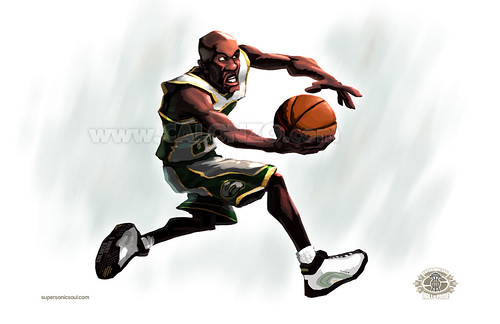
SSS HOF Inductee #1: Gary Payton

The Glove

Words: Peter Nussbaum | Illustration: Rafael Calonzo Jr.

How does it happen?

How does a man so menacing, so scowling, so intense become so beloved?

How does a brash youngster from Oakland by way of Corvallis become the most treasured player in four decades of Seattle basketball?

So many questions, all coming back to the same answer.

Intensity.

Gary Payton’s given middle name may have been Dwayne, but to those of us who followed his career in a Sonics’ jersey, his true middle name was always Intensity. His 1,335-game career was built upon a foundation of ferocious defense, perhaps more than any guard in history.


Ask yourself: How many other guards earned nicknames because of defensive skills? Are there any beyond Payton? He wasn’t “The Glove” for the way he stroked teammates’ egos, he was “The Glove” because of the way he clung to opposing guards like a wool sock to a freshly laundered towel.

Relax and remember Payton now in your mind’s eye. Not the GP that wandered the NBA like Odysseus for the final years of his career; that wasn’t The Glove. I mean the Payton who dominated his position for a decade in Seattle, the Payton who inhabited the All-Defense Team as if it was his summer cottage.

What do you see when you turn on the film projector in your mind? Is it the chest-bumping menace, arms stretching ever-outwards – as if he was part Plastic Man and could reach all the way around a man from both sides? Perhaps you see him poised in his defensive stance, shorts hiked up with a snarl – oh, that menacing snarl! – daring his opponent to try and drive past him? Is it the way he snapped off jumpers with disdain, as if he couldn’t believe he had to settle for an outside shot when all he really wanted to do was drive into the forest of big men? Maybe you see Payton artfully lofting the ball to an absolute perfect apex up-up-up for Kemp to snatch it and throw it back down-down-DOWN through the cylinder, a roller coaster of delicate passing and violent dunking so utterly incongruous it defied description?

For me, that rickety film projector always plays the same clip. It is Payton cockily trotting backwards up the court after yet another knife-like incision into the paint, his head cocked sideways, mouth wide open, words spilling out faster than an Al Sharpton sermon. It wasn’t enough for Payton to beat you, he wanted you to know you had been beaten, that he was going to beat you again the next time, and the time after that, and the time after that, and if you didn’t watch yourself, he was going to take the ball right from your ha .... crap, there he goes!

To me, the pinnacle of Payton’s tenure wasn’t the 1996 NBA Finals but two years previous, during the infamous 1993-94 season. The trio of Payton, Nate McMillan, and Kendall Gill only lasted two seasons in Seattle, but it was two seasons of utter hell for opposing guards. Three guards, three defensive demons, all three capable of a steal at a moment’s notice.

Just how fantastic were Payton and his Co-conspirators? The NBA has kept track of steals since the 1972-73 season, and in those 35 years, two teams have managed to pass 1,000 steals in a season – and one of them was the 1993-94 Sonics (if you know the other, tout your knowledge in the comments). So great were the Sonics that season that the second-place team was closer to seventh than to first. The incomparable McMillan led all individual players in steals despite averaging a scant 26 minutes, and Gill and Payton both cracked the league’s top ten, but even those amazing figures don’t tell the whole story.

The Sonics were like religious fanatics that season, and assistant coaches Tim Grgurich and Bob Kloppenburg were the resident preachers. The whole team (well, perhaps not Ricky Pierce; never Ricky Pierce) drank in their defensive mantras, and the most apt disciples were Gill, McMillan, and Payton.

Imagine yourself an opposing point guard that season. Perhaps you’re Spud Webb of the Kings, and you’ve been given the role of bringing the ball up against Gary Payton. You receive the inbounds pass and turn backwards as you approach half-court, but Payton starts bumping you with his chest, forcing you to spin sideways so you can gain an angle. Out of the corner of your eye, you see McMillan inching off his man, eyes intensely focused on the ball, waiting for you to let up for just one second. You pivot around again, trying to get by Payton so that you can just pass the ball to someone – anyone – and be done with these vultures. But he won’t let you get by; Gary wants you to do the work. The shot-clock ticks downward, urging you to cross the line before a violation is called.

Finally, you make it past half-court, and now McMillan has given up the charade of guarding his man – why bother, the idea of you passing the ball was laughable to begin with – and now he’s bearing down on you and the two-headed monster – McPayton – has you by the throat. As Payton slaps at the ball for the sixth time in the last eight seconds – or was it McMillan? who can tell? – your willpower begins to fade. Who can withstand this fury? Finally, Payton wins, Kemp sprints down the court, snatches an alley-oop, the crowd screams, Garry St. Jean beckons for a timeout, and you trudge back to the bench, only to see Gill taking off his warmups.

It never ended.

Well, that was every night in 1993-94 – every night until the Denver Nuggets and Dikembe Mutombo ... no, we won’t talk about that part today.

But back to Payton (wipes blood from forehead after aborted attempt at lobotomy). I don’t think it’s a stretch to make the claim that he’s the greatest player in team history. To wit:

- Franchise leader in games, minutes, points, assists, and steals
- 18,207 points scored, or as many as Gus Williams and Xavier McDaniel combined
- Nine-time all star
- Nine times 1st, 2nd, or 3rd-team All-NBA
- Nine times 1st-team All Defensive Team
- Of the ten best single-season PERs in team history, five belong to Payton

Admittedly, Payton was not the perfect player. His antagonistic attitude towards rookies was frustrating to the team’s development, and his undying confidence in his abilities – so useful on the court – proved to be his undoing off it, as he wound up being on the losing end of a battle with Howard Schultz. At the time of his trade to Milwaukee for Ray Allen, most fans bemoaned the move, but looking back it was obviously a wise one.

That said, there’s no point belaboring the argument of his place in Sonic history. Gary Payton is the greatest Sonic ever and will be the first (only?) drafted Sonic ever inducted into the Hall of Fame. He is the Alpha and the Omega of Seattle basketball. There is no “if only” with Payton because he never left the door open to questioning – he played seemingly every minute of every game he could in a Sonics’ uniform with a manic fury unrivaled in Seattle sports history. A history of the SuperSonics without Gary Payton would be like a history of the United States without Abraham Lincoln, a history of rap music without Public Enemy. He may not have been the first or the last, but his importance is as undeniable as his will to compete.

Have I said enough? Perhaps. I’ll yield the floor, then, to the man himself, with words from his appearance at the Save Our Sonics rally a month ago.

“You guys have always supported me, and I’m supporting you,” Payton said, the crowd chanting his name as if it was 1996 once again. “And there ain’t nothin’ going to be stamped on my chest but Sonics when I go into the Hall of Fame.”

Still intense. Still beloved.

Wednesday, July 23

A Word

I thought that before we dive in and commence with the honorations and hollerations, perhaps it would be a good idea to explain just what in the heck this SuperSonicSoul Hall of Fame is.

First, it is NOT:

1. A statistical list of the greatest players in Sonic history. That's boring, and you don't need us for that; you can just spend 10 minutes at basketball-reference.com for that sort of thing.

2. The funniest players in team history, or the coolest hairdos, or anything like that. This is (slightly) more serious than that. Although, now that you mention it, who would win a Hair-Off between Jack "Dutchboy" Sikma and Michael "Soul-Glo" Cage? And would that be the final pairing, or can we fit Slick Watts in there for his (lack of) hair? And what about Mickael Gelabale, where does he fit in? Would he win a Braid-Off against Chris Wilcox? But I digress ...

This IS:

1. Our list of who we feel are the 10 greatest players in Sonic history, based on 1 part statistics and 3 parts emotion.

2. Our move to preserve the history of the team.

3. A great chance for Sonic fans to spill their guts about their favorite players, and to share their memories of same.

The plan is thus - first, on every Thursday we'll announce the inductee with a glowing tribute combining Chunk's talents with Photoshop and mine with a typewriter. On every Friday, we'll present a favorite memory of said inductee from each of the three of us, some musical background from Paul, a few YouTube videos, and whatever else we can scrounge up. In the comments, you can purge your soul of your favorite memory of the inductee; whether that be the time you bumped into Gary Payton coming out of a strip club, or the time you spilled half a can of Rainier all over your sofa when Kemp dunked on Lister in the playoffs, or when you got into a near-fistfight with a Blazer fan about the relative merits of Nate McMillan and Terry Porter (raises hand meekly).

Now you know where we're coming from. See you tomorrow.

Supersonicsoul Hall of Fame: First Inductee Tomorrow!


Oh man, just wait 'til you get a load of Pete's introduction "speech" for our first ever inductee. It'll make you weep.

Speculating on the first member of The Most Esteemed Make-Believe Sports Hall of Fame may begin... nnnow.

Tuesday, July 22

Calabro turns to Sounders--will you?

(photo by Jim Bates / Seattle Times)

Kevin Calabro has turned down a lucrative offer to follow The Team Formally Known As The Sonics (TTFKATS) to Oklahorrible and instead will stay in town as the voice of Seattle's new MSL team, The Sounders.

Now, I've never been a huge soccer fan, but with KC calling the games, I might be converted. Hmmm, I wonder if the Sounders have any good blogs? SuperSounderSoul anyone?

Friday, July 18

It's Gettin' Better All the Time

The headline we've all been waiting for.

"Latest Donaghy news raises chance of Congressional investigation"

From Michael McCann of si.com, in reference to the ongoing story involving telephone calls between Tim Donaghy and Scott Foster. Rep. Bobby Rush of Illinois is more than a little interested in the scandal, and, being that he chairs the House Subcommittee on Commerce, Trade, and Consumer Protection, that interest is not just a passing one.

Raise your hand if you want to see David Stern try to use his condescending attitude on a member of the House of Representatives. Me, too.

Thursday, July 17

Different Type of Statistic


Normally, we only run basketball statistics here, but I thought you might be curious to see another comparison today. The chart shown above has a start date of July 2007 and details the stock performance of two companies. The blue line is Starbucks, Howard Schultz' empire, which has seen its value plummet from $28.60 a share to a low of $13.33.

The red line? The red line belongs to Chesapeake Energy, Aubrey McClendon's company, which has seen its shares go from $33 to $57.

Apparently, not only did Oklahoma City swipe Seattle's basketball team, but its mojo as well.