Saturday, August 27

The Fish That Saved Seattle

In 1979, the Seattle Supersonics were world champs . . . in this world, anyway.

That same year, in an alternative universe, the Pittsburgh Pisces also won a basketball championship. High-flying Moses Guthrie (who looked a lot like Dr. J), led a goofy band of oddballs to the promised land with the help of Stockard Channing and her astrology charts.

The Sonics may be gone (for now!), but we'll always have the Pittsburgh Pisces thanks to their unofficially official fan page on Facebook. And if you don't know what the hell I'm talking about, just watch the video below, then order The Fish That Saved Pittsburgh on DVD.

Tuesday, August 23

Kemp and Payton return!

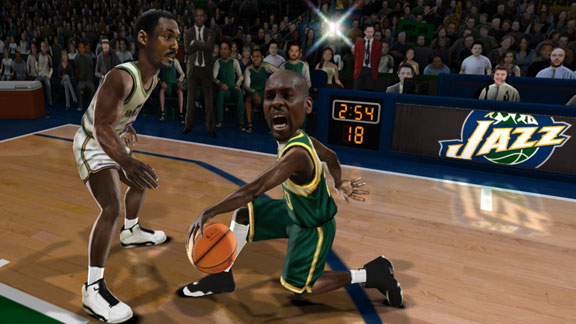
They did always say Gary had a big head. 


The Seattle Supersonics are returning to the NBA . . . well, NBA Jam at least.
So when EA Sports announced the return of "NBA Jam" to consoles last year, old school gamers like myself couldn't wait to get our hands back on "Glove" and "Reign Man" for one last leap through the rafters. Only problem was, due to licensing issues, Kemp and Payton weren't included as legends in the game, causing much frustration and outrage among all the die-hard Sonic fans out there. Thankfully for gamers (and everyone else out there looking for more alleys and less oops), EA Sports and the NBA worked out their differences, and the team of Gary Payton and Shawn Kemp will be included in the upcoming downloadable title, "NBA Jam: On Fire Edition" for the PlayStation 3 and Xbox 360. "This is an important day for 'Jam' fans," says "NBA Jam's" creative director, Trey Smith. "We tried to get this Sonics team last year but it didn't quite pan out. And this is something the fans were screaming for. This was at the top of their list, and that's a big deal to us. When we were creating 'NBA Jam: On Fire Edition' we wanted to listen to the fans, and everyone who played the game last year had one question: Where are the Sonics. "They are the quintessential one-two punch in 'Jam,' and if I'm playing hyper-competitively, this is how I roll."
Read the rest of the story at ESPN.com

Friday, August 12

Worst Sports Owners

If you're still looking for a pound of flesh from a former owner of the Sonics, you might want to visit Athlon Sports for their Worst Sports Owner Tournament.

No, it's not Clay Bennett, it's Howard "Five-Year Plan" Schultz. Schultz, unfortunately, is in a tough bracket as he's matched up with James Dolan in a four vs. five seed contest. Whomever emerges will take on the winner of the Donald Sterling/Maloofs matchup.

Hey, when you're miserable excuse for an owner, you can't expect easy matchups, right?

Wednesday, August 10

Kemp Chats at Times Today (Now with Bonus Updates!)


Fresh off his appearance at Safeco Field last weekend, Shawn Kemp is once again in the spotlight, this time taking questions via a Seattle Times chat. You can submit your questions here. You know the censors are going to be working fast and furious to keep the snarkier questions at bay.

UPDATE:

-Kemp's pick as the guest he'd most like to have walk through the doors at Oskar's Kitchen (Shawn's Seattle restaurant) ... Drew Carey (?!). Would not have guessed that in 137 years.

-Kemp's pick as his favorite player to watch in today's NBA ... Kevin Love.

Um, is it me, or does it seem like Steve Scheffler was sitting in for parts of the talk today?

Tuesday, August 2

The Sonics, Bob McAdoo, and What If?

I touched briefly on this in the review of What’s Happenin’?, but it bears repeating I think:

In the winter of 1976, the Seattle Sonics almost traded for Bob McAdoo.

And when I mean almost, I don’t mean “some hobo on a message board proposed dealing a fourth-rounder and Mike Bantom for McAdoo,” I mean the Seattle Times ran this banner headline:

Sonics Get McAdoo

Essentially, the deal was this: Seattle sent center Tom Burleson, forward Leonard Gray, and a sum of cash believed to be around $1 million to Buffalo for McAdoo and center Tom McMillen.

McMillen was another cash savings for the Braves, (he earned $200,000 a season). McAdoo, meanwhile, was expected to leave as a free agent at the end of the season, so the Braves and their new owner, John Y. Brown, figured it best to get something before he was gone.

Remember, Burleson was 7’2”, 24 years old, two years removed from being the #3 overall pick in the draft, and averaged 16 points and 9 boards the previous season– he wasn’t chump change. Gray, a bulldog power forward now long-forgotten by Sonic fans, was a strong contributor as well, although his NBA career ended abruptly at the end of the 1977 season.

So, digest all of that, as well as the fact that McMillen’s career, like McAdoo’s, lasted until the mid-1980s, and ask yourself: Would this have been a good deal for the Sonics?

Initially, the answer is an unequivocal YES. I’ll put it in the simplest terms possible; Burleson and Gray, the Sonics’ end of the deal, combined to score 1,285 points in their careers after the “trade.” McAdoo scored 2,097.

In 1978.

It’s not even close. McAdoo had led the league in scoring for three years running, would make the all star team five consecutive seasons, was two years removed from the NBA MVP Award, finished in the top ten in voting four times and in the top three in voting three times, ranked in the top ten in blocks, points, free throws, rebounds, and pretty much everything you could imagine.

Then you’ve got McMillen, a backup center who emerged as a key member of the 1979 Atlanta club that came within a whisker of knocking the Bullets out of the playoffs. By himself, McMillen would have been a good return for Gray and Burleson, but when you add in McAdoo, it’s no contest.

Of course, you’ve got to think about roster construction when something like this happens, and how the dominoes fall after you start tinkering with things. The secondary question you have to ask is, naturally, how would the McAdoo trade have impacted the Sonics’ run to the NBA Finals in 1978 and subsequent championship in 1979? It’s great to get a superstar, but if adding McAdoo means foregoing the glory of 1979, would it have been worth it?

The running backstory to all of this is the fact that Bill Russell was on his way out of Seattle and Lenny Wilkens on his way in. Would Russell still have left if McAdoo had arrived in January 1977? I’d hazard that the answer would be yes, simply because Russell and the NBA needed a break from one another.

And if Russell leaves, that means Lenny Wilkens comes to town, which means the NBA Finals runs Seattle made in consecutive seasons are still in play. With Wilkens in the front office and Bob Hopkins on the floor, here’s your roster (for the sake of argument, I’m releasing or trading the players Wilkens released or traded in the fall of 1977):

Tom McMillen, Bob McAdoo, Dennis Johnson, Slick Watts, Fred Brown, Bruce Seals, Jack Sikma, Joe Hassett

Of course, with McAdoo and McMillen on the roster, the Sonics might have opted to go with a choice other than Sikma in the draft, perhaps a forward such as Ernie Grunfeld or Cedric Maxwell. But the Sonics did love Sikma’s potential, and maybe as insurance for McMillen they might’ve still opted for the beanpole from Illinois Wesleyan. With Wilkens’ ties to Providence, I’m guessing Hassett still gets picked regardless of our alternative-universe scenario.

So far, so good then. The McAdoo trade hasn’t caused any rips in the fabric. There are eight guys on the roster, but some more moves are needed to round out the roster. Fortunately, acquiring McAdoo doesn’t preclude the Sonics from acquiring Gus Williams, so you can add him to the roster as a free agent from Golden State (although, to be fair to Sam Schulman’s wallet, McAdoo’s sizeable salary may cause some problems). And, John Johnson could still be picked up from Cleveland for a pair of second rounders. And, sadly, the Sonics could still surrender a first- and second-rounder to Portland to get Wally Walker, thus ensuring Shawn Kemp’s eventual departure from the city 20 years later.

Soon after, Wilkens could deal Watts to New Orleans for a future draft pick, and thereby close the book on the transactions for our hypothetical Supersonics. What does it all mean, then? Well, here’s the roster(s):

REAL SONICS – FAKE SONICS
Starters:
Webster – C –Sikma
Sikma – PF –McAdoo
J. Johnson – SF – J. Johnson
D. Johnson – SG – D. Johnson
Williams – SG – Williams

Bench:
Brown – Brown
Silas – McMillen
Walker – Walker
Seals – Seals
Hassett – Hassett

Essentially, we’ve got three big changes:

1. Jack Sikma replaces Marvin Webster as starting center
2. Bob McAdoo replaces Sikma as starting power forward
3. Tom McMillen replaces Paul Silas as big man off the bench

Without Burleson, you see, the Sonics would be unable to deal the 7’2” center to Denver for Silas, Webster, and Willie Wise. It’s difficult to say what impact those three changes would have had on the club. On the one hand, Marvin Webster was an indispensable component of the ’78 club’s run to the Finals. He led the club in minutes, rebounds (by more than 100 over Silas), blocks (more than twice as many as anyone else), and field goal percentage. It is entirely fair to say that without Marvin Webster’s performance the Sonics do not reach the NBA Finals.

Further, no Webster means no Lonnie Shelton, as Webster’s departure to New York in the subsequent offseason brought Shelton in return, who would prove to be a crucial part of the ’79 championship. (Or Vinnie Johnson, for that matter, whom the Sonics also picked up in the Webster signing … and then let go to Detroit for Greg Kelser. Darn.)

However, Sikma emerged in ’78 and ’79 as a terrific player, albeit one without the defensive bona fides of Webster or Shelton (or Silas, for that matter). With McAdoo and Sikma patrolling the lanes, we suddenly have two terrific offensive players, but no sizeable defensive presence. Granted, McMillen was a big guy, but his numbers do not indicate he was anywhere near the intimidating factor Silas, Shelton, or Webster were.

In essence, by acquiring McAdoo, the Sonics would have completely altered the personality of the team that reached consecutive NBA Finals, adding one of the league’s premiere offensive talents but sacrificing the fantastic, defense-oriented club with which an entire region fell in love. The fact the Sonics felt they needed something more than Sikma in the post is underscored by the acquisitions of Tom LaGarde, Lars Hansen, Dennis Awtrey, and Shelton in the offseason, and that was WITH Paul Silas on the roster. Even more troubling is the fact that both McAdoo and Sikma were more jumper-oriented big men, and forcing one of them to play in the post would have meant sacrificing their abilities.

It’s possible that McAdoo’s 25+ points a night would have been enough to offset any defensive shortcomings the McAdoo/Sikma pairing would have created, and, to be fair, McAdoo’s poor defensive reputation may have been overblown simply because of his greatness on the offensive end. After all, he did block a large number of shots, and picked up more than his fair share of steals. Would it have been enough, though, to offset the presence of Webster or Silas or Shelton?

The observer can’t help but conclude in the negative. While that trio of players never had the renown of the great Bob McAdoo, they still played a crucial role in the formation of the greatest team in Sonics’ history and without them there are no championship trophies.

Wednesday, July 27

Lenny Wilkens/Spencer Haywood Chat

It's worth a read (via The Seattle Times). I thought it was nice of Spencer to wait three minutes and 38 seconds before bringing up the wet floor incident, beating his previous record of four minutes and 17 seconds. Oh, and to bring it up again 30 minutes later was extra classy.

Two choice tidbits:

1. Lenny: "The current NBA business model doesn't work because of huge guaranteed contracts. Lots of teams make mistakes on talent, and then they're stuck with the contract for its duration. That penalizes a lot of teams who are over the salary cap."

Cough, MLB, cough.

2. Spencer:
I go into the Hall of Fame in 2012, and I would love to be a Sonic and see a Sonic team here.

Whoa ... Hold the phone. Spencer Haywood is going into the Hall of Fame? Anybody know anything about this? If what he's saying is true, then Haywood just broke a huge story on a Seattle Times chat.

Monday, July 25

Sonic Library: What's Happenin'?

It’s funny, but in a way, Blaine Johnson was blogging before blogging was blogging. He was blogging before the internet, before computers, before all of it.

Johnson just called it reporting.

And that roundabout description is the best I can muster for Johnson’s roundabout book, What’s Happenin’? A Revealing Journey Through the World of Professional Basketball.

Ostensibly about the 1976-77 Sonics, Johnson’s book contains as many paragraphs about the author as it does the subject, which is fine if the author is Spencer Haywood, but, hey, if I wanted to read a book about Blaine Johnson … wait, who wants to read a book about Blaine Johnson?


The answer is very few people, which explains the book’s less-than-prestigious standing amongst the Sonic Library. Still, despite Johnson’s best efforts to derail his book with wandering bouts of navel-gazing, there are a number of reasons to recommend Johnson’s tome. The man has a knack for phrasing (Dennis Johnson: “Kind of a black Huck Finn”) and getting people to talk, whether it’s the recalcitrant Bill Russell, the not-so-recalcitrant Slick Watts, or any of the myriad of characters you run across in a tale about 1970s NBA basketball.

That ability to get information is a boon to the latter-day Seattle hoop fan. My knowledge of ancient (all due respect to our 50+ year old readers) Sonics history is limited, and What’s Happenin’ does a stellar job of introducing us to the backstories of Seattle basketball in the mid-70s. From Russell’s enmity towards anyone and everyone (the Sonics’ coach even made an enemy of Wayne Cody, who would seem to be the most amiable – if not rotund – man in King County), to Slick Watts’ unending sparring with those he felt denied him his rightful place as a Sonic hero, to a bizarre mid-season dustup involving Bob McAdoo, a Buffalo Braves ownership change, Sam Schulman on a Hong Kong business trip, 327 other complications … well, it was 1976, and the only thing simple back then were the plots on network television.

Unfortunately, Johnson spends an inordinate amount of time congratulating himself for scoring interviews with the reclusive Bill Walton, so much so that the reader begins to wonder if the book is going to be about the Portland TrailBlazers. Further, he delves too deeply into his hardships on the road and his poor relationships with certain members of the Sonics, both of which only serve as detractions from his ability to tell a story.

A reader can easily contrast the style of What’s Happenin? to Curt Sampson’s Full Court Pressure, a classic tale of early 90s Sonic craziness. In Sampson’s book, the emphasis is on the Sonics with the author playing a minor role, a style with which I am much more enamored. Johnson’s style – emblematic of the 70s, I suppose – tends to cause the reader to skip ahead for large chunks of the book, hoping to find choice tidbits about the team’s activities, rather than the author’s.

In one ironic passage, Johnson relates his first encounter with Julius Erving. The Doctor was making his first west coast jaunt after jumping to the NBA, and Erving’s talents were already causing a stir. Trying to impress the media-besieged 76er with some inside dirt, Johnson makes a point of referencing The Legend of Dr. J, a book Erving had done with Marty Bell. Johnson felt he was able to reach a little deeper into Erving’s mind.

“I made several references to things that had been expressed in the book,” Johnson writes, “feeling he would be appreciative that a reporter was coming from a point of informed reference.”

Later, as the interview scrum concludes, Johnson makes reference again to the book, pointing out that he thought it was very well done.

“I didn’t have anything to do with it,” Erving retorts as he gets into a departing car. “I’ve never read it.”

On first blush it appears to be some welcome self-deprecation from the author. But that relief quickly vanishes as Johnson concludes the story with this gem: “He didn’t even read the fucking book. How does that make you feel, Marty Bell?”

It’s a petty and silly conclusion for Johnson to make, and winds up only belittling himself rather than his intended target.

But enough about Blaine Johnson. The two main characters of the book are clearly Russell and Watts. Russell, brought to Seattle only a few years before by owner Sam Schulman to inject some passion and (hopefully) victories into the Sonics, appears to be losing his passion for the whole business of NBA basketball. Removed from his players, Russell yearns for his halcyon days in Boston, and is frustrated by what he deems lack of team spirit and effort from his present-day club. His sparring with Johnson throughout the book makes for enjoyable reading, and the frustration Russell feels is tangible. With Johnson’s book in your brain, it becomes rather obvious that Russell was kicked out of Seattle, regardless of what his fans claim today.

Watts, meanwhile, is basking in the glow of stardom. An undrafted free agent from Xavier University, Watts was fresh off a number of accolades in the previous season, and while he burns at every perceived slight, his charming personality shines throughout the book. Clearly, he’s a decent player on an awful team, but he’s beloved by the city all the same. Ironically, neither Watts nor Russell would be associated with the Sonics within a year (and, for that matter, neither would Johnson).

It is in the jockeying with Watts and his teammates that Johnson does his best work in the book. All losing teams bitch about their coach – it’s a trite story often told. But the author does a fine job of getting angry, bitter players to open up, even after they feel he’s betrayed them by revealing locker room secrets.

Is What’s Happenin? a great book? Hardly. Is it a fun romp through NBA basketball during the Carter administration? Not exactly. It is, however, an important piece of Sonic history, and, meandering chapters aside, deserving of a spot on every obsessive Sonic fan’s bookshelf.

Sunday, July 24

H206 Charity Game Highlights


(photos by Chunkstyle)

Supersonicsoul cub-reporters Paul Merrill and Rafael "Chunkstyle" Calonzo attended the H206 Charity Game at the Key Saturday. Here's their expert analysis of the game:

PAUL MERRILL: It was the closest I've ever sat to a basketball game without actually being part of the team. Thanks for getting the tickets!

RAFAEL CALONZO: I could say I wanted to have a special bonding event with my kids, or that it was for a great charity cause, but really, I’m a sucker for cheap, up-close tickets to pro(-ish) sporting events.

PM: I admit I was a bit underwhelmed at the rosters at first (Brandon Roy in street clothes? No Sonics?!) but thought they played a hell of a no-defense, all-star type game.

RC: I figured it was unlikely they’d get any true stars like Kevin Durant or Ray Allen for The League squad, but I was really hoping for at least some guys with local connections, like Nick Collison or Jeff Green. But yes, I can’t complain, it was an entertaining exhibition game.

PM: I hadn't really seen any advertising outside of Facebook, so I was a little worried about the crowd, but back me up here, Raf--the place was packed, right?

RC: I’d say, 75-80% of the lower bowl maybe? Which honestly is good turnout for a game that was a) lacking in true star power, b) scheduled on a gorgeous summer day, the same weekend as the Block Party, and c) held three years after the Sonics left town.

PM: It really felt like old-times: a fast-paced game, awful nachos and stupid frat guys sitting behind us. WHY DO THEY ALWAYS SIT BEHIND US?!

RC: It never fails. Good thing the dude-bros always shout HI-LARIOUS commentary and never, ever spill beer on me while trying to catch a free t-shirt. OH WAIT, the opposite happened.

PM: Okay, highlights time. Hawes trying to take it coast-to-coast a couple times and that near through-the-legs alley-oop were pretty great, but I think the highlight for me was seeing Sikma and Kemp sitting side-by-side coaching. Too bad they didn't put themselves in the game!

RC: I was looking for outlines of jerseys under Kemp and Sikma’s polo shirts, but all I saw was love handles. Oh well. There was good dunkage and dribbly showboating regardless.

PM: I don't know about you, but I'd like to see an old-timers game next time. What would you add or change if you were in charge?

RC: DUDE, an old-timers game would totally pack the house. Heck, if the only guys you could get were GP, Reign Man and the Tahoma Junior High JV squad, it would pack the house. I would rig the rules so that for the last 2 minutes of each quarter, the eight other guys leave the floor and the game turns into "How many half-court alley-oops can Gary throw for Shawn before the buzzer?”

PM: Okay, I'm exhausted--I'm not used to being outside of the house for more than two hours. Goodnight!

RC: I think the organizers should chalk it up as a success and do it again next year, too. I’m honestly hoping that next year’s NBA season is cancelled altogether (ahem), which means folks will be even hungrier for another H206 game. Remind me to bring a rain slicker and headphones next year.

Friday, July 22

H206 Charity Basketball Classic Tomorrow

The NBA (sort of) returns to Key Arena tomorrow with the H206 Charity Basketball Classic, featuring well-know basketball players with roots in the Pacific Northwest.

From the press release:
The A PLUS Youth Program presents the H206 Charity Basketball Classic, a state-wide public celebration showcasing the contribution of basketball to the Pacific Northwest. The game will be held at KeyArena on July 23, 2011, at 2 pm, and will feature current professional basketball players and Seattle legends. Tickets go on sale today at 10 am at Ticketmaster.com, and range from $15 to $150. Discount tickets will also be available at the Rainier Vista Boys & Girls Club in Seattle.
Players scheduled to appear include Brandon Roy, Jamal Crawford, Aaron Brooks, Spencer Hawes, Will Conroy, Isaiah Thomas, Martell Webster, Avery Bradley, Brian Scalabrine, Marvin Williams and Michael Dickerson. According to the Sonicsgate Facebook page, tickets are heavily discounted (2 for 1!) and even free for kids if you pick up tickets at the Rainer Vista Boys and Girls Club tomorrow.

Chunkstyle and I will be there and hopefully will have some pics to share on Monday.

For more info and tickets, go to the official H206 page.