
Tuesday, May 28


Monday, May 13
Euphemism of the Year Award
This one comes courtesy of the real estate broker Aubrey McClendon designated to sell his estate on the shores of Lake Michigan.
“What we’re selling is the house and a little over six acres with 500 feet of frontage on Lake Michigan and 700 feet on the Kalamazoo River,” said Dick Waskin, a broker with the ReMax Realty of Saugatuck. “It’s a house that’s built in a location that could never be duplicated.
“It was bought pretty much as an investment,” Waskin said of the lakefront mansion. “He’s come to a point, where it’s time to start reaping back some of that investment.”
He's come to a point where it's time to start reaping back some of that investment. Gosh, when did that point come about? I wish we knew.
(Details courtesy of Michigan Live).
“What we’re selling is the house and a little over six acres with 500 feet of frontage on Lake Michigan and 700 feet on the Kalamazoo River,” said Dick Waskin, a broker with the ReMax Realty of Saugatuck. “It’s a house that’s built in a location that could never be duplicated.
“It was bought pretty much as an investment,” Waskin said of the lakefront mansion. “He’s come to a point, where it’s time to start reaping back some of that investment.”
He's come to a point where it's time to start reaping back some of that investment. Gosh, when did that point come about? I wish we knew.
(Details courtesy of Michigan Live).
The Loudest NBA Crowd of All Time? It wasn't Sacramento (or Seattle!)

Now, having had my ears drums nearly melted at several Seattle sporting events over the years, I had a hard time believing this. I mean, even with all those goddamned cowbells, how could roughly 17,000 people at Arco be louder than a sold-out Coliseum booing Charles Barkey and the refs in the 1993 Western Finals against the Phoenix Suns? Or the grunged out Key Arena maniacs cheering on the Sonics as they blew out the greatest team of all time in game four of the 1996 NBA Finals? Or the (then) record 40,172 screaming Supersonics fans at the Kingdome in 1980?
Well, it turns out the Guinness Record for loudest NBA crowd of all-time is not held by the Sacramento Kings. Nor is it held by our beloved Seattle Supersonics. Well then, who the hell does hold the record?
(click below to find out)
Flashback: Stern pressured Maloofs to sell Sacramento Kings to Seattle?
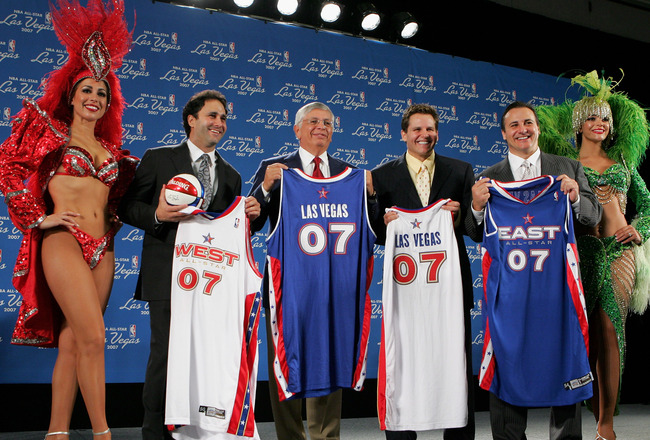
Twitter user RW34MVP (wasn't that one of the bounty hunters in Empire Strikes Back? ) posted an article from six months ago by Adrian Wojnarowski of Yahoo Sports stating that the NBA was pressuring the Maloofs to sell the Sacramento Kings to Chris Hansen because Stern was "determined to get a franchise back into Seattle" before his reign as
Between now and his departure, Stern is determined to get a franchise back into Seattle, league sources said, and has become a strong ally of Microsoft CEO Steve Ballmer’s group to bring back the NBA there. Ballmer’s group has been trying to get the Maloof family to sell the Sacramento Kings, so that the franchise can eventually play in a new arena in Seattle.
From the league office, pressure on the Maloofs to sell has been growing, sources said — just as hopes for a new Sacramento arena have been fading. Seattle Sonics fans will never forgive Stern for his complicit role in Clay Bennett’s deception to move that franchise to Oklahoma City, but make no mistake: Stern desperately wants to return the NBA to one of its great markets and wants it for his own measure of vindication before he leaves office.
As one source involved in the process said, “Stern has enough time to get a team back to Seattle, but he’ll let Silver deal with the crowd [booing] on opening night.”Yikes. Have times really changed this quickly or was this whole Seattle vs. Sacramento deal a diabolically Stern-esque set-up from the start?
Saturday, May 11
Ultimate poison pill in Seattle Supersonics, Sacramento Kings battle? Keeping Maloofs in NBA
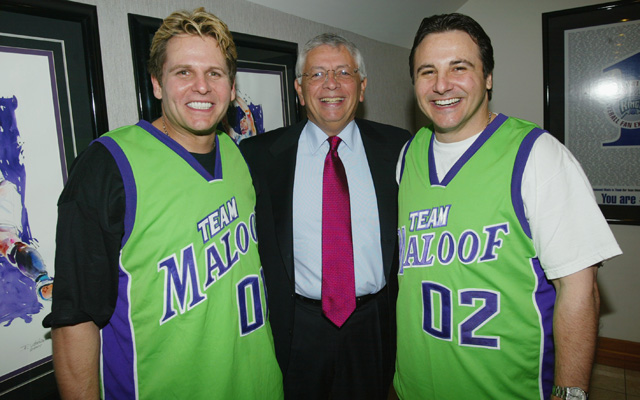
When I mentioned a few weeks ago that Team Hanson was about to go into Scorched Earth Mode in their efforts to build Seattle Supersonics 2.0, I was thinking Ballmer might let his rabid pack of Microsoft lawyers off the leash. I don't think anyone dreamed they would truly use the nuclear option. The very last of last resorts. The unthinkable horror of . . . THE MALOOF SOLUTION!
Two sources told ESPN.com the Maloofs have informed their fellow owners that if their deal to sell and relocate the Kings to Seattle is not approved by league owners next week, they will not sell the team to a Sacramento-based group that promises to keep the Kings in Sacramento.
Instead, the cash-strapped Maloofs have made a "backup" agreement with the Hansen-Ballmer group to sell it 20 percent of the team for $125 million to allow the Maloofs to continue to operate the franchise.
From ESPNOh sweet lordy. PLEASE let this just be more crafty posturing to leverage an expansion team out of the NBA. Seattle does not want these guys owning the Sonics. I think this town has had enough sleazy, awful owners, thank you.
Friday, May 3
George Karl: Still Fighting
There is, of course, a lot of sadness if you’re a fan of
George Karl today. His team, the Denver Nuggets, were given every opportunity
they could possibly hope for by their opponents, the Golden State Warriors,
last night in Oakland and yet were unable to overcome a massive second-half
deficit.
And with that, the Nuggets were out of the playoffs in the
first round, something Karl’s teams have become all-too-familiar with in the
past three decades.
In fact, Karl devotees might be surprised (not all that
surprised, but surprised) to know that no man in NBA history has failed as
often as George Karl in the first round of the NBA playoffs. Quickly, a list of
coaches who have accumulated the most first-round losses in league history:
FIRST ROUND LOSSES, BY COACH, NBA HISTORY
George Karl, 14
Jack Ramsay, 12
Jerry Sloan, 9
Lenny Wilkens, 9
Larry Brown, 9
Rick Adelman, 8
It is, in some ways, a list of great coaches. All of them
either are now or will be at some point, Hall of Fame coaches, and I include
George Karl on that list.
The smart observer will note that total 1 & Dones doesn’t
take into account the overall seasons; after all, Ray Allen missed more shots
in his career than Steve Scheffler, does that make Scheff a better shooter?
Here, then, is a graph of the top playoff
coaches in league history, with the percentage of their playoff runs which
ended in 1 & Dones:

It certainly helps Karl’s cause, and the fact that were the
Celtics to lose in the first round this season Doc Rivers’ career totals would
almost be identical to Karl’s illustrates how tenuous an NBA coach’s playoff
career results can be.
But let’s put all of that aside. I come here today not to
bury Karl, but to praise him. Denver fans this morning are no doubt morose –
their team has failed, once again, in the first round, marking the 8th
time in 9 years they have done so under Karl. The parallels to Seattle’s
experience with Karl are astounding – an exceptional regular season squad full
of exciting players is booted too early for the home fans, prompting the
tittering of dismissal talk throughout the region.
Certainly, there is more than just coincidence to Karl’s
failures in the first round. For him to have flopped out so miserably in 11 of
his past 13 playoff runs speaks to more than just idle chance, and I am sure
that someone more talented than I will be able to figure out just what it is
about Karl’s game-planning that leads to his repeated failures in the
post-season.
 But lest we forget, George Karl is a human being, and a good
one at that. Not many coaches would take on the league by sporting a Seattle
tie (see accompanying photo) while coaching a visiting team. Not many men in
his profession have been through the physical tolls that Karl has been through
in the past few years and managed to remain at or near the top of their line of
work. And fewer men still have been able to reach the post-season as often as
Karl has in his career.
But lest we forget, George Karl is a human being, and a good
one at that. Not many coaches would take on the league by sporting a Seattle
tie (see accompanying photo) while coaching a visiting team. Not many men in
his profession have been through the physical tolls that Karl has been through
in the past few years and managed to remain at or near the top of their line of
work. And fewer men still have been able to reach the post-season as often as
Karl has in his career.
And that, more than anything, is what people should focus on
today. Yes, the Nuggets failed in the first round last night, and yes, it is
easy to point fingers at George Karl this morning as the culprit. But before
you do, ponder this: George Karl has reached the post-season 22 times in his
career, the most of any coach in NBA history, alongside Pat Riley and Larry
Brown. If the Nuggets retain Karl and reach the playoffs next year, George Karl
– not Red Auerbach, not Phil Jackson, not Pat Riley, not Jerry Sloan – George Karl
will have led more teams to the playoffs than any single coach in the entire
history of the NBA.
There are many things to take away from last night – missed
opportunities, missed calls, missed shots – but I, for one, will focus on how
George Karl looked as he walked off the court. Quite a bit thinner and a little
older, certainly; but not beaten.
Never beaten.
Wednesday, May 1
Best Sixth Man in Seattle Supersonics History: EJ, Downtown, or ?
Paul had a nice mention of Eddie Johnson’s birthday today –
which brings to mind the question: Who was the best Sixth Man in Sonic history?
It’s a tough one to answer, tougher still because games
started information doesn’t exist prior to the 80s. Assuming that Fred Brown
automatically receives a nod as co-champion of this phantom trophy, who else
deserves the honor?
Here’s some quick numbers on players who started fewer than
30 games for the Sonics in a given season:
WIN SHARES
7.1, Sam Perkins, 96-97
6.9, Sam Perkins, 95-96
6.8, Antonio Daniels, 04-05
6.7, Shawn Kemp, 91-92
6.0, Vincent Askew, 93-94
6.0, Dale Ellis, 97-98
6.0, Nate McMillan, 93-94
POINTS PER GAME
20.5, Xavier McDaniel, 88-89
18.5, Tom Chambers, 85-86
17.5, Ricky Pierce, 90-91
17.4, Eddie Johnson, 90-91
17.1, Eddie Johnson, 91-92
PER
21.6, Shawn Kemp, 91-92
19.3, Ruben Patterson, 00-01
18.6, Xavier McDaniel, 88-89
18.4, Eddie Johnson, 90-91
17.7, Fred Brown, 82-83
WIN SHARES/48 minutes
.197, Danny Fortson(!), 04-05
.188, Ricky Pierce, 93-94
.177, Shawn Kemp, 91-92
.173, Sam Perkins, 96-97
Best Rebounder: Shawn Kemp, 21.2 TRB%, 1991-92
Best Scorer: Ricky Pierce, 26 points per 36 minutes, 1993-94
Best Passer: Nate McMillan, 9.3 assists per 36 minutes, 1990-91
Best Blocker: James Donaldson, 2.9 blocks per 36 minutes,
1981-82
I think you’d have to choose Shawn Kemp (1991-92 Edition) as
the winner of best performer in a single season. You’ve got a guy averaging
(per 36 minutes) 13 rebounds, nearly 20 points, two and a half blocked shots, a
steal and a half, shooting above 50 percent from the field, and 75 percent from
the line … yes, I think I’ll take that sort of production.
For a career choice, though, it’s a bit trickier. Sam
Perkins’ numbers are certainly representative of his overall contributions to
the mid-90s Sonics, Nate McMillan’s yeoman’s work for so many years certainly
deserves a mention, and who can forget Ricky Pierce’s instant offense in the
early 90s, but I think – with no influence from the fact that today’s his
birthday – Eddie Johnson deserves the nod.
EJ’s 20+ points a night (per 36) for 3 consecutive seasons
is pretty sensational, and unmatched in the team’s (documented) history. With
that in mind, I think it’s safe to say that Eddie Johnson and Fred Brown are
the two best Sixth Men in Sonic history.
Tuesday, April 30
Seattle Supersonics vs. The NBA
 |
| Chris Hansen: You won't like him when he's mad. Aw, who are we kidding? We'd totally still love him. |
I was never really a fan of taking the Sacramento Kings. We'd basically be doing the same thing OKC did to us, only we were using the excuse of being honest about it. Well, just because someone warns you before they kick you in the nuts doesn't make it hurt any less.
But this was how you got a team in the harsh 21st century economic reality of the NBA. Kill or be killed. Every basketball fan for themselves. No survivors. WOLVERINES!
Sure, I wasn't real happy about how this sausage was being made, but after a few years in the NBA wilderness, I'd probably pinch my nose and eat it.
So when the NBA relocation committee (consisting of a whopping seven team owners, including good ol' Clay-face) announced on Monday afternoon they had ruled against the Kings moving to Seattle, I admit I was a little glad I wouldn't have to abandon what little scruples I had left in regards to finally getting a replacement for my dearly departed Seattle Supersonics.
The best chance we had at snagging another city's team was gone. Five years of anxiously hovering like hungry vultures over dying basketball franchises was history. And the NBA had stated clearly that expansion, the only truly guilt-free way to enjoy the Sonics in Seattle again, was not going to happen. So it was over.
Well, at least I was now free to unleash my full hatred upon the NBA. Or, you know, not watch as many regular season games. Perhaps I could finally find some peace. Or maybe even a new sport. I wonder if Seattle has a professional handball team?
But then, something crazy happened.
Monday, April 29
Seattle: A Bridesmaid Once More

Today is a difficult day for Sonic fans. Not as difficult as
that dark day a half-decade ago, when the team announced it was leaving for Oklahoma,
mind you, but certainly not an easy one, either.
There is an ironic twist to this bizarre story, though, and here
it is: The Kings are staying in Sacramento for many reasons, and one of those
reasons is that the fan base in Sacramento was energized by what happened in
Seattle.
They were energized by the threat of relocation, they were
energized by the Sonicsgate tale, and
they were energized by the emergence of Chris Hansen’s ownership coalition.
Certainly, Sacramento’s elected officials, devoted fans, and
possible new owners deserve the lion’s share of credit for what happened today
(or, anyways, what should happen; who knows when you’ve got lawyers circling
the carcass).
But in many ways, a major reason why the Sacramento Kings
are not the Seattle Sonics today is because of the efforts of the people of
Seattle. It is entirely possible that were it not for the people behind Save
Our Sonics and so on, Here We Stay might never have shown up.
Remember, Sacramento does not have a new arena, it doesn’t
have a new ownership group, it doesn’t have anything. It certainly has the
promise of those things, but that promise has not, historically, been worth
much to the people counting chits in the NBA office. Today, though, those
promises were worth enough to the league to forestall a relocation to Seattle.
And so, Sacramento, relish your conquering of the Axis of
Evil. For once, the league’s extortion
tactics did not require an actual pound of flesh: just the promise of one.
Wednesday, April 24
Today in Sonics History: Rick Barry, Leonard Gray, and a Purse
What would you say is the craziest moment in Sonic playoff
history?
40-something fans might opt for the arrest of Dale Ellis and
Kevin Williams outside a Houston nightclub in the midst of the second round of
the 1987 playoffs. 30-somethings might go for the Ricky Pierce/Gary Payton
post-game battle after an inglorious defeat to Denver in the first round of the
1994 playoffs. 20-somethings may side with Jerome James donning his infamous garbage
bag cape after a first round win over the Kings in 2005.
But what if I told you those were mere trifles; that the
craziest moment involved a livid Rick Barry, players getting doused with
refreshments, Leonard Gray’s fists, and a crazed woman with a purse?
---
It was April 1975 and perhaps the only thing riding higher
than the Sonics were the Captain and Tenille. Coached by Bill Russell (the
Sonics, that is, not C&T), the Sonics and Seattle were NBA Playoff virgins
and the city was in pandemonium, caught up in the excitement of a first-round
win over Detroit and what had become a terrific second-round series with the
Golden State.
The Sonics had knotted the series at two with a 111-95
shellacking of the Warriors in Game 4. Sure, the team dropped Game 5 down in
San Francisco, but Game 6 was looming on Thursday, April 24th at the
Coliseum and the Sonics had lost all of two games at home in nearly two months.
Unfortunately for the home green and golds, Fred Brown
(broken finger), Tom Burleson (knee), and Spencer Haywood (sprained arch) were all
nursing injuries, meaning the team was going to need all the help it could get
from its avid supporters.
With the hated Rick Barry (and you’ll see how hated later
on) helping the Warriors get out to an early lead, aided by backup center
George Johnson, who came off the bench to finish with 18 points and 15
rebounds, the mood amongst the 14,082 in attendance began to get grim.
But the Sonics wouldn’t quit, rallying to tie the game in
the second quarter after trailing by as many as a dozen points. Haywood – still
ailing, he would only finish with 8 points – watched from the bench as backups
Tal Skinner and Rod Derline spurred the comeback.
The recovery was short-lived, though, and by halftime the
Warriors were out in front by eight points. Golden State expanded their lead to
double-digits in the third quarter, despite the best efforts of Seattle’s Slick
Watts; the headbanded wonder turned in what Russell called “one of the great
games in basketball,” finishing with 24 points, tying his career-high and
marking only the second time all season he had tallied more than 20 points in a
single game.
Watts’ tremendous play came at a price, as the diminutive young
guard noted afterwards. “They hit me, knocked me around all night,” Watts told
the AP later.
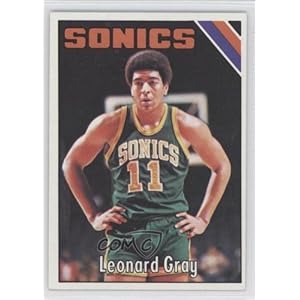 Not to worry; Watts’ physical abuse had not gone unnoticed
by one Leonard Gray.
Not to worry; Watts’ physical abuse had not gone unnoticed
by one Leonard Gray.
For that era’s Sonics, Gray embodied a role later inhabited
by Danny Fortson, Maurice Lucas and Frank Brickowski – The Enforcer. While
still a rookie, Gray wasn’t afraid of throwing his 240 pounds around. Tutored
by Lute Olson and Jerry Tarkanian at Cal State Long Beach, Gray was a big,
burly guy with a heart of gold (at least, from the vantage of his teammates and
friends; Tarkanian called him “the meanest SOB I ever coached”). Seeing his
point guard getting hammered and bludgeoned by the Warriors, Gray went to work,
picking as his target the man everyone loved to hate – Rick Barry.
The Sonics had fallen behind by nearly 20 points when Gray
and Barry began to tussle. Things got so out of hand that referee Richie Powers
was forced to issue warnings to both players – either knock it off, or hit the
road.
Well, Leonard Gray was never one to let an opportunity pass,
and the possibility of getting the red-hot Rick (he’d finish the night with 31
points) Barry out of the game was just too tempting to pass up.
It was with that in mind that Gray issued the Rump Kick
Heard ‘Round the Sound. With Barry facing the opposite direction, the Sonics’
O.G. kneed him in the hindquarters, following it up with a punch when Barry
spun around, drawing an immediate ejection from Powers and, it should be noted,
a roar of approval from the thousands watching courtside.
It didn’t end there. As soon as Gray exited the premises
fans began pelting the court with coins and “other objects,” and events started
to get crazy. Spurred on by another Sonic rally which cut the lead to
single-digits, the fans were out for blood, and Rick Barry was beginning to
look awful tasty.
When George Johnson blocked yet another shot in the final
moments, sealing the Warriors’ series-ending victory, emotions got completely
out of hand. The visitors scampered for the exits, their path blocked by unruly
Seattleites intent on revenge. Half-filled popcorn boxes, beer, and soft drinks
rained down on the visitors, and that was the least of it.
At one point, Barry, trying desperately to get to the locker
room in one piece, felt someone pawing at him.


“I was leaving the floor and someone was kicking me and
hitting me from behind,” Barry said later. “I turned around and it was a woman.
I mean, I really couldn’t believe it. I
just swung around and pushed her out of the way. But if it had been a guy I
would have hit her.
“This is basketball – what do they think we’re playing,
soccer in South America?”
Other reports indicated the woman in question had smacked
Barry with her purse and – as if that wasn’t enough – even tried to trip him. (To
be fair, pretty much everyone associated with basketball in the past 40 years
probably wanted to do the same thing to Rick Barry, and that includes his
family). Worse, the affair turned truly ugly when fans, players, and police
began to mix it up near the entrance to the Warriors’ locker room. In the end,
a half-dozen fans were taken away in handcuffs.
The final side note for this crazy story would not emerge
until a full six months later. On October 23, Spencer Haywood and Bill Russell
settled their long-simmering feud by parting ways and Haywood was dealt to the
New York Knicks for a draft choice, cash, and rookie forward Eugene Short;
meaning the scant eight points he scored were his final contributions in a
Sonic uniform. All the accolades, all the notoriety, all the hysteria of the
Haywood Era had ended that night in Seattle with barely a whimper.
20 years later, Watts, who would emerge as a local favorite
with Haywood gone, was a little less than complimentary to his teammates when he
reflected on Game 6.
“The other guys didn’t come to play,” Watts wrote in his
autobiography. “I came to win but the other guys just froze – they kind of
choked on me. All our so-called ‘big scorers’ disappeared.”
And there you have it. A beer shower, a hailstorm of coins, Spencer
Haywood’s swan song, Slick Watts’ coming out party, a purse careening off Rick
Barry’s head – that was NBA playoff basketball circa 1975, and Seattle was falling
for it harder than a love-struck teen with “Love Will Keep Us Together” on her
bedroom radio.
Monday, April 22
New Sonics Jersey Found
There have been plenty of Sonic jerseys in history - you've got your classic championship era jersey, your minimalist early 70s jersey, your Howard schmaltz jersey of the 00s, and so on ... but does anyone else recall this one?

It's from this Ebay sale, if you're interested, wherein the prospective bidders might learn that it is from the 1992-93 season, was never worn (obviously), and is in new condition (also, if you scroll to the middle photo with the finger holding an interior tag, a delightful joke about Shawn Kemp, err, arises).
Personally, the thought is in the right place, but I think the numbering is a little poor and the tightness of the letters makes it tough to read the word 'Sonics.' Still, it ranks in the top half of jerseys, had it actually been one the team wore, and would be better than what we saw on-court during the 1996 Finals.
Thoughts?

It's from this Ebay sale, if you're interested, wherein the prospective bidders might learn that it is from the 1992-93 season, was never worn (obviously), and is in new condition (also, if you scroll to the middle photo with the finger holding an interior tag, a delightful joke about Shawn Kemp, err, arises).
Personally, the thought is in the right place, but I think the numbering is a little poor and the tightness of the letters makes it tough to read the word 'Sonics.' Still, it ranks in the top half of jerseys, had it actually been one the team wore, and would be better than what we saw on-court during the 1996 Finals.
Thoughts?
Wednesday, April 17
Traveler's Guide to the NBA
The NBA will be deciding the fate of pro basketball in Seattle within a week or two (or three, or four, but who's counting, right?). Since it has been a few years since the league graced us with its presence, here's a rudimentary guide to the NBA for those unfamiliar with the terrain. As always, click to enlarge.


Subscribe to:
Comments (Atom)